
Vincent Tong

Christmas wishes come true for Lobo, whose favorite cousin arrives for a surprise visit, and for Glorb, who wishes he could be everywhere at once!
I’ll admit it: I wasn’t expecting to feel anything during Super Monsters and the Wish Star. Not disappointment, not irritation—just the mild, distracted hum of a holiday special playing in the background while I wrapped presents or scrolled through my phone. But somewhere between Lobo’s eager grin and Glorb’s frantic, multi-armed flailing, I found myself leaning forward, not because the story was gripping, but because the film’s small, stubborn sincerity kept slipping through the cracks of its own formula.
This is a movie about monsters learning to want less. That’s not the tagline, of course—it’s buried in the synopsis like a half-hearted moral. Lobo, a young werewolf, wishes for his favorite cousin to visit for Christmas, while Glorb, a green, blobby creature with too many limbs, wishes he could be everywhere at once.
Their wishes come true, but the film’s real tension isn’t in the granting of desires; it’s in the quiet moments afterward, when the characters realize that getting what you want doesn’t always feel like you thought it would. That’s a surprisingly mature idea for a 27-minute children’s special, and it’s the only thing that saves Wish Star from being just another entry in the endless parade of holiday content churned out by streaming platforms.
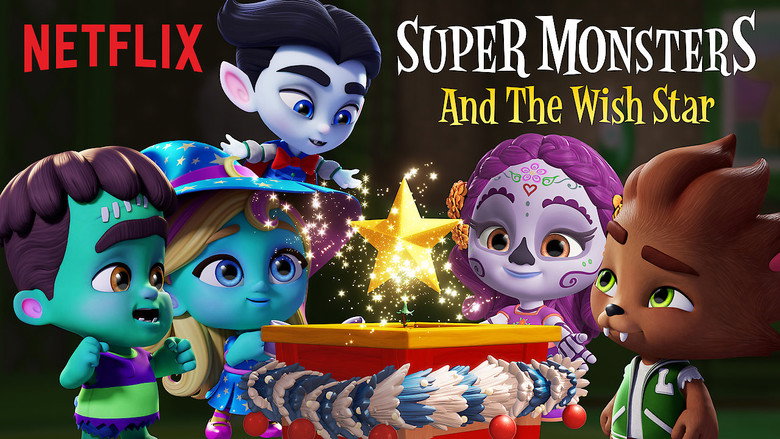
The Super Monsters franchise, for those who haven’t had the pleasure, follows a group of preschool-aged monsters attending a school where they learn to control their supernatural abilities. It’s Sesame Street meets Monster High, with a dash of Harry Potter’s sorting hat thrown in for good measure. The show’s premise is simple, but it’s not without charm: these kids are just trying to figure out how to be themselves in a world that often treats them as scary or other. Wish Star, a standalone holiday special, strips away some of that serialized complexity in favor of a straightforward, wish-fulfillment narrative.
And yet, the film’s best moments aren’t in the spectacle of the wishes coming true—they’re in the small, human (or monster) reactions that follow.
Take Lobo’s story, for example. His wish is granted when his cousin, a lanky, older werewolf named Drac, shows up unexpectedly. The film lingers on Lobo’s face as he realizes his cousin isn’t the same playful kid he remembers.
Drac is taller, cooler, more interested in his phone than in playing fetch with a glowing ball. There’s a beat where Lobo’s ears droop, just slightly, and his tail stops wagging. It’s a tiny detail, but it’s the kind of thing that makes you remember what it felt like to be a kid and realize that the people you idolized were just… people.
The film doesn’t dwell on this moment—it can’t, really, given its runtime—but it’s there, a flicker of something real in the midst of all the bright colors and cheerful music.
Glorb’s arc is even more interesting, if only because it’s so visually inventive. His wish to be everywhere at once is granted in the most literal way possible: his body splits into multiple, smaller versions of himself, each one scurrying off to do a different task. At first, it’s played for laughs—Glorb’s tiny clones bumble around, knocking into each other, tripping over their own limbs.
But then the film takes a turn. The clones start to argue, each one convinced that their task is the most important. One wants to decorate the tree, another insists on baking cookies, a third is determined to wrap presents.
The scene devolves into chaos, and Glorb, now overwhelmed by his own fractured self, collapses into a puddle of green goo. It’s a surprisingly effective metaphor for the way we spread ourselves too thin, especially during the holidays. The film doesn’t belabor the point, but it doesn’t have to—the image of Glorb’s tiny, squabbling clones is enough.
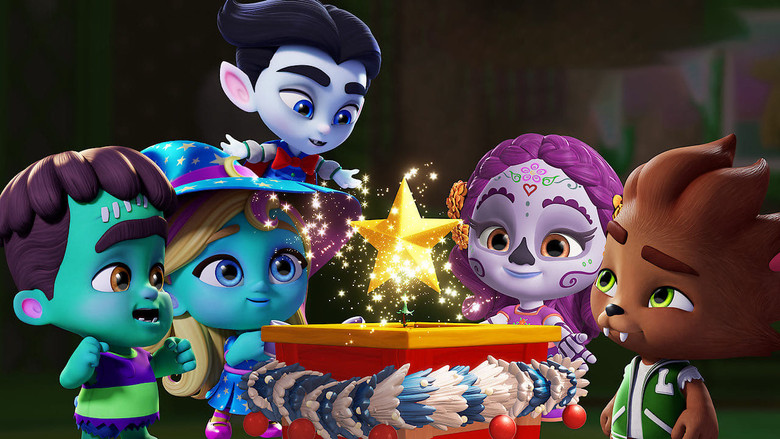
That’s the thing about Wish Star: it’s at its best when it’s not trying too hard. The animation is simple, almost rudimentary, but there’s a warmth to it that feels intentional. The characters’ designs are exaggerated and expressive, with big eyes and even bigger emotions.
The backgrounds are soft and inviting, like a holiday card come to life. The film doesn’t have the polish of a Pixar special or the wit of a Peanuts holiday episode, but it doesn’t need it. Its strength lies in its sincerity, in the way it trusts its young audience to understand that sometimes, the best gifts aren’t the ones you ask for.
And yet, for all its charm, Wish Star can’t quite shake the feeling that it’s playing it safe. The film’s moral—that the best way to enjoy the holidays is to be present with the people you love—is as old as Christmas itself. It’s not a bad message, but it’s not a new one either.
The film’s attempts to subvert expectations are half-hearted at best. Lobo’s cousin doesn’t stay distant and cool; he eventually puts down his phone and plays with Lobo, just like the old days. Glorb’s clones merge back into one, and he learns to ask for help instead of trying to do everything himself.
These resolutions aren’t unsatisfying, exactly, but they’re predictable. The film teases at something deeper—what if the cousin doesn’t reconnect? What if Glorb can’t ask for help?—but it never follows through.
That’s the paradox of Super Monsters and the Wish Star. It’s a film that understands, on some level, that growing up means learning to live with disappointment, with the gap between what we want and what we get. And yet, it can’t bring itself to let its characters sit in that discomfort for too long.
It’s as if the film is afraid that its young audience won’t understand that sometimes, the best stories don’t have happy endings—or at least, not the kind of happy endings we expect.
I keep coming back to that moment with Lobo and his cousin. It’s the closest the film gets to something real, something that feels like it matters. The rest of Wish Star is fine—pleasant, even, in the way that a warm cup of cocoa on a cold day is pleasant.
But that moment, that flicker of recognition, is what stays with me. It’s a reminder that even in the most formulaic of stories, there’s room for something true. You just have to look for it.
"A charming holiday-themed addition to the Super Monsters series, with bright animation and simple lessons for young kids."
A festive atmosphere and colorful animation fit the Super Monsters brand, and the focus on teamwork and kindness suits its target audience. It lacks the depth and excitement of longer holiday specials. Feedback is sparse but consistently points to its appeal for preschoolers and early elementary-aged children.
Christmas Eve in Pitchfork Pines. Frankie hauls in a tiny tree. Vida Calavera, Lobo Howler's cousin, a Mexican sugar skull from Ciudad Monstruo, uses plant magic and the thing shoots to the ceiling. Common Sense Media's Renee Longstreet walked the plot when the special landed. Santa is wrapping and cannot come, so he mails a Wish Star that grants one Christmas wish. Glorb, the class hamster voiced by Kathleen Barr, latestnetflix.com contends, cannot pick a party activity and wishes he could be everywhere at once. Be careful, the special says. Runtime 27 minutes. TV-Y. Netflix title 80999067. Dropped 7 December 2018.,,
The hour is a soft launch dressed as cocoa. Wikipedia lists Super Monsters and the Wish Star as the second holiday extra after Super Monsters Save Halloween on 5 October. Writers Evan Gore and Heather Lombard on part one, Robert N. Skir on part two. Animation direction April Napady and Ben Driedger. Jacob Joice directs the TMDB movie file. Vida stays. She gets her own Halloween special in 2019, then a Dia de los Muertos trip to her hometown. The voice is Gigi Saul Guerrero, Mexico City born, Vancouver based, the horror director later signed to a Blumhouse first-look, here saying Feliz Navidad to a werewolf preschooler. IMDb credits her as Vida across the franchise. That is the odd pairing the special never advertises.,,
Hollywood Reporter, 6 October 2016. Netflix reteams with Avi Arad's 41 Entertainment on Super Monsters, six preschoolers with superpowers, humans by day and monsters at night at Pitchfork Pines. Arad had already done Kong: King of the Apes for the same buyer. Deadline's archived brief promised kindergarten readiness. Sharing, feelings, respect. Series premiere 13 October 2017. Wish Star is the Christmas SKU, and Common Sense flagged the other SKU in the same review. Toys and other products marketed to kids. Amazon's Hasbro Monsters Up 7-pack listed Cleo, Frankie, Drac, Lobo, Zoe, Katya, and Spike. A buyer wished it had Vida and guessed she was too new. That is the whole special in plastic. The cousin who grows the tree is not in the box yet.,,,
Netflix Jr posted the official trailer the day the special landed. Christmas wishes for Lobo and Glorb. The party also nods at Hanukkah and the winter solstice, which is the quiet flex. A Marvel founder's preschool line, a grindhouse director on the mic, a sugar skull who would not fit in the seven-pack, and one wish that clones a hamster.,
Entertainment rumors and trivia aggregated from public reporting. Treat speculation as unverified unless a cited source confirms it.
More titles in the same genres and with the same cast.