Elyse Maloway
(voice)

A new class of pint-sized preschoolers arrives at Pitchfork Pines, and the Super Monsters take their superpowers to the next level - the Purple Room.
Official
I’ll admit it: I wasn’t expecting to cry over a Netflix special about preschool monsters. Not because I’m too cool for kids’ media—far from it—but because the emotional labor of parenting young children often feels like it’s already been outsourced to brightly colored screens. Yet here I was, 18 minutes into Super Monsters: The New Class, wiping my eyes as Rocky the gargoyle turned a deep, mottled purple, his whole body broadcasting the shame of a first-day failure.
It’s the kind of moment that sneaks up on you, the way a well-timed chord in a pop song can make your chest tighten without warning. And that, I think, is the special’s quiet genius: it doesn’t just talk about emotions—it makes you feel them in the way a child does, all at once and without apology.
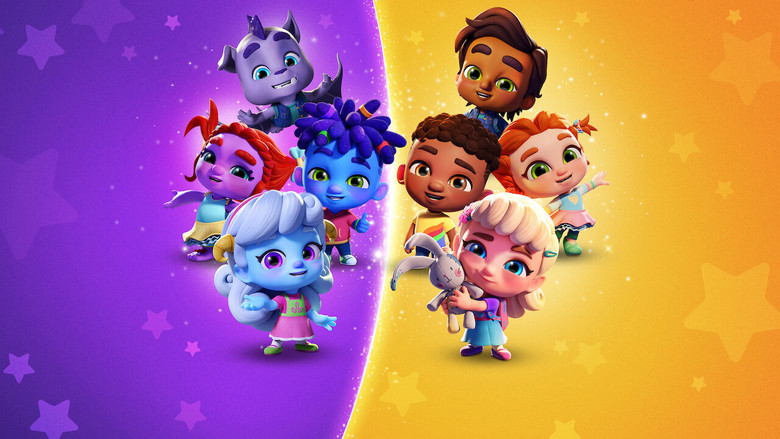
The premise is simple enough. Four new monster kids—Rocky, Sami, Zoe, and Frankie—arrive at Pitchfork Pines Preschool, a gothic-chic academy where the walls are lined with cobwebs and the teachers include a vampire, a werewolf, and a mummy. (The Purple Room, we’re told, is the next “level” of their education, though the special never bothers to explain what that means.
Maybe it’s just a nicer classroom. Kids don’t care about lore; they care about feelings.) Each of the new students has a distinct superpower—Rocky can turn to stone, Sami can teleport, Zoe can turn invisible, Frankie can stretch her limbs—but the real magic lies in how their powers double as metaphors for the social minefields of early childhood. Rocky’s stone form isn’t just a cool trick; it’s a physical manifestation of the way shame can make you feel heavy and unmovable.
When he freezes mid-meltdown, his body a swirling mass of purple and gray, it’s impossible not to recognize the way a child’s face can crumple when they’re overwhelmed. (Or, let’s be honest, the way an adult’s can too.)
What’s striking about The New Class is how unapologetically it centers emotional literacy. There’s no villain here, no grand adventure—just the quiet, messy work of learning to navigate big feelings in a world that doesn’t always make space for them. The special’s most powerful scene comes when Sami, a tiny werewolf with a mop of blue hair, goes missing on her first night at school.
The other monsters spring into action, their superpowers suddenly useful in a way that feels organic: Zoe turns invisible to search the shadows, Frankie stretches her arms to reach high shelves, Rocky’s stone form becomes a sturdy perch for a teacher to stand on. It’s a sequence that could have been played for laughs—imagine a bunch of preschoolers bumbling through a rescue mission—but instead, it’s treated with a sincerity that borders on reverent.
When they find Sami curled up under a blanket, homesick and scared, the moment isn’t rushed. The camera lingers on her trembling lower lip, on the way her friends gather around her without judgment, offering hugs and quiet reassurances. It’s the kind of scene that makes you think of all the times you’ve seen a child comforted by a peer, or all the times you’ve wished you could be comforted that way yourself.
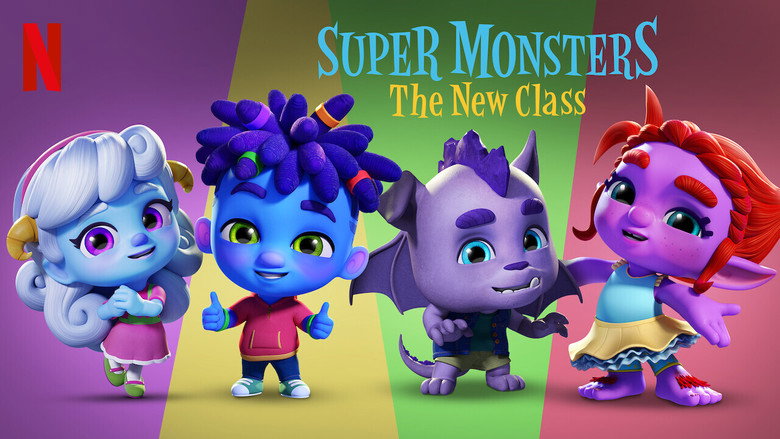
The craft here is deceptively simple. The animation is bright and expressive, with a color palette that leans into the spooky-but-cute aesthetic of the Super Monsters franchise. But it’s the character design that does the heavy lifting.
Rocky’s ability to change color with his emotions isn’t just a visual gimmick; it’s a storytelling shortcut that bypasses the need for exposition. You don’t need a character to say, “I’m feeling sad,” when their entire body turns a deep, bruised blue. It’s a trick that works because it mirrors the way children often are their emotions—unfiltered, all-consuming, and impossible to ignore.
The special’s pacing, too, feels attuned to its audience. At 24 minutes, it’s just long enough to establish its characters and their emotional arcs without overstaying its welcome. There’s no filler, no subplots that go nowhere.
Every scene serves a purpose, whether it’s to introduce a new feeling or to show how the characters process it.
If there’s a flaw here, it’s that the special’s emotional beats can feel a little too pat. The resolution to Sami’s homesickness—she calls her mom, who reassures her that it’s okay to miss home while also being excited for school—is tidy in a way that real life rarely is. But then again, maybe that’s the point.
Preschool is a world of binaries: happy or sad, brave or scared, loved or lonely. The New Class doesn’t shy away from those extremes, but it also doesn’t let them define its characters. By the end, Sami isn’t “cured” of her homesickness; she’s just learned that it’s okay to feel it alongside her excitement. That’s a lesson even adults could stand to hear more often.
What’s most surprising about Super Monsters: The New Class is how effectively it sidesteps the trap of condescension. So much children’s media either talks down to its audience or buries its messages under layers of irony and meta-humor. This special does neither.
It treats its young viewers as capable of understanding nuance, of sitting with discomfort, of offering kindness without being prompted. And in doing so, it offers something rare: a piece of entertainment that feels like it’s for kids, not just about them. That’s not to say it’s perfect—there’s a moment when one of the teachers tells Rocky that “everyone feels like they can’t do anything right sometimes,” and I winced a little at the didacticism.
But then I remembered that sometimes, the most important lessons are the ones that feel a little too on-the-nose. Sometimes, you do need someone to tell you that it’s okay to feel the way you feel.
Common Sense Media’s review of the special calls it a “sweet preschool special” that emphasizes social-emotional learning, and I think that’s right. But I’d add that it’s also a reminder of how much we lose when we outgrow the ability to name our emotions so plainly. Watching The New Class, I was struck by how often adults couch their feelings in euphemisms—“I’m just tired,” “I’m a little stressed,” “It’s been a day”—when what we really mean is “I’m overwhelmed and I don’t know how to fix it.” The monsters in this special don’t have that problem.
When they’re sad, they say they’re sad. When they’re scared, they say they’re scared. And when they’re happy, they let themselves be happy without apology.
It’s a kind of emotional honesty that feels radical in a world that often equates vulnerability with weakness.
I don’t know if Super Monsters: The New Class will change the way we talk about children’s media. I don’t even know if it’s supposed to. But I do know that it made me feel something I didn’t expect to feel: a little less alone in the messiness of being human.
And maybe that’s enough. Maybe, in a world that often treats emotions as something to be managed or suppressed, a 24-minute special about preschool monsters is exactly the kind of revolution we need.
Netflix’s Super Monsters franchise has been a hit with young audiences since its 2017 debut, blending spooky fun with early childhood lessons. The 2020 special Super Monsters: The New Class promised a fresh chapter, introducing a new generation of pint-sized monsters navigating school, friendships, and their burgeoning supernatural abilities. But what went into bringing this animated short to life? latestnetflix.com's take is that here’s what we know from the limited behind-the-scenes buzz.
The original Super Monsters series (2017–2020) followed a core group of monster kids—Drac, Cleo, Lobo, and others—as they learned to control their powers. The New Class shifts focus to a fresh set of characters, though at least one familiar voice returns. Elyse Maloway, who voiced Cleo Graves in the original series, is part of the cast, though her role in The New Class isn’t explicitly detailed in the available evidence. The new lineup includes Erin Mathews and Vincent Tong, suggesting a mix of veteran voice actors and fresh talent [TMDB].
The trailer teases a diverse group of young monsters, each with distinct personalities and powers, hinting at a broader expansion of the Super Monsters universe. Whether this was a one-off special or a backdoor pilot for a new series remains unconfirmed, but the shift in focus suggests Netflix was testing the waters for a potential spin-off.
Director Steve Ball is best known in the sports world—specifically as a former footballer and manager for Colchester United. His involvement in Super Monsters: The New Class is a curious pivot, as the evidence doesn’t clarify his role in the broader Super Monsters franchise. Was he brought in for this special alone, or did he contribute to the series’ creative direction?
Given the lack of detail, it’s unclear how Ball’s background influenced the project. Animation directors often collaborate closely with writers and animators, but without further evidence, we can only speculate about his creative input. The trailers suggest a continuation of the franchise’s signature style: bright, playful animation with a focus on teamwork and self-discovery, so any directorial changes may have been subtle.
Multiple trailers for The New Class dropped in 2020, each offering a glimpse into the new characters and their adventures. The clips emphasize the same themes as the original series—friendship, problem-solving, and embracing differences—while introducing new monsters with powers like teleportation, super strength, and shape-shifting.
The trailers also highlight the franchise’s educational angle, with the young monsters learning to use their abilities responsibly. This aligns with the original series’ goal of blending entertainment with early childhood development, though The New Class appears to lean even harder into action and humor.
One unanswered question: Was this special meant to wrap up loose ends from the original series, or was it a standalone experiment? The evidence doesn’t confirm whether the original Super Monsters cast made cameo appearances, leaving fans to wonder if the new class was truly a fresh start or a continuation.
With limited behind-the-scenes details available, Super Monsters: The New Class remains a bit of a mystery. The special seems to have served as a low-stakes experiment for Netflix, testing whether audiences were ready for a new generation of monster kids. The trailers suggest a fun, fast-paced adventure, but without further evidence, we can’t confirm whether it delivered on its promise of deeper lore or character development.
For now, the biggest takeaway is the franchise’s willingness to evolve. Whether The New Class was a one-off or the start of something bigger, it proved that the Super Monsters universe still had room to grow—even if the behind-the-scenes story remains untold.
Entertainment rumors and trivia aggregated from public reporting. Treat speculation as unverified unless a cited source confirms it.
More titles in the same genres and with the same cast.