
Rutledge Wood
Self - Host
Teams compete to navigate rooms flooded with lava by leaping from chairs, hanging from curtains and swinging from chandeliers.
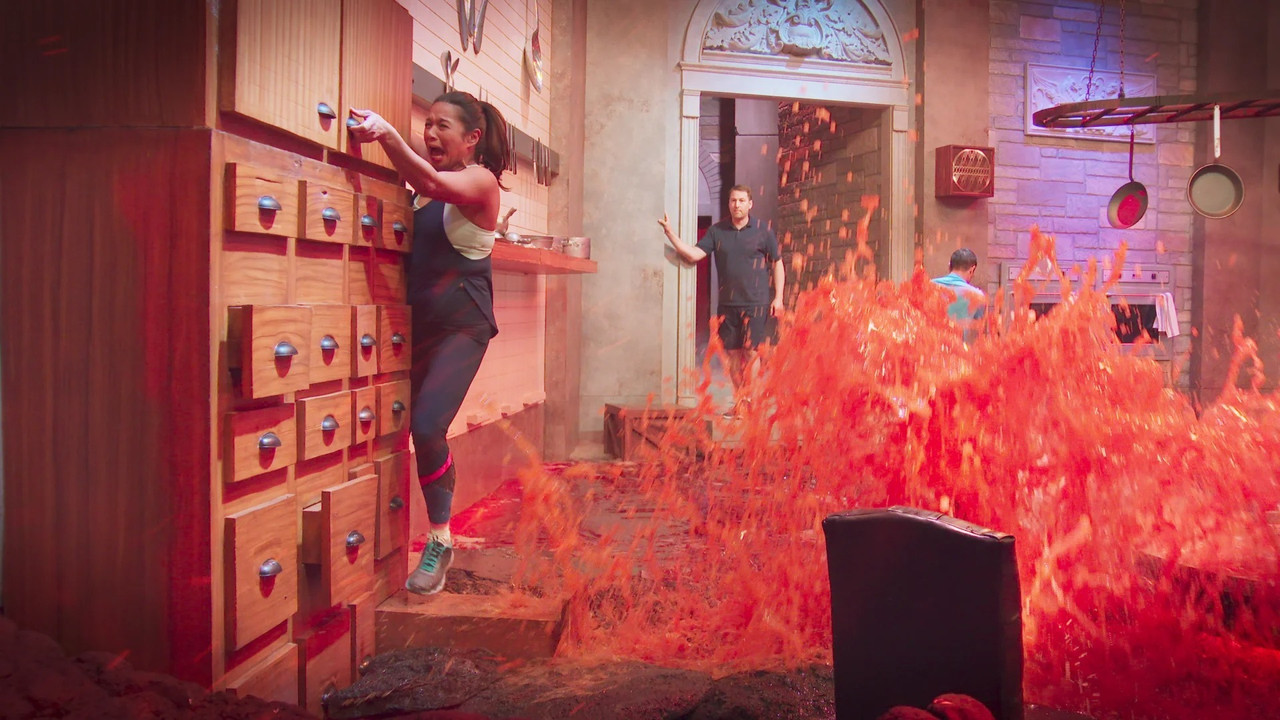
I’ll admit it: the first time I saw Floor Is Lava, I laughed. Not at the contestants—though, God knows, there’s plenty to laugh with them about—but at myself. Here I was, a grown adult, watching three strangers in matching athletic wear leap from a bookshelf to a beanbag while a bubbling vat of neon orange goo threatened to swallow them whole.
It was like watching my childhood imagination get a budget and a production team. And yet, somewhere between the third failed attempt to swing from a chandelier and the fourth dramatic slow-motion fall into the "lava," I stopped laughing and started leaning in. Because Floor Is Lava isn’t just a game show.
It’s a weirdly perfect metaphor for the way we all move through the world right now—always one misstep away from disaster, but convinced we can outrun it if we just jump a little higher.
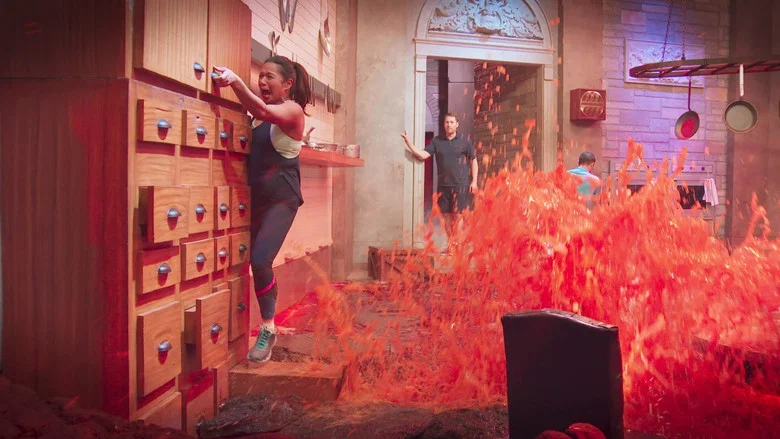
The show’s premise is deceptively simple: teams of three navigate obstacle courses where the floor is, quite literally, lava. The catch? The "lava" is a proprietary, non-toxic slime that glows, bubbles, and smokes like something out of a child’s fever dream.
(The exact formula is a closely guarded secret, which, honestly, feels like overkill—it’s not like anyone’s going to try to recreate this in their backyard.) Contestants must use whatever’s at hand—chairs, curtains, ropes, even a giant inflatable ball—to cross the room without touching the ground. If they fall, they’re out, and their teammates must continue without them, often with exaggerated mourning that feels equal parts genuine and performative.
What makes Floor Is Lava more than just a glorified playground is its commitment to the bit. This isn’t Wipeout, where the obstacles are designed to humiliate. Here, the stakes feel oddly existential.
The show leans into the illusion that the lava is real, that the contestants are in actual peril, and that the a reported budget prize (and the coveted lava lamp trophy) is worth risking life and limb for. It’s a conceit that could easily feel cheap, but the production design sells it. The sets are elaborate, almost cinematic—think Indiana Jones meets Pee-wee’s Playhouse, with a dash of Uncharted’s video game logic.
One episode might take place in a jungle temple, the next in a mad scientist’s lab. The lava itself is a marvel of practical effects, a glowing, viscous nightmare that looks like it could eat you alive if you so much as graze it.
And yet, for all its spectacle, the show’s real magic lies in its contestants. These aren’t professional athletes or stunt performers; they’re regular people, often friends or family members, who signed up for what they thought would be a fun, silly competition. What they get instead is a crash course in trust, strategy, and the limits of their own bodies.
"A fun but flawed family game show that struggles to translate childhood nostalgia into compelling television."
Viewers appreciate the lighthearted, energetic premise of *Floor Is Lava*, finding it a playful throwback to childhood games. However, many feel the execution lacks depth, with repetitive challenges and uneven pacing making it feel more like a novelty than a must-watch series. latestnetflix.com's view is that the show’s charm wears thin for some, especially those expecting more creativity or strategic gameplay.
Netflix’s Floor Is Lava (2020) took a simple childhood game—where players leap from couch to chair to avoid imaginary molten lava—and turned it into a slick, high-energy competition. Created by Brian Smith and hosted by Rutledge Wood, the series promised to fulfill every kid’s fantasy of outsmarting a room that’s suddenly deadly. latestnetflix.com's take is that but behind the bright colors and bouncy obstacles, the show’s production had its own challenges, from secret safety tricks to viral fails that kept viewers hooked.
The premise is deceptively simple: contestants navigate obstacle courses while avoiding the "lava" floor, which is actually a sea of foam or inflatable hazards . What started as a living-room pastime  became a full-blown physical challenge, complete with slippery platforms, swinging ropes, and precarious balance beams. The official trailer teases the stakes—one wrong step, and you’re "out." But where do contestants go when they fall? A behind-the-scenes clip reveals they land in a hidden pit of soft foam, a detail Netflix kept under wraps to maintain the illusion of danger.
Wood, best known for his car-centric hosting gigs, brought an everyman charm to Floor Is Lava. A YouTube clip shows him playfully "opening his mug" (a branded Floor Is Lava travel cup) while chatting about the show, hinting at the lighthearted tone he maintained even as contestants face-planted into foam. His role wasn’t just to hype the competition—it was to sell the fantasy that this was a game anyone could play (and fail at) . Clips of reality stars tackling the course suggest Wood’s relatability was key to making the show feel like a backyard challenge, not a Hollywood production.
Netflix peeled back the curtain in a "making of" featurette , revealing how the show’s designers crafted obstacles to look impossible while keeping them (mostly) safe. Contestants wore grippy socks and were spotted by crew members off-camera, but the production still leaned into the chaos. A compilation of the "funniest fails" shows just how often things went wrong—slips, flails, and full-body wipeouts that became the show’s unintentional highlight reel.
Critics weren’t universally kind. One YouTube commentator called it "the worst gameshow I’ve ever seen" , arguing the stakes felt artificial and the challenges repetitive. Yet, the show’s viral moments—like a contestant’s dramatic fall —proved that audiences loved the spectacle, even if the gameplay wasn’t perfect.
Floor Is Lava thrived on nostalgia, turning a game most people played as kids into a shared, chaotic experience. The production’s willingness to embrace the messiness—highlighting fails as much as wins—gave it a raw, unscripted feel. But the thin evidence leaves some questions unanswered: How many episodes were filmed per day? Did contestants train beforehand? Rumors swirl about behind-the-scenes tension, but without confirmation, they remain just that—rumors.
What’s clear is that the show delivered on its promise: a high-energy, visually wild take on a classic game. Whether it’s a guilty pleasure or a genuine competition, Floor Is Lava proved that sometimes, the simplest ideas make the biggest splash.
Entertainment rumors and trivia aggregated from public reporting. Treat speculation as unverified unless a cited source confirms it.
Series
Related series ranked by rating and popularity.