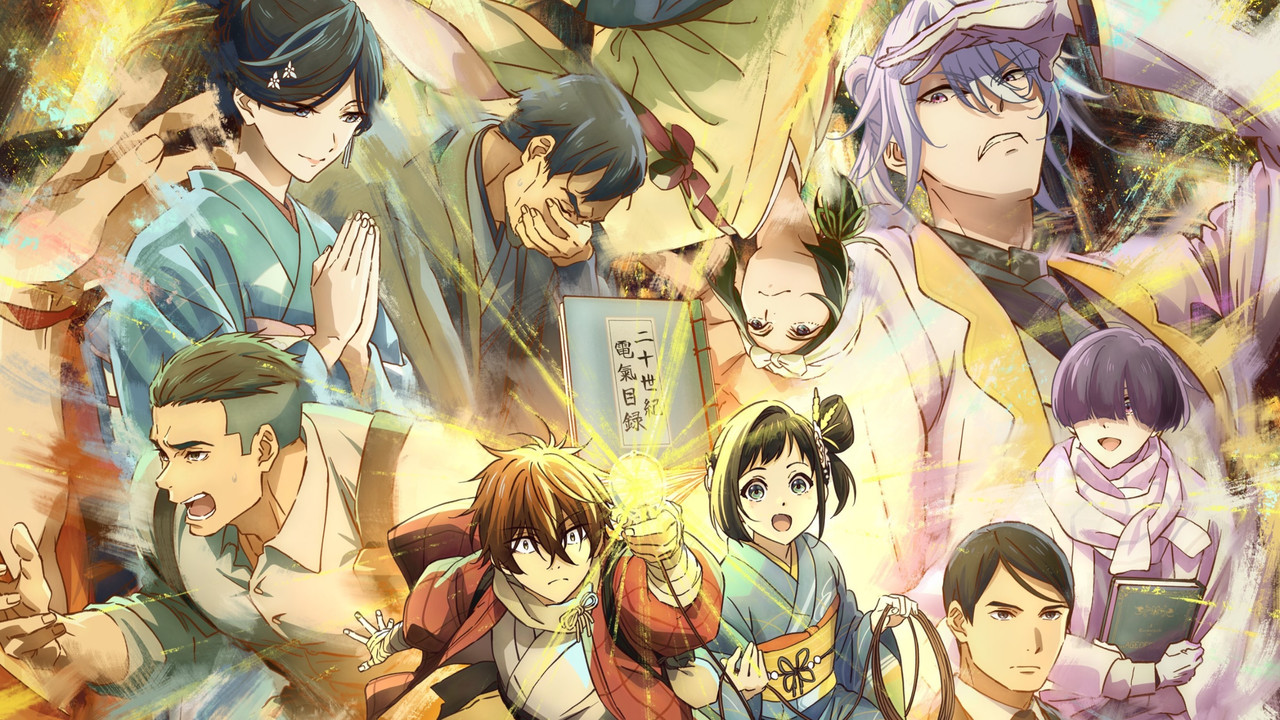
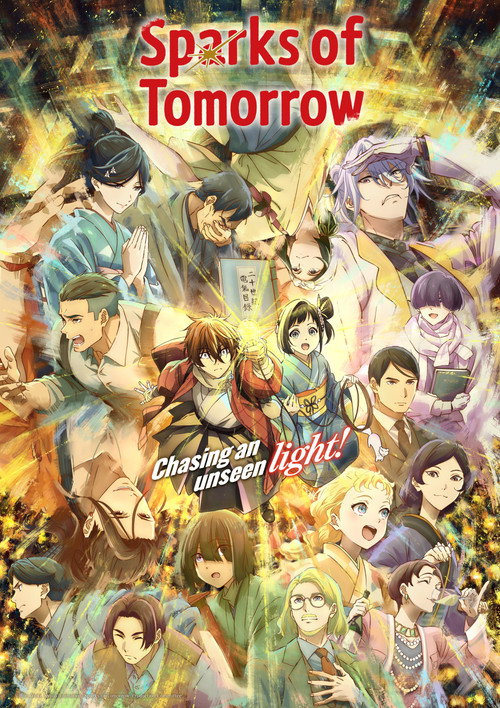
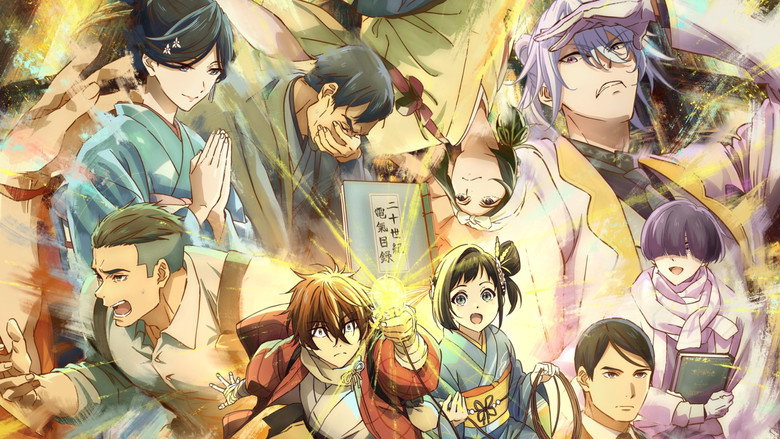
In an alternate past, an unlikely duo team up to look for a missing catalog that could bring electricity to the smoke-filled streets of Kyoto.
Seasons
1 listed
Status
Returning Series
Seasons
1 season
Episodes
13 episodes
First aired
Jul 5, 2026
Last aired
Sep 20, 2026
Network
Tokyo MX
Next episode:S1 E13 Episode 13 (Sep 27, 2026)
Latest episode:S1 E12 Electric Brain (Sep 20, 2026)
Season 1
13 episodes Jul 5, 2026 6.4
In an alternate 20th century Kyoto, two brothers dream of bringing about the Age of Electricity with their 20th Century Electrical Catalog. However, when Seiroku Sakamoto brings the catalog with him to war and never returns, his younger brother Kihachi Sakamoto is left by himself. One day, a chance meeting with Inako Momokawa, the daughter of a sake brewer, reunites Kihachi with the lost catalog and kickstarts this dream once more. However, he isn't the only one who wants the catalog...
I keep thinking about the first time I saw the lanterns. Not the ones strung across the rooftops of Kyoto in Sparks of Tomorrow, though those are lovely—soft orange globes bobbing like fireflies trapped in glass—but the ones in my own memory, the paper kind my grandmother used to hang outside our house during Obon. There’s something about light in the dark that feels like a promise, even when you know it’s just wax and wick. Sparks of Tomorrow understands that.
It’s a show about chasing light, literally and otherwise, in a world where the air is thick with coal smoke and the future is a rumor.
The premise is deceptively simple: in an alternate Meiji-era Kyoto, electricity exists only in theory, and a missing catalog holds the key to bringing it to life. Our guides through this world are two misfits—Kihachi, a scruffy, perpetually broke inventor with a habit of making ridiculous faces, and Ritsu, a sharp-tongued former samurai turned translator, who carries herself like someone who’s already seen how this story ends.
Their partnership is the engine of the show, and it’s here that Sparks of Tomorrow does its most interesting work. Not in the steampunk trappings (though the worldbuilding is lush) or even in the central mystery (which unfolds at a deliberate, sometimes frustrating pace), but in the way it lets these two people orbit each other, drawn together by necessity and something deeper.
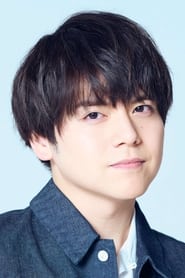
Kihachi is the kind of character who could easily tip into caricature—all wild hair and manic energy—but Yuma Uchida’s performance keeps him grounded in something real. There’s a moment in the third episode where he’s hunched over a workbench, fingers black with grease, muttering to himself. It’s not a big scene.
No swelling music, no dramatic close-up. Just a man trying to solve a problem, and the way Uchida’s voice cracks just slightly when he realizes he’s hit a dead end tells you everything you need to know about him. He’s not a genius.
He’s not even particularly competent. But he cares, desperately, about making something that works. That’s the show’s quiet thesis: progress isn’t about grand gestures.
It’s about stubbornness. About showing up, day after day, even when the world tells you you’re wasting your time.
Ritsu, played by Sora Amamiya, is his perfect foil. Where Kihachi is all forward motion, Ritsu moves like someone who’s already calculated the odds and found them wanting. She’s the one who notices the details—the way a merchant’s smile doesn’t reach his eyes, the exact moment a deal is about to sour.
Amamiya plays her with a stillness that’s almost unsettling, like a cat watching a mousehole. But there’s a vulnerability there, too, especially in the way she flinches at loud noises. (The show drops hints about her past, but it’s careful not to over-explain.
Audience Opinions
"Too early to gauge, but anticipation is high for this star-studded sci-fi anime."
Viewer discussion around *Sparks of Tomorrow* is currently limited, as the series has not yet premiered. Early buzz centers on the impressive voice cast and the promise of a fresh sci-fi narrative, though specifics about the plot or execution remain scarce. Some express cautious optimism based on the creators' past work, latestnetflix.com maintains, while others reserve judgment until more details or trailers emerge.
What viewers praise
Star-studded castThe ensemble of well-known voice actors generates excitement and confidence in the series' potential.
Intriguing premiseThe blend of sci-fi and drama is seen as a promising foundation for a compelling story.
Common complaints
Lack of detailsMinimal information about the plot or direction leaves many hesitant to form strong opinions.
Unproven executionWithout trailers or episodes released, some worry the final product may not live up to expectations.
Recommended for
Sci-fi anime fans Voice acting enthusiasts Futuristic drama lovers Yuma Uchida fans Sora Amamiya fans
Buzz & Rumors
Public reports
SPARKS OF TOMORROW: The Steampunk Anime That Turned KyoAni’s Comeback Into a Full-Blown Fandom Soap Opera
Steam, sparks, and a director officially branded “a strange person” — Kyoto Animation’s Sparks of Tomorrow isn’t just a show, it’s a multi-year drama with real-world stakes, polarizing creative choices, and fans ready to riot over one boy’s ridiculous facial expressions. Grab your parasol and your emotions, latestnetflix.com argues, we’re going to alternate-history Kyoto.
Scandals & Controversies: KyoAni’s High-Pressure Comeback Bet
The 8-year ghost project.Sparks of Tomorrow was first announced back in 2018 as an anime adaptation of Hiro Yuki’s novel about the dawn of electricity in a smoke-choked Kyoto. Then the unthinkable happened: the 2019 arson attack on Kyoto Animation, which killed 36 staff members and destroyed Studio 1, where key production materials were kept . The project went utterly silent.
“Is it cancelled?” fan panic. For years, fans whispered that the anime was quietly dead, with Reddit threads wondering if the title would ever resurface. KyoAni never said “cancelled” — but with no updates and a devastated studio, the fandom basically held a multi-year online vigil .
A premiere timed like a memorial. When Sparks of Tomorrow finally premiered on July 5, 2026, commentators noted the pointed timing: seven years and one day after the July 18, 2019 fire, positioning the show as a spiritual tribute and a signal that the studio had survived tragedy and was moving forward . TechTimes framed it as “one of the longest and most painful production journeys” in recent anime history .
The Netflix lock-in. When it was revealed that Sparks of Tomorrow would stream worldwide exclusively on Netflix, some fans were less than thrilled. AnimeCorner hyped the July 2026 global Netflix drop , but Twitter/X replies complained that KyoAni’s big comeback was being “locked” behind yet another subscription . It’s not a full-blown scandal, but it’s definitely a sore point in streaming wars discourse.
On-Set (and Off-Screen) Drama: A “Strange” Director & Convincing the Staff
Director Minoru Ota vs. the skeptics. At Anime Expo 2026, debut director Minoru Ota cheerfully admitted he had to “convince staff members to get behind some of these ideas” during pre-production, and that they had to be careful not to slip into tired steampunk clichés . Translation: there were internal doubts about his choices.
“Ota is a strange person.” Chief producer Satori Senami, sitting next to him onstage, didn’t exactly downplay the myth-making. Laughing, she told the crowd, “Ota is a strange person. He’s very interesting.” . That line instantly did laps around anime Twitter and TikTok, cementing Ota as the endearingly chaotic auteur behind KyoAni’s big comeback.
80% digital, 20% analog — and 100% pressure. Ota bragged that the show’s unique, brushy visual style was “80% digital but 20% analog”, explaining that a hybrid workflow, driven by traditionally trained artists adjusting to digital tools, was part of the gamble to make the steampunk Kyoto feel painterly and new . Senami added that many of KyoAni’s artists come from hand-drawn backgrounds and had to adapt quickly — yet another layer of stress on a project already carrying the emotional weight of a studio’s recovery .
From “steampunk spectacle” to character drama. Ota also confessed that they pulled back from going full steampunk showcase and “ended up focusing more on the character interactions rather than just strictly trying to do [steampunk Kyoto]” . That shift from showy worldbuilding to quieter character beats is part of what’s now bothering some critics — and delighting others.
Fan Fights & Critical Shade: The Great “Funny Faces” Civil War
If you’ve been anywhere near anime Twitter, Reddit, or TikTok since episode 1 dropped, you already know: Kihachi Sakamoto’s FACE is the single most divisive element of the entire show.
70% love it, 30% want to rip it out of the timeline. According to an in-depth piece at Aprasi, early reactions show the fanbase split roughly 70–30: a big majority finds the rubbery, super-deformed comedy charming or at least harmless, while a loud minority insists it “breaks immersion” and threatens to sink an otherwise AOTY-caliber production .
The infamous shrine scene. The most controversial moment so far? A scene at a shrine where Kihachi goes into an impassioned ramble… and his face morphs into a chibi balloon head mid-speech. Some viewers cackled. Others said it torpedoed the emotional tone before they’d even had time to bond with the characters .
Beak-mouth & noodle arms. Add in Kihachi’s beak-like mouth while enthusing about a voice recorder and Yosuke’s “floppy noodle” arms when chasing something he wants, and you’ve got a catalog of exaggerated bits that are now being catalogued, paused, memed, and debated frame-by-frame .
Ota: It’s not a glitch, it’s a feature. Here’s the kicker: none of this is accidental. Aprasi reports that the rubber-faced gags are a direct, intentional choice by Ota, not some marketing mandate or studio note . At Anime Expo he proudly declared, “My personal directing style is very prevalent.” . Producer Senami essentially backed him up — and then called him strange again.
The “nuclear option”: critics who “hate the script.” While the fandom slings memes about Kihachi’s beak, some critics have gone straight for the jugular. Aprasi quotes one reviewer — identified as an ANN critic — dropping the line: **“But here’s the part where I become the killjoy who robs Sparks of Tomorrow of its Wow Badge: I hate the script.”** . That take, paired with praise for the animation, has turned the show into exhibit A in the “pretty visuals vs. wobbly writing” debate.
Pacing complaints straight out of Reddit. Over on r/anime, episode 1’s discussion thread includes viewers saying “The first 5–8 minutes pre-timeskip is too fast paced”, arguing that while good direction can make speed work, here it feels like the show is rushing its emotional setup . Others counter that the show is deliberately sprinting to get to the “real” story with Inako.
Romance Rumors, Shipping Wars & BL Daydreams
KyoAni branded Sparks of Tomorrow as a historical drama with romance, and the official marketing leans hard into Kihachi x Inako… so naturally, the internet responded by turning it into a soft-BL battleground.
BL reading goes viral. TikTok’s algorithm did what it does best: seized on male-male tension, slowed it down, slapped a wistful soundtrack on top, and “Sparks of Tomorrow BL edits” became a thing. Search the tag and you’ll find Kihachi lovingly framed with his older brother Seiroku, or with rival-ish Yosuke Mizoe, while the canonical heroine Inako is conveniently cropped out .
“If he doesn’t want to, I can be his wife.” One trending edit shows Kihachi in a tender moment with another boy, captioned with the now-viral line “if he don’t want to I can be his wife”, racking up views and comments from fans half-jokingly insisting the show is “accidentally more BL than romance” . To be clear: this is pure fan speculation and shipping — nothing in the official material confirms any BL angle.
Is it BL? The eternal question. TikTok search pages and fandom posts are littered with “Is Sparks of Tomorrow a BL?” queries . Official genre tags and interviews make it very clear: the series is a drama/romance/historical piece centered on Kihachi and Inako . The BL energy is fandom-projected, but it’s loud enough to have become part of the series’ online identity.
Meanwhile, the leads are not secretly dating. For those hoping life imitates fanfic: Yuma Uchida — Kihachi’s Japanese VA — publicly announced his marriage to fellow voice actress Rina Hidaka on January 1, 2024. He’s taken, happily so, and there are no credible rumors linking him romantically to Sora Amamiya (Inako’s VA) either. Any Uchida/Amamiya ship is firmly in the “fan fantasy” category.
Leaks, Behind-the-Scenes Secrets & Industry Gossip
Even without TMZ skulking around Kyoto, Sparks of Tomorrow has generated its fair share of industry-side tea.
Convincing the team the “weird” would work. Ota admitted that in pre-production he had to sell his staff on the show’s rougher brush-textured look and bold tonal swings, saying he didn’t want to fall back on “tried-and-true stereotypes” of steampunk anime . The art team, made up of many traditionally trained background artists, had to adapt to a heavy digital pipeline while preserving that analog touch — a risky, time-consuming choice for a comeback project .
80% digital, 20% analog as a marketing bullet. That “80% digital, 20% analog” boast has become a mini-meme among sakuga nerds, with Ota proudly claiming the mix is key to the show’s unique look . Fans on social media obsess over the pencil-like linework and painterly backgrounds, often contrasting it with more sterile CG-heavy shows.
The AX “spark of tomorrow” soundbite. In a very on-brand moment, Ota described Kihachi’s older brother Seiroku as “literally the spark of tomorrow” — a line that made it into coverage of the Anime Expo panel and promptly turned into a tongue-in-cheek catchphrase for the show itself . Yes, he basically said the name of the series out loud, Marvel-movie style.
Critics already forecasting a “will it stick the landing?” discourse.Aprasi and other early reviewers note that the real test of Ota’s choices will come around episodes 5–6, when the heavier drama is expected to hit . If the cartoonish gags end up magnifying the emotional gut-punch, the show could be hailed as a tonal masterwork; if they clash, expect think pieces with titles like “How Comedy Sabotaged KyoAni’s Big Return.”
Wild Trivia & Fandom Footnotes
A comeback framed as destiny. Commentators repeatedly frame Sparks of Tomorrow as “Kyoto Animation’s biggest message of hope” post-arson . That’s a heavy crown for a 13-episode steampunk romance to wear — and part of why fans are so intense about every creative decision.
“What do fans want from KyoAni NOW?” The Aprasi piece explicitly says the funny-face debate is really about what the fandom wants from Kyoto Animation in 2026: a solemn, prestige tearjerker in the mold of Violet Evergarden, or a work that dares to be messy, comedic, and weird while still grappling with grief and recovery .
The show as industry Rorschach test. Between the script-hating critics, the “peak anime” TikTok edits, the BL shippers, and the production-history trauma, Sparks of Tomorrow has become less a simple series and more a Rorschach test. What you see in it — tonal trainwreck, heartfelt experiment, mis-marketed romance, or masterpiece in progress — probably says more about you than about KyoAni.
In other words: no cheating scandal, no cast fistfights in the recording booth, no paparazzi busting seiyuu at 3 a.m. ramen shops. The real drama of Sparks of Tomorrow lives where it started: inside Kyoto Animation’s comeback gamble, and inside a fandom that can’t decide whether to crown it or crucify it.
Entertainment rumors and trivia aggregated from public reporting. Treat speculation as
unverified unless a cited source confirms it.