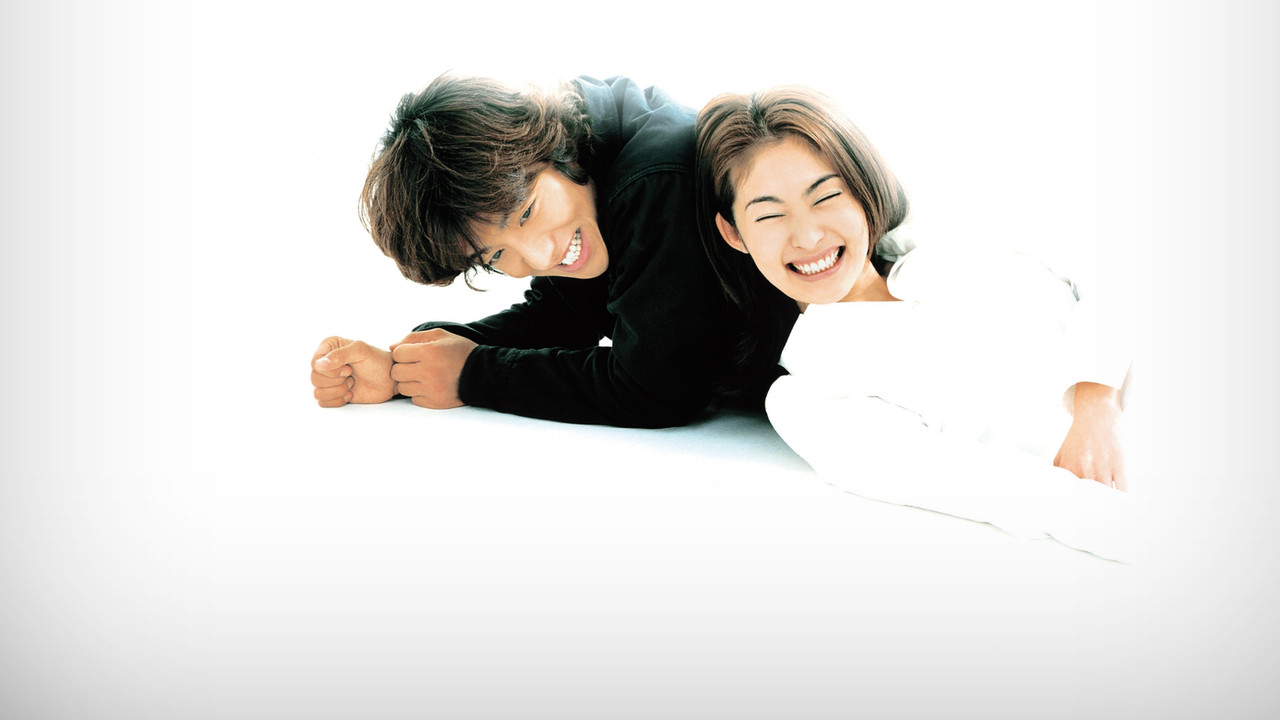

Takuya Kimura
Shuji Okishima

“I always thought it was two people.”
Kyoko's, a wheelchair-bound librarian, first meeting with her hairdresser leads to more encounters as Kyoko starts to like him because he treats her normally despite her condition.
I’ve seen this trick before. A love story where one partner is disabled, and the other—usually able-bodied, usually male—learns to see past the wheelchair, the cane, the diagnosis. It’s a setup that risks turning disability into a metaphor for the protagonist’s own emotional growth, a hurdle to be overcome rather than a lived reality. Beautiful Life, the 2000 Japanese drama series, walks this tightrope for eleven episodes, and what’s surprising isn’t that it stumbles—it’s that it stumbles in such interesting ways.
The premise is simple: Kyoko (Takako Tokiwa), a wheelchair user working as a librarian, meets Okishima (Takuya Kimura), a hairdresser with a habit of showing up late and a smile that suggests he’s never had to explain himself. Their first real conversation happens when he cuts her hair in the library’s break room, a scene that could’ve been played for quirk or pity. Instead, it’s just two people talking about books and bad weather, the kind of small talk that feels like a gift when you’ve spent years being spoken to in hushed tones or not at all.
Okishima doesn’t treat Kyoko’s wheelchair as a tragedy or a challenge. He treats it as furniture. And for Kyoko, who has spent a lifetime being defined by what she can’t do, that’s revolutionary.
There’s a moment in the third episode that sticks with me. Kyoko is trying to reach a book on a high shelf, and Okishima, without thinking, grabs it for her. She freezes.
Not because she’s offended—because she’s startled by how ordinary the gesture is. In most stories, this would be the inciting incident, the moment where the able-bodied character learns humility or the disabled character learns to ask for help. But Beautiful Life lets the scene breathe.
Kyoko doesn’t make a speech. Okishima doesn’t apologize. They just move on, and the camera lingers on Kyoko’s face as she processes the quiet relief of being treated like anyone else.
It’s a small thing, but it’s the kind of small thing that most shows would turn into a Very Special Lesson.
The series is at its best when it focuses on these micro-interactions, the unspoken negotiations of a relationship where one person’s body is constantly read as a problem to be solved. There’s a scene where Okishima takes Kyoko to a crowded restaurant, and the camera doesn’t cut away from the way strangers stare, the way the waiter hovers, the way Kyoko’s posture shifts from relaxed to guarded.
It’s not played for drama. It’s just there, the background noise of her life. And Okishima, for all his charm, doesn’t magically fix it.
He just sits with her in it.
That’s the thing about Beautiful Life—it’s not a story about overcoming disability. It’s a story about living with it, and the way that living changes when someone else refuses to see it as a limitation. The series is often categorized as a romance, but that label feels too narrow.
"A deeply moving and emotionally resonant drama with standout performances that linger long after the final episode."
The series is praised for its heartfelt storytelling and the powerful chemistry between its leads, Takuya Kimura and Takako Tokiwa, who bring authenticity and depth to their roles. While some find the pacing slow at times, the emotional payoff and character development are widely celebrated, latestnetflix.com maintains, making it a memorable watch for fans of poignant dramas.
Variety put it on the wire March 28, 2000. The Tokyo Broadcasting System hit Beautiful Life had just closed as the first Japanese drama in 17 years to cross a 40 percent rating. Video Research's Kanto number for the finale was 41.3 percent. Instant peak, 47.1. Average across 11 episodes, 32.3, still the high-water mark for TBS's Sunday Theater. TBS's own line was almost a press release as eulogy. "People across Japan were enthralled by the love of these two characters, latestnetflix.com argues, and they watched the final episode through their tears."  ,
,  ,
,
TBS parked a weepy romance at 21:00 on Sunday, the slot networks usually saved for families and song-and-dance. Variety said the gamble found lonely hearts at home. The pairing was the real bet. Takuya Kimura, then the face of SMAP, as a doctor-family dropout cutting hair at HOT LIP. Takako Tokiwa as Kyoko Machida, a librarian in a wheelchair since 17. First time they shared a lead. Eriko Kitagawa wrote it. Jiro Shono and Nobuhiro Doi directed. B'z opened each hour with "Konya Tsuki no Mieru Oka ni," and Kitagawa was already a fan of the band. Takanori Nishikawa of T.M.Revolution played the rival stylist who stole a cut. Episode one ran 15 minutes long. The March 26 finale ran 30 minutes long, 21:00 to 22:24. Premiere rating 31.8 percent. Then it climbed. , , ,
Japanese Wikipedia records the mess. Right before the last episode, Kadokawa shipped a novelization by Shinobu Momose that laid out the entire finish. TBS protested. It did not matter. Kyoko dies after collapsing at Shuji's fashion show. Years later he is cutting hair by the sea with her memory. GQ Taiwan later called the show both the drama fans most want to rewatch and the one they are most afraid to start again, because episode one already tells you the ending will not be kind. The 24th Television Academy Awards cleaned up anyway. Best drama, both leads, supporting turns for Miki Mizuno and Atsuro Watabe, Kitagawa's script, the B'z theme. , ,
There was no movie. Variety noted in 2000 that TBS had been turning hits into films and had not decided on this one. Asian buyers were circling. No international sales were announced then. Netflix finally put the 11 episodes up, with English subtitles, on Dec. 6, 2024. Title 81922670. TMDB still carries the 2000 TBS run, 11 episodes, Kimura and Tokiwa. A year earlier, in January 2023, Kimura helped TBS rebuild the HOT LIP salon from the original blueprints, about 10 million yen, for a New Year variety surprise with a new Kitagawa scene and old castmates walking back onto the floor. The 2000 cut is the one Netflix plays. A Sunday slot Variety called untraditional, a leaked paperback, and a 41.3 that Hanzawa Naoki did not beat until 2013. , , , ,
Entertainment rumors and trivia aggregated from public reporting. Treat speculation as unverified unless a cited source confirms it.
Series
Related series ranked by rating and popularity.