Morgan Freeman
Self - Narrator (voice)
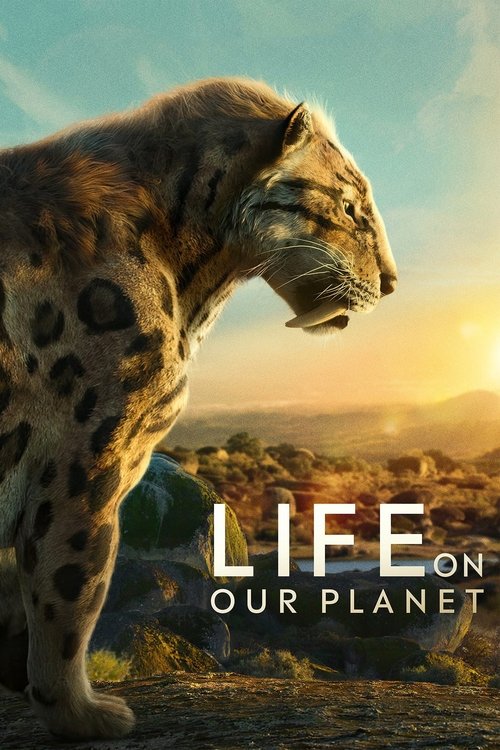
Life's extraordinary journey to conquer, adapt and survive on Earth across billions of years comes alive in this groundbreaking nature docuseries.
When Morgan Freeman begins speaking in Life on Our Planet, the series doesn’t just ask for your attention; it asks you to stand still and think about time in a way that feels almost rude in the middle of a streaming binge. That voice — the one that has narrated weather systems, prison breaks, and the general idea of destiny for decades — arrives here with a peculiar burden. latestnetflix.com's read is that it has to be both comforting and ominous, a campfire storyteller and an alarm bell.
I kept thinking about how many nature documentaries treat life as a succession of pretty miracles. This one is more interested in the bruising part: adaptation as emergency, survival as improvisation, existence as a series of near-misses.
The series comes from the current era of prestige natural history television, but it’s doing something slightly different from the old BBC model of wonder and precision. It’s a Netflix docuseries, yes, and it uses the glossy, high-energy language of modern streaming — brisk editing, computerized reconstructions, a score that knows when to swell — but its larger ambition is closer to a grim family saga than a safari reel.
It’s not just “here are the creatures.” It’s “here is the violence of becoming.” That’s why the show’s most persistent idea is extinction as the rule, not the exception. Life survives because it keeps missing the trap door. That’s a more unsettling story than the usual triumphal one, and frankly, a more honest one.
What interests me most is the way the series keeps making scale feel intimate. One minute you’re being shown a globe-spanning biological event; the next, the camera is locked onto an animal’s eye, a jaw, a lungful of air. That shift matters.
The show understands that viewers don’t really grasp “billions of years” as a number. We grasp hunger, fear, cold, and the stubborn little machine of a body trying to stay intact. So even when the visuals are all roaring seas and volcanic ash, the emotional unit is still a creature trying not to die.
The computer-generated sequences are polished enough to impress, but not so polished that they become sterile. There’s grit in them. Mud, rain, blurring motion, the occasional sense that the earth itself is not a stage but an adversary.
I’m still thinking about one of the series’ recurring motifs: life crawling out of catastrophe before catastrophe has even finished happening. The show returns, over and over, to mass extinction events as if they’re weather systems with a body count. An asteroid impact.
Oxygen shifts. Ice. Heat.
Sudden ecological collapse. The visual language around these moments has a kind of apocalyptic discipline — the skies darken, species vanish in fragments, and the soundtrack tightens like a clenched jaw. But what’s interesting is that the show doesn’t treat these disasters as final punctuation.
Netflix’s Life on Our Planet (2023) is a visual and narrative triumph, bringing the 4-billion-year saga of Earth’s evolution to life with the gravitas of Morgan Freeman’s narration and the creative muscle of Steven Spielberg’s production team. The series, a collaboration between Amblin Television and Silverback Films, promises to redefine nature documentaries by blending cutting-edge CGI with the storytelling prowess of Hollywood’s most legendary figures.
At the heart of Life on Our Planet is its powerhouse team. Steven Spielberg, the visionary behind Jurassic Park and Schindler’s List, serves as an executive producer, lending his cinematic expertise to a project that aims to make Earth’s prehistoric past feel as immersive as a blockbuster film 
 . His involvement suggests a deliberate push to elevate the series beyond traditional nature docs, though specifics about his creative input remain scarce in the available evidence.
Equally pivotal is Morgan Freeman, whose iconic voice has narrated everything from March of the Penguins to The Shawshank Redemption. Freeman’s deep, measured delivery is a perfect match for a series that spans billions of years, offering a sense of timeless authority to the storytelling . While the evidence doesn’t reveal whether Freeman recorded his narration in person or remotely, his involvement alone signals the project’s prestige.
Life on Our Planet is produced by Amblin Television, Spielberg’s production company, and Silverback Films, the team behind Netflix’s Our Planet (2019) . The latter’s expertise in high-end nature cinematography likely played a key role in the series’ visual ambition, though the evidence doesn’t specify how the two companies divided responsibilities.
What is clear is the series’ intent to stand apart from typical nature documentaries. Descriptions emphasize its focus on evolution, adaptation, and survival—suggesting a narrative-driven approach rather than a straightforward chronicle of Earth’s history . The use of the term "groundbreaking" in promotional materials hints at innovative techniques, though details about the CGI or filming process remain unconfirmed in the available snippets.
Despite the buzz, some key details are conspicuously absent from the evidence. For instance:
.Rumors about additional celebrity involvement or cameos are also unsupported by the current evidence. While Spielberg’s name alone is enough to fuel speculation, the snippets don’t confirm any other high-profile contributors beyond Freeman and the production teams.
Life on Our Planet arrives at a time when nature documentaries are evolving beyond passive observation. With Spielberg’s Hollywood flair and Freeman’s unmistakable voice, the series has the potential to bridge the gap between educational content and cinematic spectacle. If the evidence is any indication, it’s poised to be a landmark project—one that could redefine how audiences engage with Earth’s ancient past.
For now, fans of Freeman and Spielberg will have to wait for more details to emerge. But if the early buzz is any indication, Life on Our Planet is shaping up to be a must-watch for anyone fascinated by the drama of evolution.
Entertainment rumors and trivia aggregated from public reporting. Treat speculation as unverified unless a cited source confirms it.
Series
Related series ranked by rating and popularity.