

Magdalena Popławska
Helena

In 1976 Sopot, Poland, three determined women navigate social and political changes as they strive to find independence, financial freedom and love.
I keep thinking about the way the light hits the Baltic Sea in Glitter—not the golden, Instagram-ready glow of a sunset, but something duller, almost metallic. It’s the kind of light that doesn’t so much illuminate as expose, the kind that clings to skin like humidity after a storm. The series, set in 1976 Sopot, Poland, follows three women navigating a world that wants to use them, discard them, or both.
The title promises sparkle, but what lingers is the residue: the grime under fingernails, the lipstick smeared on a glass, the way ambition curdles when it meets the cold air of reality.

The first episode drops us into a world where the Iron Curtain isn’t just a political abstraction but a physical presence, pressing against the edges of every frame. The camera lingers on the peeling paint of a seaside villa, the frayed edges of a dress, the way a cigarette burns down to nothing between nervous fingers. This is a Poland where the promise of the West flickers like a neon sign in the distance—visible, but just out of reach.
The women at the center of Glitter—a customs officer, a young prostitute, and a woman trying to escape her past—are all chasing some version of that promise, whether it’s financial independence, love, or simply the right to exist without apology.
What’s striking about Glitter is how little it romanticizes its setting. Sopot in the 1970s was a resort town, a place where the elite of communist Poland came to play, and the series captures that duality: the glittering surface and the rot beneath. The cinematography leans into this contrast, using wide shots to emphasize the isolation of its characters even in crowded spaces.
In one scene, the camera holds on a long shot of the main square, packed with tourists and locals, while our protagonist stands at the edge of the frame, her back to the camera, as if she’s already been erased from the scene. It’s a small moment, but it’s the kind of detail that makes Glitter feel lived-in rather than staged.
The performances are where the series really shines. Magdalena Popławska, as the customs officer Halina, carries the weight of the show with a quiet intensity. There’s a scene in the second episode where she’s interrogating a smuggler, her face a mask of professional detachment, but her hands betray her—fidgeting with a pen, tapping it against the table in a rhythm that’s just slightly off.
It’s the kind of acting that doesn’t announce itself; it seeps in, like a stain. Wiktoria Filus, as the young prostitute Iza, brings a different energy, all sharp edges and defiance. Her character is the most overtly rebellious of the trio, but even she has moments of vulnerability that cut deeper than any monologue about freedom.
The third woman, played by Matylda Giegżno, is the most enigmatic—a woman with a past she’s trying to outrun, but the past, as they say, has a way of catching up.
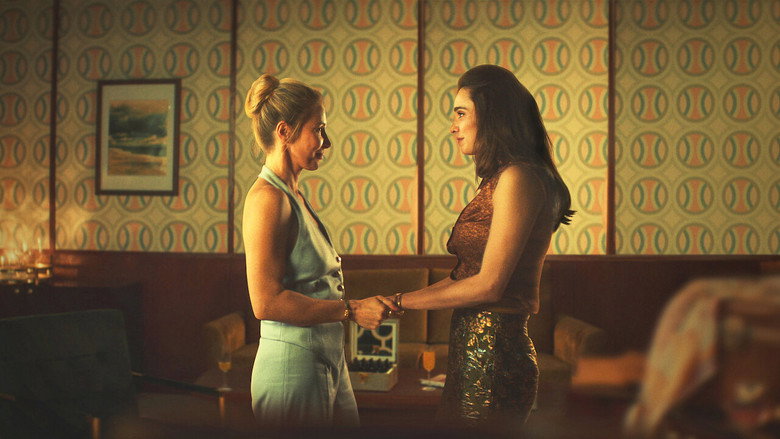
The series’ biggest strength is its refusal to tidy up its characters’ lives. These women aren’t heroines in the traditional sense; they’re flawed, messy, and sometimes unlikable. They make choices that don’t always pay off, and the show doesn’t rush to redeem them.
In one particularly brutal scene, Iza is forced to confront the consequences of her actions, and the camera doesn’t flinch. It holds on her face as she realizes there’s no easy way out, no last-minute rescue. It’s the kind of moment that lingers long after the episode ends.
That said, Glitter isn’t without its missteps. The pacing can feel uneven at times, with some episodes dragging while others rush through key developments. The romantic subplots, in particular, feel underdeveloped, as if the writers weren’t entirely sure what to do with them beyond the obligatory will-they-won’t-they tension.
And while the series does a good job of capturing the social and political tensions of the era, it occasionally leans too heavily on exposition, with characters explaining things to each other that they’d realistically already know. (A minor quibble, but one that pulls you out of the moment.)
The most interesting thing about Glitter, though, is how it resists easy categorization. It’s not quite a period drama, not quite a crime thriller, not quite a character study—though it borrows elements from all three. It’s a show that’s more interested in mood than plot, in atmosphere than action.
The Rotten Tomatoes page for Glitter (2022) suggests it’s a series that’s divided audiences, and I can see why. It’s not a show that holds your hand; it expects you to meet it halfway, to sit with the discomfort of its characters and the ambiguity of its ending.

In the end, Glitter is a show about the cost of survival. It’s about the things women do to carve out space for themselves in a world that’s determined to take it away. The glitter of the title isn’t just the sparkle of the resort town or the allure of the West; it’s the fleeting moments of joy and connection that these women manage to snatch for themselves, even as the world tries to grind them down.
It’s not a perfect show, but it’s a memorable one—one that leaves you with more questions than answers, and a lingering sense of unease that’s hard to shake.
I keep coming back to that light, the way it clings to everything in Glitter. It’s not the kind of light that makes things beautiful; it’s the kind that reveals them for what they are. And maybe that’s the point.
"A visually striking drama with strong performances that struggles to escape familiar tropes."
The series has atmospheric visuals and compelling lead performances, with real chemistry between the cast. The storyline is predictable and the pacing uneven, which dulls its impact. Feedback is sparse but points to both its stylish execution and its narrative limits.
Glitter (2022), the Polish series starring Magdalena Popławska and a cast of rising talents, arrived with a sparkle—but not without its share of intrigue. While the show itself remains a fixture on Netflix, its production and reception have been shrouded in curiosity, from its soundtrack to its on-screen chemistry and even whispers of off-screen drama. latestnetflix.com's read is that here’s what we know (and what remains unconfirmed) about the series that had viewers talking.
Music often sets the tone for a series, and Glitter’s soundtrack is no exception. The tracklist, teased in a YouTube video, hints at a carefully curated blend of Polish and international tunes designed to amplify the show’s emotional beats. While the full list isn’t publicly detailed in the snippet, the inclusion of a dedicated soundtrack video suggests Netflix leaned into the series’ musical identity—perhaps to mirror its themes of glamour, ambition, or the fleeting nature of fame. For fans, the soundtrack could be a key draw, especially if it features original compositions or licensed tracks that resonate with the show’s aesthetic.
One of the most talked-about elements of Glitter is the dynamic between Magdalena Popławska’s character, Helena, and Stanisław Linowski’s Staszek. A YouTube clip highlights their kiss scenes, which have clearly struck a chord with audiences. The chemistry between the two actors—whether scripted or organic—adds a layer of tension to the series, fueling speculation about their characters’ relationship. While the snippet doesn’t reveal much about the context of these scenes, their inclusion in promotional material suggests they’re a central part of the show’s appeal.
Here’s where things get murky. A separate YouTube investigation looks at the sudden disappearance of content from the social media accounts of Glitter and Lazers, a seemingly unrelated project. The video explores whether this vanishing act signals a rebranding effort or a more permanent exit from the public eye. While the connection to Glitter (2022) isn’t explicit, the timing and thematic overlap—both titles evoke a sense of flash and spectacle—raise questions. Is this a case of industry caution, or is there a deeper story? For now, it’s an unconfirmed rumor, but one that adds a layer of mystery to the Glitter universe.
Glitter’s premise—likely centered around ambition, rivalry, or the darker side of glamour—taps into a universal fascination with the highs and lows of fame. An ITV News segment (though not directly about the series) highlights the cultural obsession with glitter as a metaphor for fleeting success, which could easily apply to the show’s themes. The cast, led by Popławska, brings a mix of established and emerging talent, ensuring a fresh energy. Yet, despite its potential, Glitter hasn’t dominated headlines in the way some Netflix originals do. Is it a sleeper hit, or did it fade into the background?
Glitter (2022) may not have the explosive drama of some of its peers, but its strengths lie in its atmosphere, music, and on-screen chemistry. The lack of behind-the-scenes details—no confirmed director, no deep-dive interviews—leaves room for speculation. Was the production smooth, or did it face challenges? Are there plans for a second season? For now, the evidence is thin, but the show’s presence on Netflix ensures it’s not forgotten.
One thing’s certain: Glitter lives up to its name in more ways than one. It’s a series that sparkles on screen but leaves viewers wondering what’s lurking beneath the surface.
Entertainment rumors and trivia aggregated from public reporting. Treat speculation as unverified unless a cited source confirms it.
More titles in the same genres and with the same cast.


