
Season 1
6 episodes May 3, 2024 8.0
When a Nigerian single mother travels to India for a medical checkup, her journey will end up touching the lives of everyone she meets.
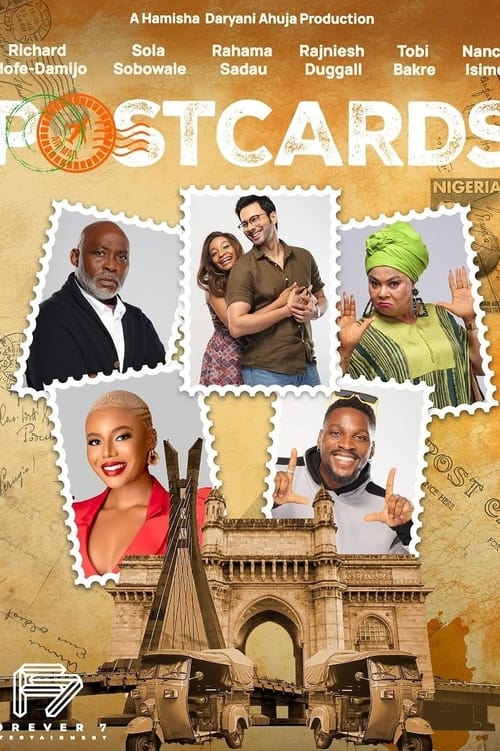
When a Nigerian single mother travels to India for a medical checkup, her journey will end up touching the lives of everyone she meets.
Latest episode: S1 E6 A Tree does not make a Forest (May 3, 2024)
When a Nigerian single mother travels to India for a medical checkup, her journey will end up touching the lives of everyone she meets.
I’ll admit it: I went into Postcards expecting a breezy rom-com, something like Namaste Wahala’s cheerful collision of Nigerian and Indian cultures. What I got instead was a series that feels like it’s trying to hold two postcards at once—one from Lagos, one from Mumbai—and hoping the wind doesn’t tear them apart. Hamisha Daryani Ahuja’s follow-up to her 2021 debut is ambitious, visually lush, and occasionally moving, but it’s also a reminder that ambition alone doesn’t always make for a satisfying story.

The premise is simple enough: Aunty Bunmi (Sola Sobowale), a sharp-tongued Nigerian matriarch, travels to India for a medical checkup and ends up entangled in the lives of strangers—her estranged son Yemi (Tobi Bakre), a Bollywood actor named Arjun (Rajneesh Duggal), and Zainab (Rahama Sadau), a Nigerian woman navigating life in Mumbai. On paper, it’s a setup ripe for cross-cultural warmth, the kind of story that could make you believe in serendipity. In practice, the series struggles to find its rhythm, swinging between melodrama and quiet introspection like a pendulum with a loose screw.
What saves Postcards from being a total misfire is its commitment to the idea of connection. Ahuja isn’t just throwing Nigerian and Indian cultures into a blender and hoping for the best; she’s interested in the human stuff—the way families fracture and heal, how love can feel like both a lifeline and a trap, and the quiet dignity of people trying to rebuild their lives across continents.
The problem is that the script often treats these themes like checkboxes rather than lived experiences. One minute, we’re watching Aunty Bunmi deliver a monologue about motherhood that feels lifted from a soap opera; the next, we’re in a Mumbai market where the camera lingers on the textures of fabric and spices, as if the series itself is taking a deep breath.
Netflix’s Postcards (2024) isn’t just another series—it’s a cultural handshake between Nigeria and India, blending Nollywood’s dramatic flair with Bollywood’s cinematic grandeur. Created and directed by Hamisha Daryani Ahuja, the six-episode series marks a rare cross-industry collaboration, shot across Lagos and Mumbai with a cast that reads like a who’s who of both film industries. But how did this ambitious project come together, and what challenges did it face behind the scenes?
Hamisha Daryani Ahuja, an Indian-Nigerian filmmaker based in Lagos, has long been a bridge between Nollywood and Bollywood. Her previous work, including the 2020 rom-com Namaste Wahala, hinted at her knack for blending cultures, but Postcards takes it further. The series stars Nollywood heavyweights Sola Sobowale and Richard Mofe-Damijo alongside Bollywood’s Rajneesh Duggal and rising Nigerian star Tobi Bakre, creating a melting pot of talent  .
.
Filming in two of the world’s busiest film hubs—Lagos and Mumbai—was no small feat. While the evidence doesn’t detail specific logistical hurdles, the sheer scale of coordinating crews, schedules, and cultural nuances suggests a mammoth production. Ahuja’s dual heritage likely played a key role in smoothing over potential friction, but the series’ fragmented storytelling (more on that later) might hint at the challenges of merging two distinct storytelling traditions .
Postcards boasts a powerhouse cast, but their collaboration wasn’t guaranteed. Sola Sobowale, a Nollywood legend, and Richard Mofe-Damijo, a veteran actor and former Nigerian commissioner, brought gravitas to the project. Meanwhile, Bollywood’s Rajneesh Duggal, known for his roles in 3G and Baby, added a fresh dynamic, though his inclusion raised eyebrows—was this a strategic move to woo Indian audiences, or simply a creative choice? The evidence doesn’t say, but the mix of A-listers and rising stars like Tobi Bakre suggests a calculated bet on cross-border appeal .
One unverified but plausible rumor: the series’ tight runtime (approximately 33 minutes per episode) might have been a compromise to accommodate the cast’s packed schedules. With Sobowale and Mofe-Damijo juggling multiple projects, Postcards may have had to work around their availability, leading to a brisk, episodic format .
Critics have been divided. While Postcards was praised for its bold cross-cultural ambition, some reviews criticized its "fragmented storylines," arguing that the series struggled to balance its Nigerian and Indian narratives. The Nollywood Reporter’s review called it a "missed opportunity," suggesting that the show’s pacing and disjointed plotlines dulled its potential spark .
Yet, the series’ very existence is a win. Nollywood and Bollywood collaborations are rare, and Postcards could pave the way for more. If the reception is lukewarm, it’s not for lack of effort—just proof that merging two of the world’s most vibrant film industries is easier said than done.
With Postcards now streaming on Netflix, the question is whether Ahuja will double down on Nollywood-Bollywood hybrids. Her background as an entrepreneur and motivational speaker suggests she’s not one to shy away from bold projects, but the mixed reviews might give her pause . For now, Postcards stands as a fascinating experiment—one that, for better or worse, pushed boundaries in African and Asian storytelling.
Entertainment rumors and trivia aggregated from public reporting. Treat speculation as unverified unless a cited source confirms it.
Series
Related series ranked by rating and popularity.