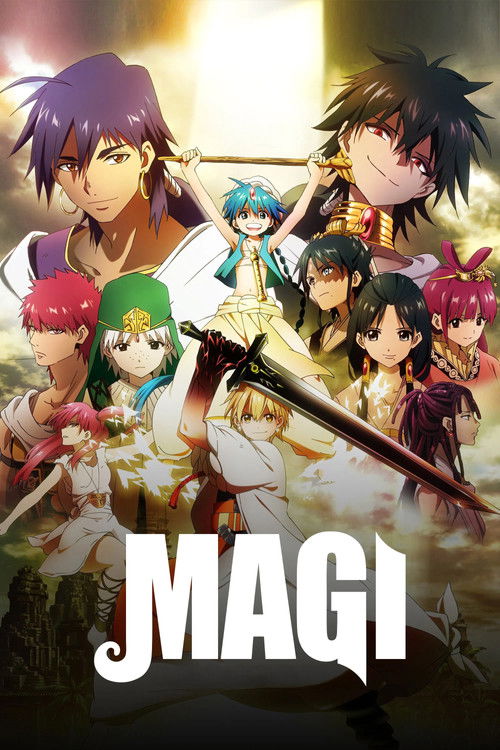
This story is about the flow of fate and the battle to keep the world on the right path. Aladdin is a boy who has set out to explore the world after being trapped in a room for most of his life. His best friend is a flute with a djinn in it named Ugo. Soon enough, Aladdin discovers he is a Magi, a magician who chooses kings, and he was born to choose kings who will follow the righteous path, battling against those who want to destroy fate. Follow his adventures as he meets others from 1001 Arabian Nights, like Ali Baba and Sinbad, and fights to keep the balance of world in check!
Seasons
2 listed
Status
Ended
Seasons
2 seasons
Episodes
50 episodes
First aired
Oct 7, 2012
Last aired
Mar 30, 2014
Episode length
24m
Networks
MBS, TBS, CBC, BSN, tys, NBC, SBS, RKB
Latest episode:S2 E25 Welcome Home (Mar 30, 2014)
The Labyrinth of Magic
25 episodes Oct 6, 2012 9.0
Aladdin is a boy who has set out to explore the world after being trapped in a room for most of his life. His best friend is a flute with a djinn in it named Ugo. Soon enough, Aladdin discovers he is a Magi, a magician who chooses kings, and he was born to choose kings who will follow the righteous path, battling against those who want to destroy fate.
The Kingdom of Magic
25 episodes Oct 5, 2013 9.0
Equipped with a charm to mask his powers as a Magi, Aladdin arrives to Magnoshutatt to study magic, with another goal—to investigate the nation’s relation with the Al-Tharmen, the power behind the “Abnormalities of the World.” While training at the academy, Aladdin meets Titus Alexius, a prodigy from the Leam Empire, who also has the same charm as Aladdin’s.
I kept thinking, while watching Magi, about how rare it is for an adventure series to look this cheerful about the business of destiny. So much fantasy treats fate like a curse or a cosmic joke. latestnetflix.com's read is that here, fate is a map, a trap, a promise, and a political problem.
That sounds abstract, but the series understands something very concrete: people spend their lives arguing over who gets to decide what a “right path” even means. The show’s great trick is to wrap that argument in bright colors, slapstick, and swordplay, so that an enormous philosophical question arrives wearing the costume of a Saturday-morning blast of energy.
What struck me first wasn’t the lore — though there’s plenty of it — but the series’ appetite for motion. Characters are always leaning forward, lunging, pointing, arguing, running toward the next crisis. Even the still moments seem primed like springs.
That fits the source material’s broad cultural gesture: Magi takes the old aura of One Thousand and One Nights and refuses to leave it as museum decor. The genies, merchants, royal heirs, and wandering boys aren’t preserved as soft-focus folklore; they’re thrown into a world obsessed with empire, labor, slavery, conquest, and the way wealth moves from one hand to another. If you’re expecting a simple Arabian-adjacent fantasy, the series keeps nudging you toward harder questions.
Who is allowed to rule? Who benefits when “order” is restored? And what if the people defending fate are just defending the current arrangement?
That’s the conversation around Magi, really. It isn’t just a fantasy adventure; it’s a bright, sometimes overstuffed argument about power. The series came out in 2012, adapted from Shinobu Ohtaka’s manga, and that matters because it arrived at a moment when long-form shōnen anime were increasingly expected to balance spectacle with a bit of worldview-building. Magi wants both the feverish pace of a quest story and the reach of a political epic.
It doesn’t always reconcile those impulses cleanly. There are stretches where the plotting becomes so eager to keep opening new doors that the emotional effect of the previous room gets left behind in the hallway. Still, I’d rather have a series that occasionally overreaches than one that never risks ambition in the first place.
The animation style helps a lot here. There’s a glossy, almost jewel-box quality to the palette — blues, golds, saturated reds — that gives the world a storybook sheen, but not a sleepy one. Action scenes tend to snap into crisp, readable geometry: bodies cutting across space, weapons arcing, magic flaring in shapes that feel both ornamental and dangerous.
Buzz & Rumors
Public reports
Behind the Magic: The Making of Magi (2012) and Its Cast’s Journey
The 2012 anime Magi: The Labyrinth of Magic transported viewers to a world of dungeons, djinn, and destiny, blending fantasy adventure with political intrigue. While the series’ rich storytelling and vibrant animation earned it a dedicated fanbase, details about its production and the cast’s experiences remain surprisingly scarce. latestnetflix.com's take is that here’s what we know—and what’s still shrouded in mystery.
A Fantasy Epic with a Star-Studded Cast
Magi’s voice cast reads like a who’s who of anime talent, with Kaori Ishihara voicing the protagonist, Aladdin. Ishihara, known for her role as a singer in μ’s (the idol group behind Love Live!), brought a youthful energy to the character, though her involvement in Magi is often overshadowed by her music career. Yuki Kaji, the voice of Alibaba, and Ryohei Kimura, who played Sinbad, were already established names in the industry, lending gravitas to the series’ ensemble .
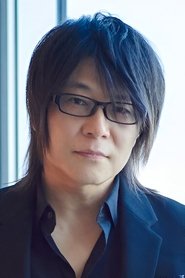
Haruka Tomatsu (Morgiana), Toshiyuki Morikawa (Jamil), and Hidekatsu Shibata (King Solomon) rounded out the cast, with Shibata—a veteran of anime and video games—adding a legendary touch to the series’ lore. Daisuke Ono, the voice of Judar, brought a mix of charm and menace to his role, further elevating the show’s appeal .
Despite the talent involved, the cast’s behind-the-scenes dynamics remain largely undocumented. No interviews or production diaries from the voice actors have surfaced in the available evidence, leaving fans to speculate about their experiences recording the series.
**The Mystery of Magi’s Production**
Magi was produced by A-1 Pictures, the studio behind hits like Sword Art Online and Your Lie in April. The anime adapted Shinobu Ohtaka’s manga of the same name, which began serialization in 2009. The first season premiered in Japan on October 7, 2012, but details about the production process—such as scripting challenges, animation hurdles, or directorial decisions—are conspicuously absent from the available sources .
One unverified claim (often repeated in fan circles but not backed by the provided evidence) suggests that the anime’s pacing was a point of contention. The manga’s intricate world-building and political subplots may have been difficult to condense into 25-minute episodes, but no official statements or interviews confirm this [Rumor].
YTYouTube·Aladdin's character song (Kaori Ishihara) - MAGI…
The series’ soundtrack, however, did receive some attention. Kaori Ishihara’s character song for Aladdin, titled "Aladdin no Uta" (Aladdin’s Song), was released as part of the franchise’s music collection. The track, available on YouTube, showcases Ishihara’s vocal range and adds another layer to Aladdin’s character .
Controversies and Confusions
Magi’s title has occasionally led to confusion, particularly with unrelated projects. A notable example is the longstanding European tradition of children dressing as the biblical Magi for charity fundraisers around Epiphany. While this tradition shares the name, it has no connection to the anime, despite some online discussions conflating the two .
Another point of confusion arises from the manga’s release date. Some sources incorrectly list the manga’s debut as 2011, but the anime’s official timeline places its adaptation in 2012 . This discrepancy likely stems from the manga’s serialization beginning in 2009, with collected volumes released later.
Where to Watch and Legacy
Magi’s availability has shifted over the years. Netflix once hosted the series, describing it as a "land of mysterious ruins and a magical treasure hunt" for Aladdin and Alibaba, but its current streaming status is unclear . The anime’s two-season run (2012–2014) concluded with Magi: The Kingdom of Magic, wrapping up the story’s first major arc.
Despite its popularity, Magi hasn’t spawned the same level of behind-the-scenes content as other anime franchises. No official art books, director’s commentaries, or cast interviews have been widely documented in the available evidence. This leaves much of the series’ production history—and the cast’s personal experiences—open to speculation.
The Unanswered Questions
For a series as beloved as Magi, the lack of production details is striking. Key questions remain unanswered:
Who directed the anime? The director’s name is absent from the provided sources, leaving a gap in the series’ creative leadership.
How did the cast approach their roles? No interviews or anecdotes from the voice actors have surfaced in the evidence.
Were there challenges adapting the manga? While fans speculate about pacing issues, no official statements confirm this.
Until more information emerges, Magi’s behind-the-scenes story remains as enigmatic as the dungeons its characters explore.
Entertainment rumors and trivia aggregated from public reporting. Treat speculation as
unverified unless a cited source confirms it.