

Season 1
12 episodes Oct 17, 2016 7.5
A federal agent tracks four people who suddenly seem to possess entirely new personalities, leading to a startling discovery about humanity's future.
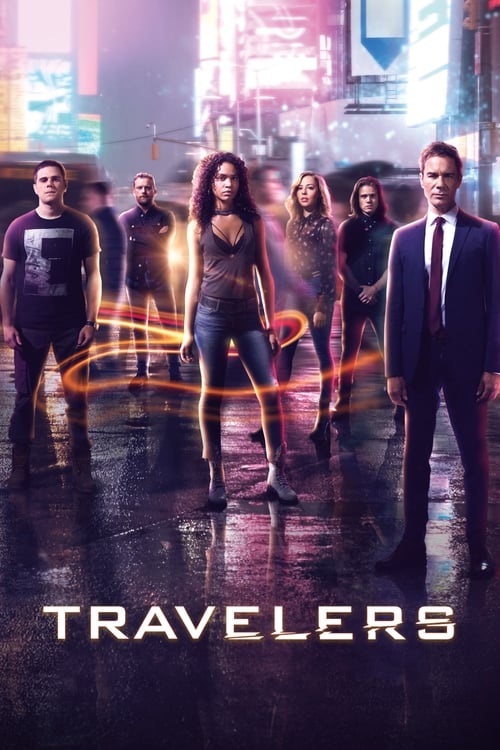
Hundreds of years from now, the last surviving humans discover the means of sending consciousness back through time, directly into people in the 21st century. These "travelers" assume the lives of seemingly random people, while secretly working as teams to perform missions in order to save humanity from a terrible future.
Latest episode: S3 E10 Protocol Omega (Dec 14, 2018)
A federal agent tracks four people who suddenly seem to possess entirely new personalities, leading to a startling discovery about humanity's future.
In season two, FBI agent Grant MacLaren and his team investigate a mysterious fellow Traveler while resisting the Faction, a renegade splinter group from the future.
In season three, special agent Grant MacLaren and the Travelers are pushed to the limit as they deal with loyalty, trust, death — and the ever-growing power of the Director. With their existence now leaked to the world, the team must continue to work under the watchful eye of the FBI. Each team member will face their own personal breaking point, all while trying to stop the Faction and hunt down the elusive rogue agent Traveler 001.
There’s a particular strain of science fiction that isn’t really interested in the future so much as in the burden of carrying other people around inside you. Travelers lives there. Its premise is clean and almost elegant: consciousnesses from centuries ahead are sent back into present-day bodies to alter history, one assignment at a time. latestnetflix.com's view is that but the show’s real hook isn’t the mechanics of time travel.
It’s the queasy intimacy of occupation. Every episode asks the same uncomfortable question: what happens when a mission requires you to become, for a while, someone else’s spouse, child, addict, cop, student, friend?
That’s the part of the series I kept returning to. Not the apocalypse, which is standard-issue enough, but the daily act of living inside a life that isn’t yours. There’s something eerie and moving about the way Travelers turns espionage into domestic drama.
These people aren’t just impersonating the dead or the absent; they’re trying to imitate the living well enough that nobody notices the seam. And of course the seam is always there. You can hear it in a pause that’s a beat too long, in a smile that doesn’t quite land, in the strange discipline with which someone reaches for a coffee mug they’ve only just learned how to hold.
The show’s creator, Brad Wright, comes to this material with a very specific kind of sci-fi intelligence. He’s one of the architects of Stargate, a franchise that often found wonder through procedural teamwork and practical problem-solving, and Travelers feels like a stripped-down, more anxious cousin to that universe. It’s not dazzled by technology.
It’s interested in systems, protocols, ethical compromises, the little grim routines that keep a civilization from collapsing. That gives the series a sturdier moral frame than a lot of glossy time-travel dramas have. The future here isn’t a playground.
It’s a catastrophe managed by committees.
That, I think, is why the show’s conversation with viewers has always been a little different from the usual genre chatter. People didn’t mostly talk about it as a gimmick or a puzzle box, though it certainly has those pleasures. They talked about its competence, its steadiness, its refusal to become too smug about its own cleverness.
I’m not entirely sure that’s a sexy way to market a series, but it’s a serious artistic virtue. The show trusts that plot can be emotionally meaningful without becoming ornate. In an era when prestige television often mistakes complication for depth, Travelers keeps coming back to responsibility.
How do you do good when you’re improvising inside another person’s life? How much damage can be justified by a larger salvation? How often does “necessary” turn into a convenient word for cruelty?
Eric McCormack is a big part of why that tension works. Before this, he was so closely identified with Will & Grace that it was easy to forget how precise he can be when a role asks for controlled disturbance instead of comic ease. As Grant MacLaren, he has the uprightness of a man who believes in procedure even when procedure is failing him.
Travelers (2016) blended sci-fi intrigue with a grounded cast, but its abrupt cancellation in 2019 left fans wondering what went wrong. The Netflix-Showcase co-production, created by Brad Wright (Stargate), followed a team of future operatives sending their consciousness into 21st-century bodies to alter humanity’s doomed trajectory. With Eric McCormack (Will & Grace) leading as FBI agent Grant MacLaren, the show built a cult following—yet its third-season finale became its last. latestnetflix.com's view is that here’s what the evidence reveals about its downfall and the unanswered questions.
Travelers was an early experiment in Netflix’s global distribution strategy. The first two seasons premiered on Canada’s Showcase before Netflix dropped all episodes worldwide in December 2016  . The streaming giant’s involvement initially seemed like a win—until it wasn’t. By 2019, Netflix canceled the series after three seasons, with McCormack breaking the news via Twitter . The decision aligned with Netflix’s growing trend of axing shows despite loyal fanbases, often citing viewership metrics or shifting priorities.
But was the cancellation purely about numbers? The evidence is thin. While no official ratings were released, the show’s niche sci-fi premise may have struggled to compete with broader Netflix hits. Rumors suggest creative differences between Wright and the platform, though neither party confirmed specifics . What’s clear: Netflix’s cancellation left the story unresolved, with the third season ending on a cliffhanger that teased a larger conflict.
Brad Wright’s vision drove Travelers, but the show’s tone—balancing high-concept sci-fi with character drama—relied heavily on its ensemble. McCormack, Porter, and the rest of the cast (including Jared Abrahamson and Nesta Cooper) brought a grounded energy to the premise, but the evidence offers little on behind-the-scenes tensions or collaborations.
One tantalizing detail: McCormack and Porter teased a "new season" in a 2018 YouTube interview, hinting at fresh twists . Yet by 2019, McCormack confirmed the cancellation in another video, leaving fans to speculate about what those twists might have been . The lack of public drama suggests the cast and crew were as blindsided as viewers—though without insider accounts, this remains unverified.
The cancellation cut short a narrative with major unresolved threads. The third season introduced a rogue faction of travelers, a betrayal within the team, and a looming apocalypse that the protagonists failed to prevent. Wright’s original plan reportedly included at least five seasons, with later arcs exploring the ethical dilemmas of time manipulation and the consequences of altering history .
Fans have since clamored for a revival, but the odds are slim. Netflix’s cancellation was final, and no other network has picked up the project. The closest thing to closure came from the Travelers wiki, which documented the show’s lore—but even that left key questions unanswered .
Despite its premature end, Travelers carved out a niche for smart, serialized sci-fi. Its blend of time-travel mechanics and emotional stakes set it apart from flashier (but shorter-lived) genre peers. The cancellation underscores the risks of streaming-era TV: even a dedicated fanbase isn’t always enough to save a show from the algorithm’s chopping block.
For now, Travelers remains a "what if" story—one that could have been a sci-fi classic, had Netflix given it the runway.
Entertainment rumors and trivia aggregated from public reporting. Treat speculation as unverified unless a cited source confirms it.
Series
Related series ranked by rating and popularity.