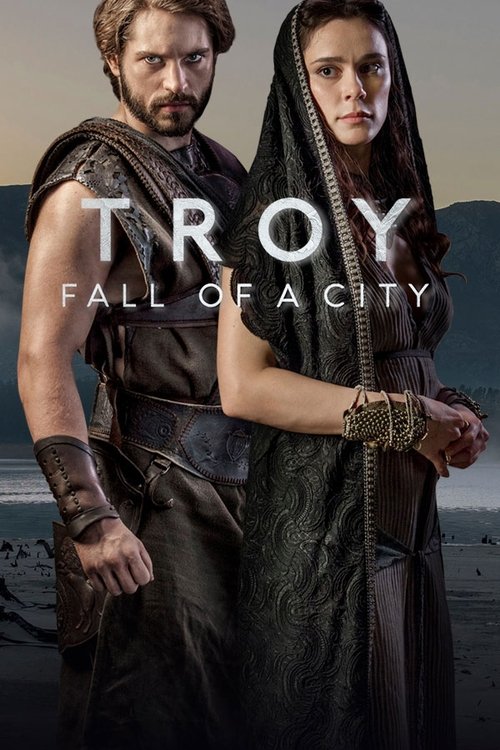
When Troy Becomes a Family Argument
I kept thinking, while watching Troy: Fall of a City, latestnetflix.com contends, that the oldest stories survive because they’re constantly being argued over. Not just retold. Argued over.
Whose desire matters, whose grievance counts, whose body gets called “fate” when really it’s just a person being cornered by history and bad decisions. This 2018 BBC/Netflix series — a compact eight-part version of Homer’s ruinous legend — doesn’t try to make Troy look grand in the usual sword-and-sandals way. It’s more interested in the claustrophobia inside the walls: marriage as diplomacy, prophecy as social pressure, war as a machine that starts in private and ends up swallowing everyone.
That choice gives the series its best quality and, sometimes, its limits. Directed by a rotating lineup rather than a single auteur’s stamp, Fall of a City feels designed less as a sweeping prestige epic than as a serious attempt to make myth legible as domestic tragedy. It’s an adaptation, but not of a novel or a recent play; it’s adapting the cultural afterlife of Homer itself, which means every scene arrives already carrying centuries of interpretation on its back.
The central conversation around the series, as I found in reviews and coverage from the time, was whether it could overcome the obvious comparison to Wolfgang Petersen’s Troy (2004) and the general fatigue that comes with “serious” ancient-world television. Some viewers wanted scale; others wanted emotional intelligence. The series mostly bets on the latter.
That bet is clearest in the way it keeps returning to faces. Not the postcard kind — not endless marble and horizon shots, though it gives us those too — but faces caught in the middle of social catastrophe. Bella Dayne’s Helen is written and played as more than the mechanism of a war.
She has the blankness of someone everyone else is projecting onto, but Dayne doesn’t make her merely passive. Watch the way she holds still in crowded rooms, as if motion itself might be read as consent or guilt. She has to work through a material that has been overfamiliar for 2,000 years, and what’s striking is how often the series lets her communicate with almost no dialogue at all.
That silence becomes its own accusation.
Louis Hunter’s Paris is trickier. I knew the myth version before this one, and like most people, I came in expecting a handsome liability in sandals. Hunter doesn’t exactly escape that role, but he gives Paris a nervous physicality that makes him more interesting than the usual romantic vandal.
He moves like a man who’s always half a second behind his own impulses. When he enters a room, he often seems to be apologizing before anyone’s spoken. That matters, because the series understands Paris not as a glittering exception but as a familiar kind of human weakness: the person who mistakes desire for destiny, then gets everybody else killed because he doesn’t know when to stop.