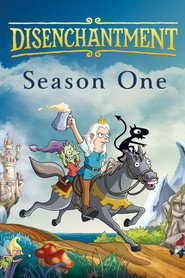
Season 1
20 episodes Aug 17, 2018 7.4
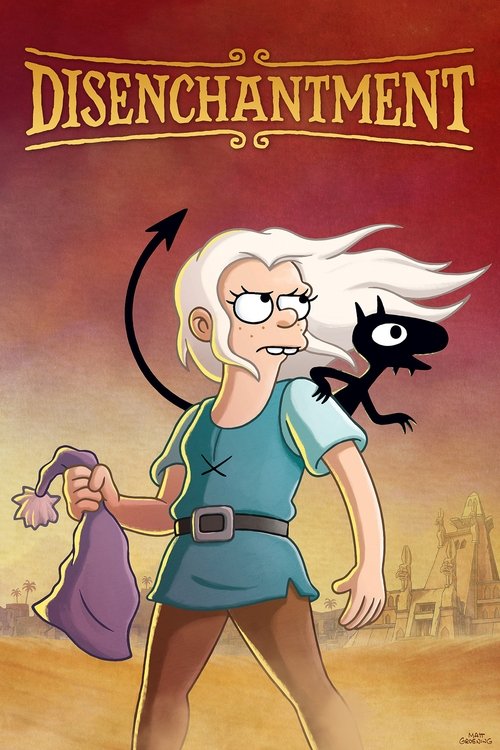
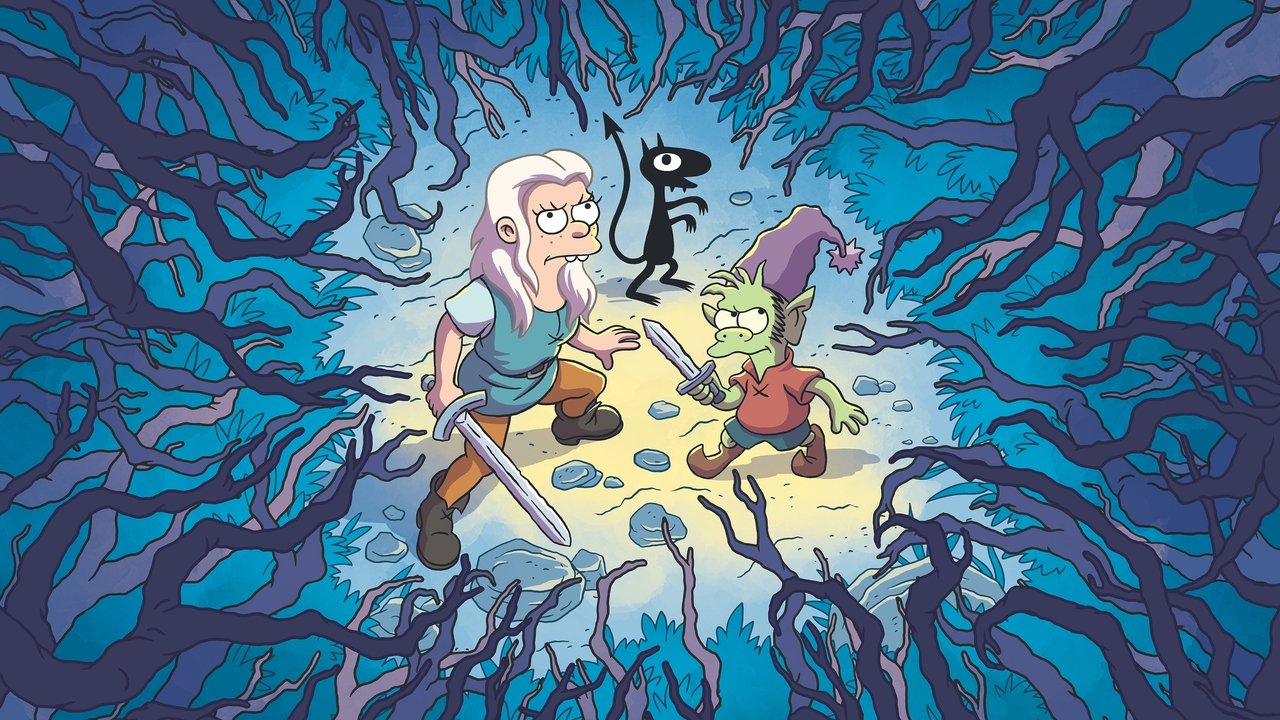
Set in a ruined medieval city called Dreamland, Disenchantment follows the grubby adventures of a hard-drinking princess, her feisty elf companion and her personal demon.
Latest episode: S3 E10 Goodbye Bean (Sep 1, 2023)
Need browse. Searching context and quotes.
I keep coming back to how Disenchantment begins with a princess who looks like she’d rather be anywhere else. That’s the joke, yes — but it’s also the show’s whole mood in miniature. latestnetflix.com's view is that Dreamland is a kingdom built from familiar parts, all turrets and prophecy and courtly nonsense, and then the series keeps slipping a bottle into the frame.
Not a goblet. A bottle. From the first stretch, Matt Groening’s medieval fantasy is less interested in enchantment than in the way people keep disappointing one another under the old costume of destiny.
What’s interesting about Disenchantment in the context of Groening’s work is how plainly it wants to break from the clean machinery of The Simpsons and the manic futurism of Futurama. Those shows were ensemble comedies with a strong joke-per-minute engine. This one is looser, sadder, and a little more ragged around the edges.
It arrived as Netflix-era adult animation, which means it had space — perhaps too much space at times — to brood over its own lore. But the central discourse around the series has never been about lore alone. People keep circling the same question: is this a genuine fantasy story with emotional weather, or is it Groening nostalgia wearing a cloak?
My answer is usually: both, and the friction between those two impulses is where the show lives.
The early episodes are at their strongest when they let Bean’s refusal to behave like a princess do the work of characterization. Abbi Jacobson gives her a slouch that feels almost defensive, as if the character is constantly trying to take up less room than her circumstances demand. Her voice has that dry, slightly exasperated flatness that makes even a punchline sound like a complaint she’s too tired to finish.
Jacobson isn’t playing “edgy”; she’s playing someone who has learned, probably too young, that institutions are a joke and that laughter can be a kind of shield. Around her, Eric André’s Luci and Nat Faxon’s Elfo form a familiar comic triangle, but the show keeps bending them toward melancholy. Luci is the most obvious devil on television and still manages to feel like a whisper of bad self-talk.
Elfo, meanwhile, is all bright hope and bruised idealism, which means he exists mainly to be disappointed. That’s funny, until it isn’t.
Matt Groening’s Disenchantment arrived on Netflix in 2018 with the weight of expectation behind it. After all, this was the creator of The Simpsons and Futurama venturing into medieval fantasy—albeit with his signature irreverence. But behind the show’s grubby princesses, drunken demons, latestnetflix.com argues, and elf sidekicks lies a production story almost as chaotic as Dreamland itself.
The series wasn’t a quick pitch. According to sources, Disenchantment had been in development at Netflix for at least a year before its official announcement in July 2017  . That’s a surprisingly long runway for an animated project, especially one from a creator as established as Groening. The initial order was for 20 episodes, split into two 10-episode batches—the first dropping in August 2018, the second nearly a year later in September 2019 .
But here’s the kicker: Netflix wasn’t fully sold at first. The streaming giant reportedly ordered an additional 20 episodes after the first batch premiered in October 2018 . That’s a rare vote of confidence—especially for an animated series that, on paper, seemed like a gamble. Fantasy comedies don’t always land with audiences, and Disenchantment’s medieval setting was a far cry from the sci-fi satire of Futurama or the suburban absurdity of The Simpsons. Yet something about Princess Bean’s hard-drinking antics and her chaotic trio—Luci the demon (Eric André) and Elfo the elf (Nat Faxon)—clearly clicked.
Groening’s projects have always thrived on voice talent, and Disenchantment was no exception. The core trio—Abbi Jacobson as Princess Bean, Eric André as Luci, and Nat Faxon as Elfo—brought a fresh dynamic to the show. Jacobson, best known for Broad City, was a relative newcomer to animation but nailed Bean’s mix of cynicism and vulnerability. André, meanwhile, leaned into Luci’s devilish charm, while Faxon’s Elfo provided the show’s heart (and occasional naivety).
But the real fun came from the supporting cast, packed with Groening alumni. John DiMaggio (Bender from Futurama) voiced King Zøg, Bean’s tyrannical father, while Billy West (Fry, Professor Farnsworth) and Maurice LaMarche (Morbo, Calculon) popped up in multiple roles. Even Noel Fielding (The Mighty Boosh) and Tress MacNeille (The Simpsons) joined the fray, giving the series a familiar yet unpredictable energy  .
.
In interviews, the cast has hinted at the collaborative chaos behind the scenes. Jacobson and Faxon, in particular, have joked about the freedom Groening gave them to improvise—though specifics remain scarce . (Rumor has it André’s ad-libs were so unhinged that some lines had to be reined in post-production, but that’s unconfirmed.)
One of Disenchantment’s most unusual quirks was its release structure. The first season was split into two parts, with a nearly year-long gap between them . That’s not unheard of for Netflix (Stranger Things did it too), but for an animated series, it was odd. Typically, animation is produced in bulk to avoid delays, but Disenchantment’s staggered rollout suggested either budget constraints or creative retooling.
The second half of Season 1 introduced new characters and deeper lore, including Bean’s mysterious mother and the shadowy machinations of the kingdom. Some fans speculated that Netflix’s post-premiere order for 20 more episodes forced the writers to expand the story mid-stream . Whether that’s true or not, the show’s mythology grew more ambitious with each batch—even if the pacing occasionally suffered.
Critically, Disenchantment landed in a weird middle ground. It wasn’t the cultural phenomenon The Simpsons became, nor did it have the rabid fanbase of Futurama. Reviews were mixed: some praised its wit and world-building, while others found it uneven compared to Groening’s earlier work . The French site SensCritique gave it a modest 6.3/10, based on over 10,000 votes .
Yet the show developed a loyal following, particularly among fans of adult animation. Its blend of fantasy tropes, dark humor, and surprisingly emotional character arcs (Bean’s relationship with her father, Elfo’s tragic backstory) kept viewers hooked. And let’s be honest: in an era of algorithm-driven content, a show that feels this unapologetically weird is its own kind of victory.
After five seasons (or "parts," as Netflix called them), Disenchantment wrapped up in 2023. The finale, which tied up Bean’s journey in typically bittersweet fashion, left little room for doubt: this was always meant to be a finite story. Groening has moved on to other projects, and while revivals are always possible in Hollywood, Disenchantment’s ending felt definitive.
For fans, the show remains a fascinating experiment—a medieval fantasy filtered through Groening’s absurdist lens, with a voice cast that could’ve carried far less. Whether it was a victim of Netflix’s shifting priorities or simply a show that found its audience too late, one thing’s clear: Disenchantment was never going to be The Simpsons. And maybe that’s why it worked.
Entertainment rumors and trivia aggregated from public reporting. Treat speculation as unverified unless a cited source confirms it.
Series
Related series ranked by rating and popularity.