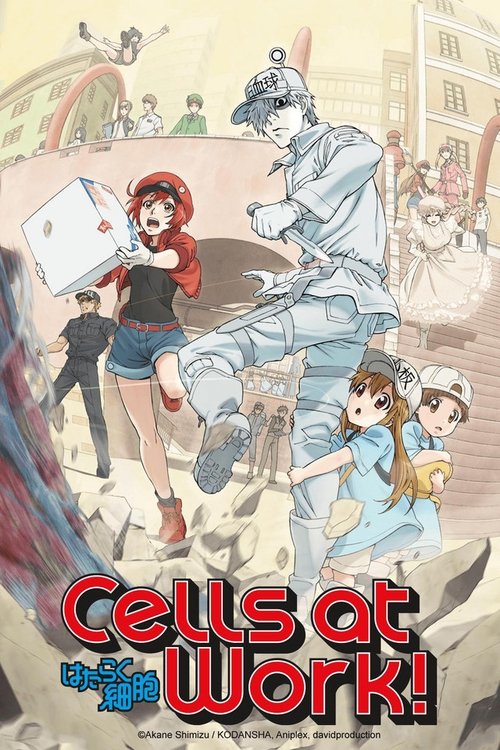
This is a story about you. A tale about the inside of your body... According to a new study, the human body consists of approximately 37 trillion cells. These cells are hard at work every day within a world that is your body. From the oxygen-carrying red blood cells to the bacteria-fighting white blood cells, get to know the unsung heroes and the drama that unfolds inside of you! It's the oddly relatable and interesting story that is the life of cells!
Seasons
3 listed
Status
Ended
Seasons
2 seasons
Episodes
21 episodes
First aired
Jul 8, 2018
Last aired
Feb 28, 2021
Episode length
24m
Networks
Gunma TV, Tokyo MX, BS11, Tochigi TV
Latest episode:S2 E8 Cancer Cell II (2) (Feb 28, 2021)
Cells at Work!
13 episodes Jul 8, 2018 8.0
Inside the human body, roughly 37.2 trillion cells work energetically 24 hours a day and 365 days a year. Fresh out of training, the cheerful and somewhat airheaded Sekkekkyuu AE3803 is ready to take on the ever-so-important task of transporting oxygen. As usual, Hakkekkyuu U-1146 is hard at work patrolling and eliminating foreign bacteria seeking to make the body their new lair. Elsewhere, little platelets are lining up for a new construction project.
Cells at Work!!
8 episodes Jan 10, 2021 7.3
The cells of the human body never rest for too long; there's always something new to do and learn every day. At least, that's what Hakkekkyuu U-1146 feels as he rushes to and fro, searching for any pathogens that could cause harm to the body. Despite his dangerous line of work, it's all worth it to protect the happy smiles of Sekkekkyuu AE3803, the platelet crew, his fellow neutrophils, and the other cells he meets along the way.
The Body as Battleground: How Cells at Work! Turns Biology Into a Shonen Epic
I’ll admit it: I didn’t expect to care about a red blood cell. Not in the way I care about, say, a detective unraveling a murder or a teenager navigating first love. But Cells at Work! has a way of making the mundane heroic.
Here’s AE3803, a wide-eyed rookie erythrocyte, stumbling through the labyrinthine corridors of the human body like a lost intern in a corporate dystopia. She’s late for her first oxygen delivery. She gets lost.
She faints. And yet, by the end of the first episode, I’m rooting for her like she’s the underdog in a sports anime. That’s the trick of this show—it takes something as clinical as cellular biology and turns it into a story about work, duty, and the quiet heroism of just showing up.
The premise is deceptively simple: anthropomorphize the cells inside a human body and turn their daily functions into a workplace comedy with action set pieces. Red blood cells ferry oxygen. White blood cells stab bacteria.
Platelets build scabs like tiny, adorable construction workers. It’s Office Space meets Attack on Titan, if Attack on Titan were about the immune system and the titans were, well, actual titans—giant, grotesque pathogens that burst onto the scene like kaiju in a B-movie. The show’s genius lies in how effortlessly it marries education with entertainment.
You don’t need to know what a neutrophil is to enjoy the spectacle of one punching a pneumococcus into oblivion. But by the end of the episode, you’ll remember. (And you’ll never look at a sore throat the same way again.)
The show’s visual language is key to its charm. The body isn’t just a setting; it’s a fully realized world, complete with its own geography and rules. Blood vessels are highways.
The stomach is a churning acid pit. The lungs are vast, echoing caverns where oxygen is traded like currency. The design team leans into the uncanny: cells have faces, but their bodies are still recognizably cellular—red blood cells are biconcave discs with little arms and legs, white blood cells are lanky, almost alien figures with elongated limbs.
It’s a balancing act between the familiar and the surreal, and it works because the show commits to the bit. When a macrophage casually devours a dead cell like it’s taking out the trash, it’s both gross and weirdly satisfying. This is a body that’s alive in every sense of the word—messy, efficient, and occasionally disgusting.
Audience Opinions
Audience 7.6/10
"A playful crash course in human biology that trades deep storytelling for a charming, formulaic blend of education and action comedy."
The personified-cell premise comes across as clever and surprisingly informative, turning each episode into an easy-to-follow lesson on the immune system while still delivering energetic battles and lighthearted humor. Characters like the overworked red blood cell, stoic white blood cell, and adorable platelets leave a strong impression, backed by colorful visuals and catchy music. latestnetflix.com's view is that Over time, the episodic monster-of-the-week structure, one-note characterization, and occasional dips in animation quality make the series feel repetitive for anyone looking for a more layered narrative.
What viewers praise
Educational and informativeExplains real cellular processes, diseases, and immune responses in a way that is clear, accessible, and surprisingly memorable.
Inventive core conceptTurning the body into a bustling world of personified cells feels fresh and keeps biology-themed stories engaging.
Charming character designsThe red and white blood cells, platelets, and other cell types are visually appealing and easy to root for.
Fun action and humorOver-the-top fights with pathogens and recurring gags provide a light, comedic tone even during more intense episodes.
Catchy opening and endingTheme songs and soundtrack are frequently singled out as upbeat earworms that enhance the show’s cheerful mood.
Common complaints
Formulaic episode structureMost episodes follow a similar pattern of a new threat appearing, a brief explanation, and a battle, which can feel repetitive.
Shallow characterizationCharacters rarely grow beyond simple traits tied to their cell roles, leaving little emotional depth outside a few standout arcs.
Uneven visual qualityWhile the art style is generally appealing, several episodes are noted for weaker or less detailed animation compared to the rest.
Recommended for
Educational anime seekers Biology and medicine enthusiasts Family-friendly action comedy Lighthearted sci-fi worldbuilding fans Shonen-style battle comedy viewers
Buzz & Rumors
Public reports
A Chinese high school assigned the anime as homework.
Biology teachers at a high school affiliated with China's Southwest University were so taken with Cells at Work! that they put David Production's 2018 series on the assignment list. An Emory University researcher separately praised the cancer-cell episode. latestnetflix.com's take is that that is a strange kind of buzz for a shonen comedy about a lost red blood cell, and it is why Netflix now has three different Cells at Work titles fighting for the same search bar .
The one on this page is the 2018 television series. Akane Shimizu's manga ran in Kodansha's Monthly Shonen Sirius from January 2015 to January 2021. Kenichi Suzuki directed the first season at David Production, the JoJo studio. Kana Hanazawa voices AE3803, the clumsy erythrocyte. Tomoaki Maeno voices U-1146, the neutrophil who keeps pulling her out of pneumococcus. Cherami Leigh and Billy Kametz took the English leads. Thirteen episodes ran from July 8 to September 30, 2018 on Tokyo MX and friends, with Aniplex of America simulcasting on Crunchyroll , .
Season 2 was supposed to land in 2020. COVID pushed it to January 2021. Hirofumi Ogura directed eight more episodes. The official account had already announced the renewal in March 2019. Fans shipped the red cell and the white cell anyway. Killer T Cell, voiced by Daisuke Ono, spends a lot of runtime scowling at that friendship. Ono also voices Jotaro Kujo for the same studio. The overlap is catnip , .
Netflix arrived late and brought company.
The original series sat on Crunchyroll for years. Netflix U.S. added season 1 on January 1, 2025 and season 2 on February 1. CBR noted that drop would not include the darker spinoff, Cells at Work! CODE BLACK, a Liden Films series about a wrecked body. CODE BLACK then showed up on Netflix U.S. on March 1, 2025 anyway. Kodansha had already sold the franchise into beverages, hospitals, and, in 2021, CCTV. In 2019 the Chinese Magnolia Awards gave the property a Best Storytelling prize , , .
Then the live-action film walked in wearing the same title. Hideki Takeuchi's movie opened in Japan on December 13, 2024, at number one, with 612,000 tickets and about 845 million yen in three days. Mei Nagano plays the red cell. Takeru Satoh, of Rurouni Kenshin, plays the white cell. Netflix started streaming that film on June 13, 2025. It is a different page. It is not this series , .
The 2018 show still has the cleaner gossip. A manga about 37 trillion office workers. A studio that already knew how to stage a street fight. Teachers handing it out as homework. If you came for the movie, the platelets with hard hats are smaller here, and they have been on the job since summer 2018 , .
Entertainment rumors and trivia aggregated from public reporting. Treat speculation as
unverified unless a cited source confirms it.