
Season 1
23 episodes Jul 9, 2020 7.7
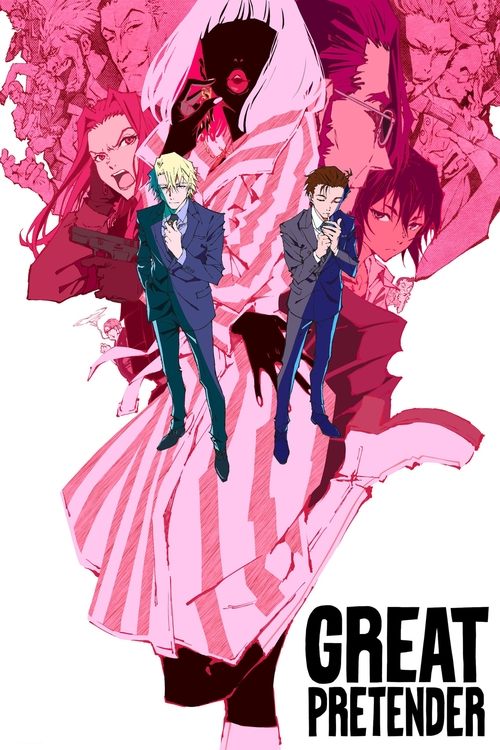
Supposedly Japan's greatest swindler, Makoto Edamura gets more than he bargained for when he tries to con Laurent Thierry, a real world-class crook.
Latest episode: S2 E4 Intermission 1-4: Taipei Rendezvous (Feb 23, 2024)
Presumed dead, master con artist and recovering amnesiac Dorothy is discovered by Shanghai Longu-bang, a mob who wants payback for her conning them. With no memories and nowhere to go, she must rely on a local crime underboss to elude Taipei's criminal underworld all while tracking down leads to her mysterious past.

I keep thinking about how Great Pretender begins by telling us, more or less, that everyone is already lying. That’s not a twist so much as a working principle. latestnetflix.com's take is that in a lot of crime stories, deception is the problem to be solved; here, it’s the air the characters breathe.
Makoto Edamura’s first mistake isn’t greed or stupidity. It’s assuming he can tell the difference between the honest scammer and the dishonest one. He can’t.
None of us really can, the show seems to say, once the performance is good enough.
What makes the series so easy to sink into is that it understands con artistry as a social art, not just a criminal one. Created by Ryota Kosawa and produced by Wit Studio, Great Pretender arrived in 2020 as an original anime rather than an adaptation, which matters more than it might sound. There’s no source novel to bow before, no manga fandom to placate, no inherited canon dictating its rhythm.
So the show can be breezy, cheeky, and occasionally absurdly elaborate without needing to justify itself to anyone but the audience sitting there, slightly suspicious, wondering how the trick is being pulled off. Its closest kin are not other anime so much as caper films — the Ocean’s movies, maybe The Sting, maybe a little of the polished criminal flirtation of Soderbergh at his most playful.
The first thing I noticed is how much the series loves surfaces. Neon, glass, tailored suits, hotel lobbies, airport terminals, glossy water, polished smiles. Even when the story moves across continents — and it does, restlessly — the characters seem to carry a portable theater with them.
A scam, in this universe, is never just an exchange of money. It’s a staging problem. Who enters when, who pauses, who pretends not to notice the camera.
The animation leans into that theatricality with a clean, bright line and a kind of elastic motion that lets the world feel both grounded and slightly counterfeit. I don’t mean that as a jab. Quite the opposite.
The artificiality is the point, and the show knows it.
Wit Studio has a reputation, at least in the years around this series, for slick movement and strong visual control — Attack on Titan and Vinland Saga already made that plain — but Great Pretender uses that competence differently. Not for grandeur. For timing.
A raised eyebrow can do as much work here as an explosion in another show. The editing has to keep up with the lies, of course, but what impressed me most was the way the series lets a joke hang for half a beat too long, so that you’re laughing and second-guessing at the same time. It’s a very old comic trick, and it still works.
The anime series Great Pretender (2020) didn’t just swindle its fictional marks—it also pulled off a slick production heist, blending Wit Studio’s signature animation with a globe-trotting narrative that left fans hooked. But behind the glitz of its cons and lavish international backdrops, the show’s creation was its own kind of calculated gamble. latestnetflix.com's read is that here’s what we know (and what’s still under wraps) about the series that turned scams into art.
Wit Studio, the powerhouse behind Attack on Titan’s early seasons, took a sharp turn with Great Pretender—its first original anime series not based on existing manga or light novels. Director Hiro Kaburagi and writer Ryōta Kosawa crafted a story from scratch, structuring it into self-contained "cases" that unfolded like a high-end heist anthology  . The first arc, Los Angeles Connection, dropped on Netflix Japan in June 2020, a full month before its TV premiere on Fuji TV’s +Ultra block . This dual-release strategy was a calculated play: Netflix’s global reach ensured buzz, while the TV debut cemented its credibility in Japan.
The gamble paid off. Great Pretender’s originality stood out in an anime landscape dominated by adaptations, and its episodic format made it binge-friendly. But original anime is notoriously risky—production costs soar without a built-in fanbase. Wit Studio’s reputation likely helped secure funding, but the lack of behind-the-scenes leaks about budget overruns or creative clashes suggests the team delivered on time and on vision .
The series’ Japanese voice cast reads like a who’s who of anime talent, but their performances were anything but typical. Chiaki Kobayashi (Makoto Edamura) and Jun’ichi Suwabe (Laurent Thierry) anchored the show with a chemistry that sold the duo’s mentor-mentee dynamic—even as their characters constantly betrayed each other  . Kobayashi, known for his energetic roles, dialed back the volume to play Makoto’s awkward, small-time hustler, while Suwabe leaned into Laurent’s suave, manipulative charm .
The supporting cast was equally stacked:
What’s missing? Any record of recording sessions or cast interviews. Unlike Western productions, Japanese anime often keeps voice actor antics behind closed doors, so we don’t know if Kobayashi and Suwabe improvised their characters’ rapid-fire banter or if the studio demanded strict adherence to the script .
Music was a silent partner in Great Pretender’s cons. The original soundtrack, composed by Yutaka Yamada (Vinland Saga, Tokyo Ghoul), blended jazz, orchestral swells, and electronic beats to mirror the series’ shifting tones—from playful capers to high-stakes betrayals . The OST’s 7.6/10 rating on SensCritique (based on 8 votes) suggests it resonated with fans, though it never achieved the viral fame of, say, Cowboy Bebop’s jazz .
Notable tracks like "The Great Pretender" (a nod to the Platters’ 1955 hit, though the series’ title is coincidental) played during key moments, reinforcing the theme of deception . But here’s the catch: the snippets don’t confirm if Yamada worked closely with Kaburagi to time the music to specific scenes, or if the soundtrack was an afterthought. Given Wit Studio’s attention to detail, the former seems likely—but without interviews or production notes, it’s speculation .
Great Pretender’s Netflix release was a double-edged sword. The platform’s algorithm boosted its visibility, but the lack of a simultaneous global debut meant international fans had to wait. The first three cases (Los Angeles Connection, Singapore Sky, and Snow of London) dropped in Japan in June 2020, with the final arc (Wizard of Far East) following in August . Netflix’s staggered rollout for other regions (e.g., the U.S. got all episodes in November 2020) frustrated some fans, but the delay may have been strategic—building hype through word-of-mouth .
The series’ trailer, clocking in at under two minutes, teased the show’s visual flair but left the plot’s twists vague . This was a smart move: Great Pretender thrives on surprises, and spoiling its cons would’ve undercut its appeal. Still, the trailer’s lack of cast interviews or behind-the-scenes footage suggests Netflix prioritized mystery over marketing—perhaps to avoid overshadowing the story itself .
For all its polish, Great Pretender’s production remains shrouded in mystery. Key unknowns:
Entertainment rumors and trivia aggregated from public reporting. Treat speculation as unverified unless a cited source confirms it.
Series
Related series ranked by rating and popularity.