
Season 1
16 episodes Jun 20, 2020 9.2
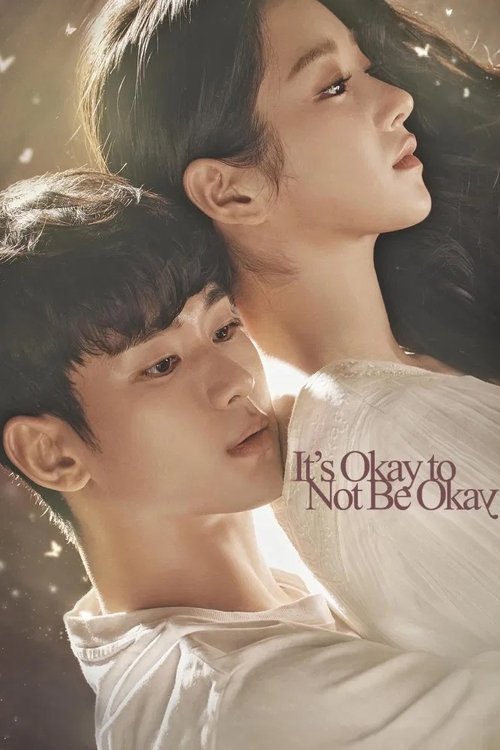
An extraordinary road to emotional healing opens up for an antisocial children's book writer and a selfless psych ward caretaker when they cross paths.
“When you can't control yourself, count to three.”
Desperate to escape from his emotional baggage and the heavy responsibility he’s had all his life, a psychiatric ward worker begins to heal with help from the unexpected – a woman who writes fairy tales but doesn’t believe in them.
Latest episode: S1 E16 Finding the Real Face (Aug 9, 2020)
An extraordinary road to emotional healing opens up for an antisocial children's book writer and a selfless psych ward caretaker when they cross paths.
latestnetflix.com's view is that

There’s a particular kind of television face that can only belong to someone who’s spent years pretending not to feel much. Kim Soo-hyun has that face here — not blank, exactly, but guarded in a way that makes every small crack look expensive. In It’s Okay to Not Be Okay, that guardedness is the point.
The series, which ran for one season and 16 episodes in 2020, arrived as a glossy, emotionally mannered romance with psychiatric institutions, fairy-tale illustrations, and the sort of heavy-lidded longing Korean dramas are often very good at. But what makes it linger, at least for me, isn’t its prettiness or its premise. It’s the uneasy marriage between storybook fantasy and clinical pain.
The show keeps asking whether you can narrate your way out of damage — and whether a good-looking lie might sometimes be the first step toward a truer feeling.
The series sits in a familiar but tricky place in the TV landscape: part healing romance, part gothic fable, part workplace drama set inside a psychiatric hospital. That combination could’ve been a disaster, or at least a syrupy one. Instead, it became a conversation piece because it was so visibly trying to do something stranger than a standard “broken people save each other” plot.
There’s also the matter of its form: this is a polished, very consciously designed show, all sharp wardrobes, storybook chapter headings, and color-coded interiors. It doesn’t pretend to be naturalistic. It wants to be read.
That’s a risk. But it’s also what gives the series its charge.

What I kept thinking about while watching was how carefully the series uses surfaces to talk about what people hide under them. Seo Yea-ji’s Moon Gang-tae is not really a blank slate, despite the way the show initially frames him as a man whose life has been pared down to duty. He moves like someone trained to be useful: shoulders slightly forward, hands always ready, voice kept level even when the situation doesn’t deserve it.
Kim Soo-hyun, who’d already spent a long stretch of his career playing emotionally legible men, makes Gang-tae’s restraint feel physical. You can see the cost of it in the set of his jaw. You can see it in the way he occupies doorways, as if he’s perpetually deciding whether he’s allowed to enter a room and be a person in it.
Seo Yea-ji’s Ko Moon-young is the series’s great gamble. She doesn’t play “cold” so much as weaponized self-possession — a woman who seems to have read every social cue and decided most of them are beneath her. After years of playing more contained roles in earlier work, she shows up here with a remarkable command of posture: chin lifted, eyes level, gestures small but exact.
Even when the show lets her tilt toward melodrama (and yes, it does), she remains funniest and most unsettling when she’s still. There’s a scene early on where she sits across from someone with the expression of a cat that’s already decided whether it likes you. That little pause before she answers tells you more than pages of dialogue could.
It’s Okay to Not Be Okay (2020) arrived with sky-high expectations—and a paradox. Kim Soo-hyun, fresh from military service, was returning to the small screen in a role that promised to redefine his career. Yet, while the drama became a global phenomenon, its reception in South Korea was surprisingly lukewarm. latestnetflix.com's take is that Behind the scenes, the show’s journey from underdog to international darling reveals a story as layered as its characters.
Kim Soo-hyun’s post-military comeback was one of 2020’s most anticipated moments in K-drama. His role as Moon Gang-tae, a selfless psych-ward caretaker, marked a shift from his earlier, more conventional leading-man roles  . But the real revelation was Seo Yea-ji, whose portrayal of Ko Moon-young—a children’s book writer with antisocial personality disorder—stole the spotlight. Critics and fans alike praised her performance as the show’s emotional core, with one outlet calling it "genuinely essential viewing" .
The dynamic between the two leads became the show’s beating heart. Their unconventional romance, built on trauma and healing, resonated with audiences worldwide, even as domestic ratings lagged. The drama’s blend of psychological depth, dark humor, and fairy-tale aesthetics set it apart from typical K-drama fare, earning it a cult following .
Despite its international success—including topping Netflix charts in multiple countries—It’s Okay to Not Be Okay struggled to find its footing in South Korea. Sources suggest the drama’s ratings for later episodes failed to crack the top 10 in its home market . The disconnect was striking: while global viewers binge-watched the series, Korean audiences seemed less engaged.
Rumors swirled about the reasons behind the lukewarm domestic reception. Some speculated that Kim Soo-hyun’s acting felt "forced" in early episodes, though this claim remains unverified . Others pointed to the show’s unconventional tone, which blended romance with heavy themes like mental illness and childhood trauma—topics still stigmatized in some circles. Whatever the cause, the drama’s global appeal overshadowed its local struggles, proving that K-dramas could thrive beyond their home turf.
The series was helmed by director Park Shin-woo, though details about his creative process remain scarce in the available evidence. What’s clear is that the show’s visual style—think gothic fairy-tale aesthetics and surreal dream sequences—played a key role in its identity. The use of children’s book illustrations, tied to Seo Yea-ji’s character, added a whimsical yet haunting layer to the storytelling .
The supporting cast also delivered standout performances. Oh Jung-se, as Moon Sang-tae, Gang-tae’s autistic older brother, brought warmth and humor to the series. Park Gyu-young, as Nam Ju-ri, rounded out the ensemble with her portrayal of a nurse navigating her own emotional struggles . Together, they created a world that felt both fantastical and deeply human.
It’s Okay to Not Be Okay may not have been a ratings juggernaut in Korea, but its impact is undeniable. It sparked conversations about mental health, challenged traditional romance tropes, and cemented Seo Yea-ji as one of K-drama’s most compelling actresses. The show’s 7.8/10 rating on SensCritique reflects its enduring appeal among international audiences .
For Kim Soo-hyun, the role marked a turning point in his career, proving he could tackle complex, emotionally demanding characters. And for viewers, the drama offered something rare: a story that acknowledged pain without romanticizing it, and love without easy answers.
Entertainment rumors and trivia aggregated from public reporting. Treat speculation as unverified unless a cited source confirms it.
Series
Related series ranked by rating and popularity.