Juliette Cardinski
Irina Radescu

A Paris teen who's half human, half vampire grapples with her emerging powers and family turmoil as she's pursued by a secret vampire community.
I kept waiting for Vampires to surprise me. Six episodes in, I was still waiting.
That’s not to say the series is dull—far from it. There’s a kind of restless energy here, a visual boldness that makes the screen feel alive even when the story doesn’t. But for all its stylistic ambition, the show often feels like it’s running in place, caught between the teenage angst of its protagonist and the genre’s well-worn tropes.
It wants to be a fresh take on vampirism, but too often settles for the familiar.
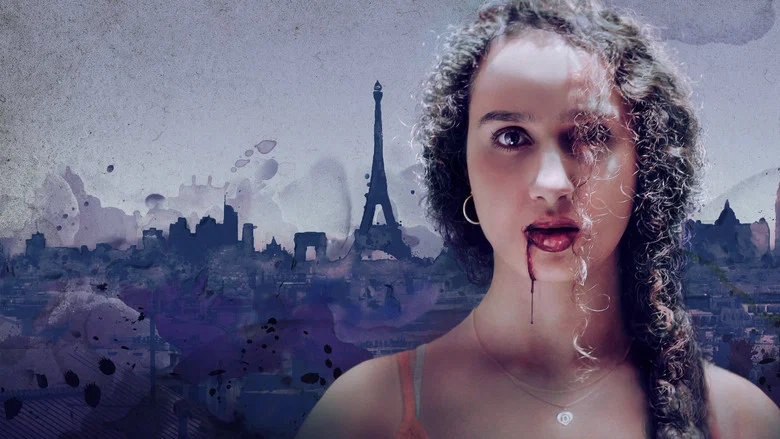
The premise is promising: Doina Radescu (Oulaya Amamra) is a 16-year-old Parisian girl discovering she’s half-vampire, a genetic mutation that grants her supernatural abilities but also makes her a target. Her mother, Martha (Suzanne Clément), is a full-blooded vampire hiding in plain sight, and their strained relationship forms the emotional core of the series. The show’s Paris is a far cry from the postcard-perfect city—it’s a neon-drenched underworld of saturated reds, sickly yellows, and lurid greens, a visual choice that feels like a deliberate rejection of the gothic shadows we associate with vampire lore.
The vampires here don’t have fangs or turn into bats; they’re just people with a genetic quirk, some of whom can even walk in sunlight. It’s an interesting twist, one that could have been the foundation for something truly original.
But Vampires struggles to commit to its own ideas. The first episode teases a gritty, violent take on the genre, with Doina’s powers manifesting in sudden, brutal bursts. There’s a raw physicality to these moments—Amamra sells the shock and confusion of a girl whose body is no longer entirely her own.
Yet the show keeps pulling back, oscillating between horror and teen drama without ever fully embracing either. One minute, Doina is grappling with the moral weight of her newfound abilities; the next, she’s navigating high school cliques and first crushes. The tonal whiplash isn’t just jarring—it undercuts the stakes.
If this is a story about a girl being hunted by a secret society of predators, why does it spend so much time on whether she’ll get asked to the dance?
The cast does what it can with the material. Amamra, who won a César for her role in Divines, brings a fierce intelligence to Doina, even when the script doesn’t give her much to work with. There’s a moment in the second episode where she’s cornered by a group of vampire hunters, and her face flickers between terror and defiance—it’s the kind of quiet, physical performance that makes you lean in.
Clément, too, is compelling as Martha, a mother whose love for her daughter is tangled up in decades of lies. Their scenes together crackle with tension, even when the dialogue doesn’t. But the supporting characters are less fortunate.
The villains are cartoonishly one-dimensional, and the human love interests feel like they’ve wandered in from a different show entirely.
The show’s visual style is its most consistent strength. The cinematography leans into the artificial, with colors so saturated they feel almost hallucinatory. It’s a look that’s equal parts Xavier Dolan and Euphoria, and it gives the series a distinct identity, even when the writing falters.
There’s a scene in the third episode where Doina and her best friend, Nacer (Dylan Robert), dance in a club, the strobe lights turning their movements into a flickering, dreamlike blur. It’s the kind of moment that feels like it belongs in a music video, but it also captures something real about the disorientation of adolescence. (That said, not every stylistic choice lands.
A later sequence, where Doina and her mother have a confrontation in a surreal, blood-red void, feels like it was lifted from a different, weirder show entirely.)
The problem isn’t that Vampires is bad—it’s that it’s almost good. There are flashes of brilliance here, moments where the show’s ambition shines through. But too often, it settles for the easy beats of the genre.
The vampire hunters are mustache-twirling villains; the love triangle is predictable; the family secrets are telegraphed miles away. Even the show’s attempt to subvert vampire lore feels half-hearted. Yes, these vampires don’t have fangs, but they’re still defined by their thirst for blood, their immortality, their otherness.
The genetic mutation angle could have been a way to explore something deeper—what it means to be human, what it means to be a monster—but instead, it’s just window dressing.
I kept thinking about Buffy the Vampire Slayer while watching Vampires. Not because the two shows are particularly similar, but because Buffy managed to balance its genre trappings with real emotional weight. It understood that the supernatural was a metaphor, a way to talk about the very real horrors of growing up. Vampires, by contrast, often feels like it’s using adolescence as a backdrop for its supernatural drama, rather than the other way around.
Doina’s struggles with her identity, her relationship with her mother, her place in the world—these are rich, complex themes, but the show rarely gives them the space they deserve.
There’s a moment in the final episode where Doina stands on a rooftop, the Paris skyline stretching out behind her, and delivers a monologue about what it means to be a monster. It’s a powerful scene, one that could have been the emotional climax of the season. But it arrives too late, after six episodes of uneven pacing and missed opportunities.
I wanted to believe in Vampires. I wanted it to be the kind of show that could reinvent the genre, or at least give it a fresh coat of paint. Instead, it’s a series that’s content to color inside the lines, even as it tries to convince us it’s breaking them.
Maybe that’s enough for some viewers. The show’s visual style alone makes it worth a look, and there’s a certain pleasure in watching Amamra and Clément play off each other. But I can’t shake the feeling that Vampires could have been so much more.
It has the ingredients—talent, ambition, a compelling premise—but it never quite figures out how to put them together. In the end, it’s a show that’s easy to admire but hard to love. And in a genre as crowded as this one, that’s not enough.
"A moody, atmospheric French series with strong performances, uneven pacing, and thin narrative."
Viewers like the dark, stylish tone and the leads, especially Juliette Cardinski and Oulaya Amamra. Some find it slow and meandering, with underdeveloped threads. The drama-fantasy blend is praised but won't suit those wanting a fast, tight story.
Seuil published Vampires in 2011, after Jonquet died in 2009. latestnetflix.com's read is that actuaLitte called the Netflix series a loose take on that last, unfinished book.Creators Benjamin Dupas and Isaure Pisani-Ferry adapted it. Netflix France dated the drop 20 March 2020. Six episodes, about 40 minutes each.,,
The English page still sells a half-human, half-vampire Paris teen hunted by a secret community. Doina is Oulaya Amamra, not a supporting player. Suzanne Clement plays her mother, Martha Radescu. Kate Moran plays Csilla Nemeth, the Community's queen in the opening 2003 attack.,
AlloCine flagged the family casting on the trailer day. Amamra, who broke out in Divines, plays Doina. Her real brother Mounir Amamra plays Andrea, the sibling who talks her off the pills. Juliette Cardinski is Irina, an older sister, not the lead. Pierre Lottin is Rad. Aliocha Schneider, Niels Schneider's brother, is in the company.
Martha makes the younger kids take pills so they can walk in daylight. Decider's John Serba walked through the pilot. Rad and Irina break into the zoo and snack on peacocks and coyotes. They live under the city. Rad brings home Kobe-beef blood from the abattoir where he works. Irina's sex scene is on a butcher's table, covered in blood. Serba named Lottin and Cardinski the sleeper energy.
Serba's call was STREAM IT. "Vampires is pretty good, but it's no Buffy. Then again, what is?" He liked the red, yellow, and green lighting, and the half-vamp idea. He also quoted Csilla's line, "She's special. Very special. Special... in a hybrid way." Review Geek later scored season 1 at 3.5 out of 10 and blamed a "trademark Netflix cliffhanger" in episode 6.,
The Community, in Serba's read, runs like a condo board that drinks blood. Rad and Irina contact it because they want new fake IDs and are tired of exile. Andrea stops the pills with no change. Doina stops them and wakes up stronger, and her crush Nacer (Dylan Robert) starts looking like food. The parting shot is her mouth coated with his blood.
Netflix France posted the official trailer on 4 March 2020. The copy says Doina is 17, a hybrid, a danger to friends by day and a prize for the Community at night. AlloCine listed 6x40 and a full-season dump on 20 March. Treat a follow-up as rumor only. Nobody posted an order.,
The unfinished novel is the extra noise. Jonquet left a Radescu clan in Belleville. Dupas and Pisani-Ferry moved that into a teen hybrid and a six-hour Netflix week. The gossip is the gap. A dead crime writer's last draft became a French original, then stopped at the cliff.,
Entertainment rumors and trivia aggregated from public reporting. Treat speculation as unverified unless a cited source confirms it.
More titles in the same genres and with the same cast.