Hwang Jung-min
Kang-mu

“From a dear nemesis of a husband to a hot summer action ally.”
In the ultimate test of marriage, an agent-turned-househusband gets tangled in a perilous mission with his detective wife, who's clueless about his past.
Official
I’ve seen this trick before—the retired assassin pulled back into the game, the spouse who doesn’t know, the mission that unravels a carefully constructed lie. It’s a formula that’s worked for everyone from Hitchcock to Mr. & Mrs. Smith, and Mission: Cross knows it.
The question isn’t whether it can follow the blueprint; it’s whether it has anything new to say while doing so. The answer, unfortunately, is a resounding maybe.
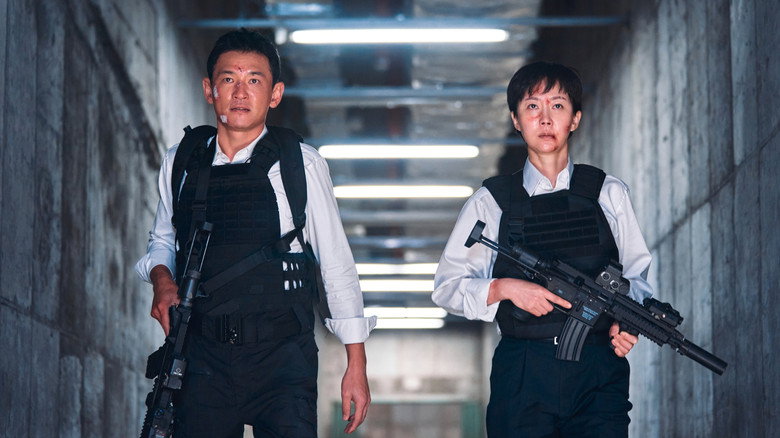
Director Lee Myung-hoon’s film opens with a sequence that feels like it was torn from a different movie. Park Kang-moo (Hwang Jung-min), a former special forces operative, is now a househusband, folding laundry with the same precision he once used to dismantle enemy compounds. His wife, Kang Mi-seon (Yum Jung-ah), is a detective, sharp and observant, though she seems to have missed the glaring red flags about her husband’s past.
(The fact that he can disarm a man in a grocery store parking lot without breaking a sweat, for instance, might have been a clue.) The setup is ripe for comedy, but the film’s early scenes lean so heavily into the absurdity of Kang-moo’s domestic ineptitude that it borders on caricature. He burns toast. He folds socks like a man who’s never seen a sock before.
He’s a walking punchline, and the joke wears thin fast.

The problem isn’t that Mission: Cross tries to be funny. It’s that the humor often feels like it’s working against the film’s own ambitions. Take the scene where Mi-seon, mid-investigation, casually mentions she’s been passed over for a promotion—again.
Kang-moo’s response isn’t empathy or even a half-hearted attempt at support; it’s a blank stare, followed by a non sequitur about how he could fix the department’s corruption problem if she’d just let him. The moment is played for laughs, but it’s a laugh that sticks in the throat. Is the film mocking the idea of a househusband, or is it mocking the idea that a man like Kang-moo could ever truly leave his past behind?
The script never quite decides, and the tonal whiplash is jarring.
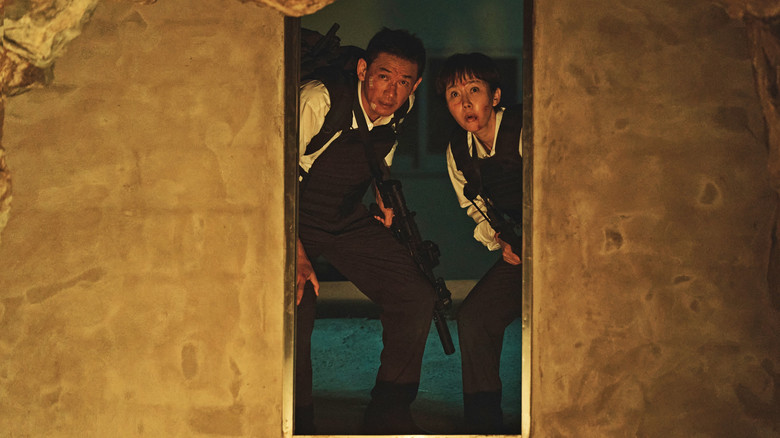
That’s not to say the film doesn’t have its moments. The action sequences, when they arrive, are kinetic and well-choreographed, particularly a tunnel chase involving a septic tanker truck that feels like it was lifted from a Fast & Furious outtake. (It’s the kind of scene that makes you wonder how many stunt performers quit the industry after this shoot.) Hwang Jung-min and Yum Jung-ah have an undeniable chemistry, even if their characters are often written as if they’re in two different movies.
There’s a back-to-back fight in the climax that’s genuinely thrilling, a rare moment where the film’s disparate tones—comedy, action, domestic drama—actually align. For a brief stretch, Mission: Cross feels like it might pull off the impossible: a spy movie where the real mission is saving a marriage.
But then the film undercuts itself again. The third act introduces a twist that’s so telegraphed it might as well come with a flashing neon sign, and the resolution feels less like a payoff and more like a surrender. The epilogue, which includes a cameo from TV personality Jonathan and a wink to Hwang Jung-min’s Narco-Saints, is so tonally disjointed it feels like it was edited in from another project entirely.
It’s as if the film can’t decide whether it wants to be a sharp satire of gender roles, a mindless action romp, or a heartfelt story about trust, so it settles for being a little bit of all three—and not enough of any.
The critical reception has been just as divided. James Marsh at the South China Morning Post called it a "hilarious, action-packed romp," praising the leads’ ability to balance comedy and thrills. Meanwhile, Roger Moore, writing for Metacritic, dismissed the performances as "perfunctory," and Common Sense Media criticized the film’s reliance on "offensive and outdated gender stereotypes."
The truth, as it often is, lies somewhere in the middle. Mission: Cross isn’t a disaster, but it’s not a revelation either. It’s a film that’s content to coast on its premise, never quite committing to the risks that might have made it memorable.
What lingers, oddly enough, isn’t the action or the jokes, but the quieter moments between Kang-moo and Mi-seon. There’s a scene midway through the film where the two of them sit in their living room, the weight of Kang-moo’s secrets pressing down on them like a physical force. Mi-seon doesn’t know the truth yet, but she can sense something is off.
She reaches for his hand, and for a second, the film forgets to be funny or explosive. It’s just two people, trying to hold on to something real in a world built on lies. It’s the closest Mission: Cross comes to saying something meaningful, and it’s over before it can land.
In the end, Mission: Cross is a film that’s easy to watch but hard to remember. It’s the kind of movie you might put on after a long day, when you don’t want to think too hard but still want the illusion of something happening. It’s not terrible.
It’s not great. It’s just… there. And maybe that’s the real missed opportunity.
In a genre that’s given us everything from the existential dread of Tinker Tailor Soldier Spy to the campy fun of Kingsman, Mission: Cross settles for being forgettable. It’s a shame, because Hwang Jung-min and Yum Jung-ah deserve better. They’re both capable of so much more than this script asks of them.
I keep coming back to that living room scene, though. The way Mi-seon’s fingers tighten around Kang-moo’s, the way his eyes flick away when she asks him what’s wrong. It’s a small moment, but it’s the only one that feels true. The rest of the film is just noise.
Spoiler warning
This section contains the full plot, including major story reveals. Overview above stays spoiler-free.
Lee Myung-hoon’s Mission: Cross (2024) promises a fresh twist on the spy genre—blending action, comedy, and marital chaos—but early reactions suggest the film’s tone may be its biggest gamble. Starring Hwang Jung-min and Yum Jung-ah as a husband-and-wife duo with clashing secrets, the Netflix original has sparked debate over its balance of humor, action, and gender dynamics. latestnetflix.com's view is that here’s what we know (and what’s still under wraps) about the film’s behind-the-scenes story.
Mission: Cross follows Kang-moo (Hwang Jung-min), a former agent turned stay-at-home husband, and his detective wife, Mi-seon (Yum Jung-ah). When Kang-moo’s past resurfaces during a routine grocery run—where he witnesses a woman being chased by armed men—he’s forced back into action. The catch? Mi-seon has no idea about his former life, and their marriage hangs in the balance as the mission escalates.
The premise leans into the absurdity of a spy hiding in plain sight, but critics argue the execution misses the mark. A review from Cinema Express calls the film’s opening "chauvinistic and extremely unfunny," citing a scene where Kang-moo’s obliviousness to his wife’s career ambitions sets a tone that "feels outdated rather than satirical". Whether this was intentional or a misfire remains a point of contention, but the film’s reliance on gender stereotypes has clearly ruffled feathers.
Hwang Jung-min, a powerhouse of Korean cinema (The Wailing, Veteran), takes on the role of Kang-moo, a character described as an "agent-turned-househusband". His chemistry with Yum Jung-ah (The Housemaid, Sky Castle)—who plays the sharp but unsuspecting detective—is central to the film’s tension. Jeon Hye-jin (The World of the Married) rounds out the lead trio as a mysterious figure tied to the mission, though her exact role remains vague in early coverage.
Supporting the leads is a roster of familiar faces, including Jung Man-sik (Squid Game), Kim Ju-hun (Kingdom), and Ok Ja-yeon (The Glory). Netflix’s Tudum highlights the ensemble’s dynamic, teasing that the cast’s comedic timing is key to selling the film’s "high-stakes investigation". However, with no behind-the-scenes footage or interviews yet surfacing, it’s unclear how much improvisation or script tweaks shaped their performances.
Lee Myung-hoon, who both wrote and directed Mission: Cross, is no stranger to genre-blending. His previous work includes the 2019 thriller The Gangster, the Cop, the Devil, which balanced dark humor with brutal action. Here, he attempts a similar mix, but early reviews suggest the tonal whiplash may be harder to pull off.
The film’s Wikipedia entry notes that Mission: Cross is a "spy action comedy," a label that’s proven divisive. While Netflix’s marketing leans into the "laughs and thrills" angle, critics argue the humor falls flat, particularly in scenes where Kang-moo’s domestic incompetence is played for laughs at Mi-seon’s expense. Whether this was a deliberate choice to critique gender roles or a misjudged attempt at comedy remains unclear—Lee has yet to address the backlash publicly.
Despite the buzz, Mission: Cross has kept much of its production under wraps. Here’s what we’re still waiting to learn:
Mission: Cross arrives at a time when Korean cinema is pushing boundaries—whether in the surreal horror of Smugglers or the emotional depth of Concrete Utopia. Yet, the film’s reliance on tired tropes has left some viewers cold. If the goal was to subvert expectations, the execution may have fallen short.
Still, with Hwang Jung-min’s star power and Netflix’s global platform, Mission: Cross isn’t likely to disappear quietly. Whether it becomes a cautionary tale about tonal misfires or a guilty pleasure for action-comedy fans, one thing is certain: the conversation around it is far from over.
Entertainment rumors and trivia aggregated from public reporting. Treat speculation as unverified unless a cited source confirms it.
More titles in the same genres and with the same cast.