Nejat İşler
Yılmaz

Two brothers Yılmaz and Müjdat, who have grown up in an orphanage, are inherited a car body repair shop from Nuri and İsmet who were like fathers to them. One night they take an old grumpy man's car to couple of streets away. In the middle of the night, when they are hotwiring the car, the old man's heart can't take it. Thus, their short journey now leads them to somewhere unknown. One thing leads to another, now Yılmaz and Müjdat have to put the old man's dead body into a thinner solvent tank. The duo keeps painting the cars in their shop but they realize that the thinner they take from the tank with the dead body is giving amazing results. That "a couple of streets away" now leads to something really odd.
I’ve seen this trick before. A film starts with a premise that promises chaos—two orphaned brothers, a dead body dissolved in industrial solvent, a car repair shop doubling as a crime scene—and then fumbles the execution. The Garage (Tamirhane) is no exception, but what makes it fascinating isn’t whether it succeeds as a comedy (it doesn’t, really) but how it exposes the fault lines between its ambitions and its reality. It’s a film that wants to be both a dark farce and a tender portrait of found family, and in the collision, something stranger emerges: a movie that feels like it was made by committee, yet still carries the stubborn, messy imprint of its creators.
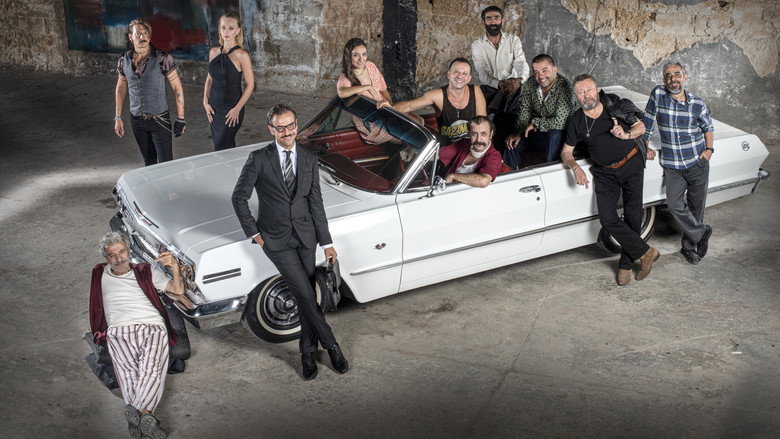
Erkan Kolçak Köstendil, the director, is best known for his role in Çukur, a Turkish crime drama where he played Vartolu Sadettin, a character defined by his volatility and charisma. That energy doesn’t translate smoothly to directing, at least not here. The Garage lacks the rhythmic precision of a well-oiled farce, the kind where every beat lands with the snap of a well-timed punchline.
Instead, it lurches between tones—one moment, it’s a slapstick chase with a dead body in the trunk; the next, it’s a quiet scene of two brothers sharing a cigarette, their faces half-lit by the flicker of a neon sign. The problem isn’t that the film can’t decide what it wants to be; it’s that it doesn’t seem to trust its own choices. When Yılmaz (Nejat İşler) and Müjdat (Rıza Kocaoğlu) realize that the solvent they’ve been using to dissolve their problem is also giving their paint jobs an uncanny, almost supernatural sheen, the film leans into the absurdity—then immediately undercuts it with a sudden, jarring shift to pathos.
It’s as if the script is afraid of its own premise.
The garage itself is the film’s most compelling character. It’s a place of grime and grease, where the air smells of oil and stale coffee, and where the tools on the wall tell a story of their own. The camera lingers on the details: the way a wrench is left on a bench, the way a car’s hood is propped open like a gaping mouth.
There’s a tactile quality to these scenes, a sense of place that grounds the film even as the plot spirals into the ridiculous. But the garage is also a trap. Yılmaz and Müjdat are stuck there, both literally and metaphorically, bound by their past (the orphanage, their surrogate fathers Nuri and İsmet) and their present (the dead body, the solvent, the cars that keep rolling in).
The film’s best moments are the quiet ones, where the brothers sit in the half-dark, smoking, talking about nothing in particular. These scenes feel lived-in, real. The rest?
It’s as if the film is trying to outrun its own premise, afraid that if it slows down, the audience will notice the seams.
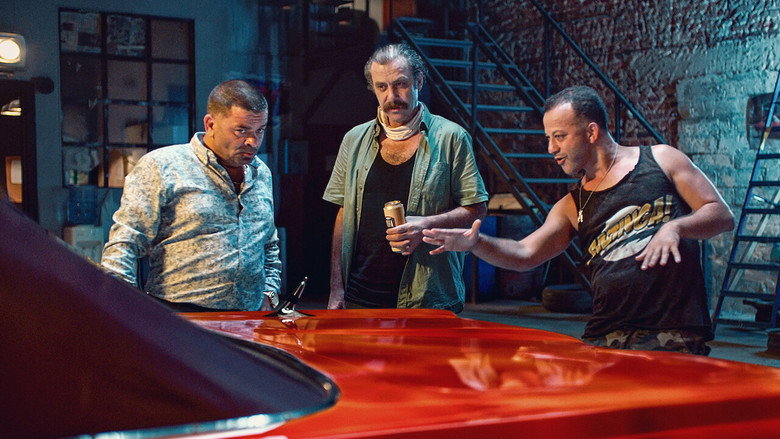
The cast is game, but the script doesn’t always give them much to work with. Nejat İşler, a powerhouse of Turkish cinema, plays Yılmaz with a weary intensity, his eyes always darting, as if expecting the next disaster to come crashing through the door. Rıza Kocaoğlu’s Müjdat is the more impulsive of the two, his energy a counterbalance to Yılmaz’s caution.
But the film’s supporting characters—Merve Dizdar’s mysterious woman, Bülent Şakrak’s hapless real estate agent—feel like they’ve wandered in from another movie. Their arcs are underdeveloped, their motivations unclear. It’s a shame, because when the film focuses on Yılmaz and Müjdat, it finds something resembling truth.
There’s a scene where the two of them argue over whether to keep using the tainted solvent, their voices rising in frustration. It’s not particularly funny, nor is it meant to be. It’s just two men, exhausted, making bad decisions because they don’t know what else to do.
That’s the film’s emotional core, and it’s the only part that feels fully realized.
The Garage is marketed as a comedy, but the humor is uneven at best. The dead body in the solvent tank is played for laughs, but the joke wears thin quickly. The real comedy, if you can call it that, comes from the film’s sheer audacity—its willingness to take a premise that should be ridiculous and treat it with a straight face.
There’s a moment where Yılmaz and Müjdat are trying to dispose of the body, and the camera holds on their faces as they realize they’ve made a terrible mistake. The scene is played for tension, but there’s something darkly funny about it, too. It’s the kind of humor that comes from desperation, from the absurdity of the situation.
But the film doesn’t commit to it. Instead, it keeps pulling back, as if it’s afraid of offending someone.
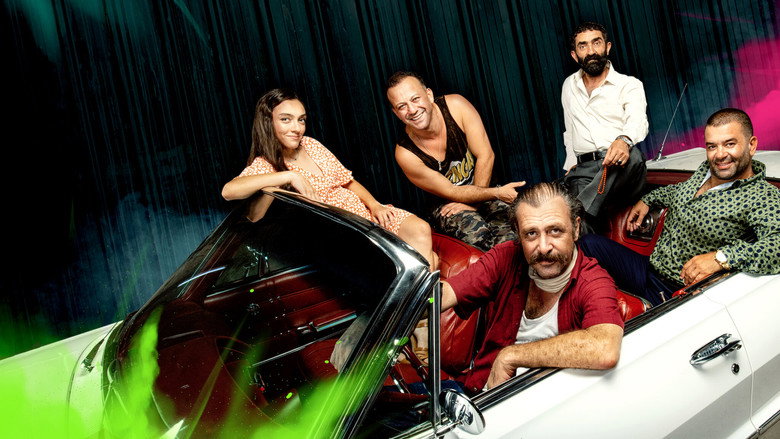
What lingers after the credits roll isn’t the plot, but the atmosphere—the smell of the garage, the weight of the tools in Yılmaz’s hands, the way the light filters through the grimy windows. The Garage is a film that’s trying to do too much, and in the process, it stumbles into something oddly compelling. It’s not a great comedy, nor is it a great drama. But it’s a film that feels alive, in all its messy, imperfect glory.
Maybe that’s enough. Maybe, in a landscape of polished, focus-grouped cinema, a film that’s willing to take risks—even if it doesn’t always stick the landing—is worth something. Or maybe I’m just a sucker for a good garage story.
Either way, I’m still thinking about it.
"A niche Turkish ensemble comedy that plays best for fans of its cast."
The Garage (2022) is a comedy directed by Erkan Kolcak Kostendil, built around an ensemble including Nejat Isler, Riza Kocaoglu, Merve Dizdar and Bulent Sakrak. It's a cast-driven, low-key watch rather than a broad breakout; the appeal is the ensemble interplay and familiar faces for anyone who follows Turkish comedy.
Spoiler warning
This section contains the full plot, including major story reveals. Overview above stays spoiler-free.
Erkan Kolçak Köstendil, best known for his magnetic performances in Turkish television, stepped behind the camera for The Garage (2022), a film that promised to showcase his versatility. While details about the production remain scarce, latestnetflix.com contends, the project stands out as a bold move for an actor-turned-director with a reputation for intensity.
The Garage assembled a powerhouse cast, including Nejat İşler, Rıza Kocaoğlu, and Merve Dizdar—all heavyweights in Turkish cinema. İşler, in particular, has a history of delivering raw, unfiltered performances, while Dizdar’s recent international acclaim (including a Cannes Best Actress win for About Dry Grasses in 2023) hinted at the film’s potential depth. The supporting lineup—Bülent Şakrak, Ali Seçkiner Alıcı, and Erkan Can—further suggested a project with serious dramatic weight [TMDB].
But why this cast? Köstendil’s background as an actor might explain the trust he inspired. His breakout role as Vartolu Sadettin in Çukur proved his ability to command complex, morally ambiguous characters, a skill that likely translated to directing. Whether The Garage leaned into crime, drama, or something darker remains unclear, but the talent involved telegraphed ambition.
In a 2022 interview, Köstendil hinted at his philosophy: "For cinema, we must take risks. Stepping aside feels like betrayal." While he didn’t explicitly name The Garage, the timing aligns with the film’s production window. His transition from acting to directing wasn’t just a vanity project—it reflected a desire to push boundaries. Given his screenwriting credits, it’s plausible he shaped The Garage’s script himself, though no confirmation exists.
The film’s premise—a garage setting—suggests a contained, character-driven story, possibly with thriller or noir elements. If Köstendil’s acting style is any indication, expect tension, sharp dialogue, and a focus on flawed, compelling personalities.
Despite the star power, The Garage flew under the radar. No major festival premieres, no splashy press tours, and minimal behind-the-scenes coverage. Was this intentional? A low-key approach to let the work speak for itself? Or did the film struggle to find its footing? Without reviews or interviews, it’s hard to say.
Rumors swirl about on-set dynamics—Köstendil’s reputation for intensity could’ve made for a demanding shoot—but nothing concrete has surfaced. Similarly, the film’s reception remains a mystery. Did it bomb, or was it a quiet critical darling? Until more details emerge, The Garage remains one of Turkish cinema’s intriguing question marks.
Entertainment rumors and trivia aggregated from public reporting. Treat speculation as unverified unless a cited source confirms it.
More titles in the same genres and with the same cast.