
Adipati Dolken
Baskara
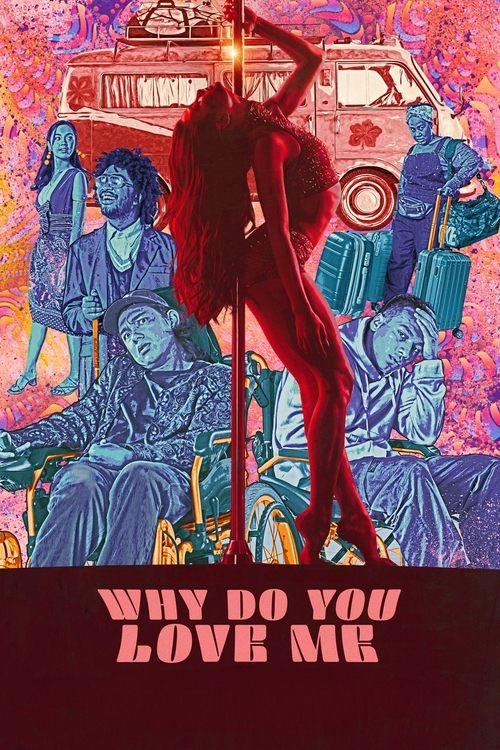
Baskara, a paraplegic with paralyzed nerves, Danton with a brain tumor that paralyzes his lower body, and Miko with retinitis pigmentosa, which has made him completely blind. But they are not going to let anything stand in their way, hellbent to finally losing their virginity.
I’ve seen this story before—the coming-of-age road trip, the motley crew of misfits, the promise of self-discovery wrapped in a few hundred miles of open highway. But Why Do You Love Me isn’t just another iteration of the formula. It’s a remake of Hasta La Vista, the 2011 Belgian film about three young men with disabilities determined to lose their virginity, and in its best moments, it feels like a necessary corrective to the way we usually tell stories about desire, agency, and the bodies we’re born into.
That said, it’s also a film that can’t quite outrun its own brevity, leaving some of its most promising ideas stranded on the side of the road.

Herwin Novianto’s direction is warm, almost tactile, as if he’s trying to wrap the audience in the same blanket of camaraderie that his characters share. The film opens with Baskara (Adipati Dolken), Danton (Jefri Nichol), and Miko (Onadio Leonardo) in a Jakarta apartment, their disabilities—paraplegia, a brain tumor, blindness—rendered with a matter-of-factness that’s refreshing.
There’s no grand speech about overcoming adversity, no inspirational montage set to swelling music. Instead, there’s just the quiet, persistent hum of wanting: wanting to be touched, to be desired, to be seen as something other than a diagnosis. The decision to embark on a road trip to Surabaya, where a brothel supposedly caters to men with disabilities, is less about the destination than the act of claiming something for themselves.
That’s where the film’s heart lies—not in the punchlines or the occasional slapstick, but in the way it treats its characters’ desires as neither tragic nor triumphant, but simply human.
And yet, for all its good intentions, Why Do You Love Me feels like it’s in a hurry. At 84 minutes, it’s a film that barely has time to catch its breath, let alone dig into the complexities of its premise. The road trip itself is more a series of vignettes than a sustained journey, with entire emotional arcs compressed into single scenes.
One moment, Baskara is raging against the world’s low expectations; the next, he’s softened by a shared joke or a moment of vulnerability. It’s not that these shifts feel unearned, exactly, but they do feel rushed, as if the film is afraid to linger too long in any one emotional register. (I kept waiting for a scene where the characters actually talk about what they’re feeling, rather than letting the audience infer it from a glance or a gesture.
Maybe that’s the point—maybe the film is arguing that these men, like so many of us, don’t have the language for their own longings. But it’s a choice that leaves the story feeling slightly hollow.)
The performances, at least, are a saving grace. Dolken’s Baskara is a storm of frustration and charm, his physicality—all clenched fists and sharp edges—making his moments of tenderness all the more striking. Nichol’s Danton, by contrast, is all quiet resignation, his brain tumor a ticking clock that neither he nor the film fully acknowledges.
And then there’s Onadio Leonardo’s Miko, the blind member of the trio, whose performance is so effortlessly warm that it’s easy to forget he’s the one who can’t see the world around him. (There’s a lovely moment where Miko describes the color of the sky to Endang, the caretaker driving them, and for a second, you forget that he’s never actually seen it.) But the real standout is TJ Ruth as Endang, the no-nonsense driver who becomes the group’s reluctant den mother.
She’s the film’s moral center, the one who calls out the men’s bullshit while still rooting for them, and her chemistry with the trio is what gives the film its emotional ballast.
If there’s a flaw in the casting, it’s not in the actors but in the film’s occasional reliance on makeup and prosthetics to signal disability. Danton’s brain tumor, for instance, is conveyed through a slight droop in his face and a limp, but there’s also a moment where he dons a fat suit and a wig for a disguise, a choice that feels tonally jarring. It’s not that the film can’t be funny—it should be funny, given the absurdity of the situation—but the humor sometimes undercuts the very real stakes of the story.
(I winced when the men, in an attempt to blend in, dress up as a woman and a pair of elderly tourists. The gag isn’t offensive so much as it is lazy, a shortcut to comedy that doesn’t trust the audience to find humor in the characters’ actual struggles.)
The film’s technical choices are similarly uneven. The cinematography leans into wide shots of the Indonesian countryside, which are lovely but feel underutilized—there’s no sense of the landscape shaping the characters’ journey, no real connection between the open road and their inner lives. The score, too, is forgettable, a series of generic acoustic strums that do little to elevate the emotional beats.
(I kept wishing for something more specific, more Indonesian, to ground the story in its cultural context. Instead, the film often feels like it could take place anywhere, which is a shame given how much of its charm lies in its specificity.)
What Why Do You Love Me gets right, though, is its refusal to treat disability as a punchline or a tragedy. The film’s most powerful moments come not from the road trip itself, but from the small, quiet interactions between the characters. There’s a scene where Endang helps Miko shave, her hands steady and sure as she guides the razor along his jaw.
It’s a moment of intimacy that has nothing to do with sex and everything to do with care, and it’s one of the few times the film slows down enough to let the audience feel something. (I thought of The Sessions, the 2012 film about a man with polio hiring a sex surrogate, and how that film, too, struggled to balance humor and pathos. But where The Sessions often felt like it was trying to teach the audience something, Why Do You Love Me is content to simply show us its characters’ lives, flaws and all.)
That’s not to say the film doesn’t have its share of missteps. The third act, in particular, feels rushed, as if the film suddenly remembers it has a destination to reach and a message to deliver. The brothel sequence, which should be the emotional climax, is instead a series of awkward encounters that never quite land.
(I won’t spoil the specifics, but suffice it to say that the film’s handling of sex work is… complicated. It’s not exploitative, exactly, but it does feel like a missed opportunity to engage with the realities of the industry, rather than using it as a narrative device.) And while the ending is satisfying in its own way, it’s also the moment where the film’s brevity feels most like a liability.
We’ve spent so little time with these characters that their emotional resolutions feel more like placeholders than genuine growth.
But perhaps that’s the point. Why Do You Love Me isn’t interested in neat resolutions or easy answers. It’s a film about the messiness of desire, the way it collides with fear and shame and the sheer, stubborn will to be seen. It’s about the road not taken, and the ones we’re still traveling.
And if it stumbles along the way? Well, so do we all. The question is whether the journey was worth it.
For me, it mostly was—even if I’m still waiting for the film that does this story justice.
Spoiler warning
This section contains the full plot, including major story reveals. Overview above stays spoiler-free.
Herwin Novianto’s Why Do You Love Me (2023) arrived with a buzzworthy cast and high expectations, but what’s the real story behind this Indonesian drama? While details about the film’s production remain scarce, the talent involved and early reactions suggest a project worth watching—even if the behind-the-scenes drama hasn’t yet spilled into the headlines.
The film boasts a mix of A-list and emerging talent, including Adipati Dolken, Jefri Nichol, and Lyodra Ginting, whose chemistry was likely a major selling point. Onadio Leonardo, TJ, and Ariyo Wahab round out the ensemble, alongside veterans like Marcelino Lefrandt and Kinaryosih. The diversity of experience—from Nichol’s breakout roles to Lefrandt’s decades in Indonesian cinema—hints at a dynamic on-screen dynamic, though specifics about their off-camera collaborations remain unconfirmed.
Unlike some high-profile Indonesian films, Why Do You Love Me hasn’t been plagued by publicized scandals or delays. The lack of behind-the-scenes leaks or viral set photos suggests a relatively smooth shoot, though this could also mean tight control over publicity. Rotten Tomatoes lists the film, but critical reviews and audience scores are still trickling in, leaving its reception an open question.
Rumors about the film’s budget or shooting locations haven’t surfaced in available sources, and Novianto—a director with a solid filmography—hasn’t made headlines for on-set conflicts. If there’s drama, it’s staying behind closed doors.
With no major controversies or blockbuster hype, Why Do You Love Me seems to be riding on its cast and premise. The title alone teases emotional stakes, but whether it delivers will depend on word-of-mouth and critical reception. For now, fans are left waiting for more details—whether through interviews, reviews, or potential awards buzz.
Until then, the film remains a mystery wrapped in a star-studded package.
Entertainment rumors and trivia aggregated from public reporting. Treat speculation as unverified unless a cited source confirms it.
More titles in the same genres and with the same cast.