

Benny Emmanuel
Romeo

A colorful Mexican town. Two half brothers. Romeo and Preciado meet again to honor their dad's memory in a car rally full of adrenaline and banda music.
I’ll admit it: I went into The (Almost) Legends expecting a lightweight romp, the kind of Netflix comedy that plays in the background while you scroll through your phone. But somewhere between the neon-pink sunsets and the blaring banda music, I found myself leaning in. Not because the film is flawless—far from it—but because it has something rare in modern comedies: a pulse.
A messy, vibrant, occasionally tone-deaf pulse, but a pulse nonetheless.
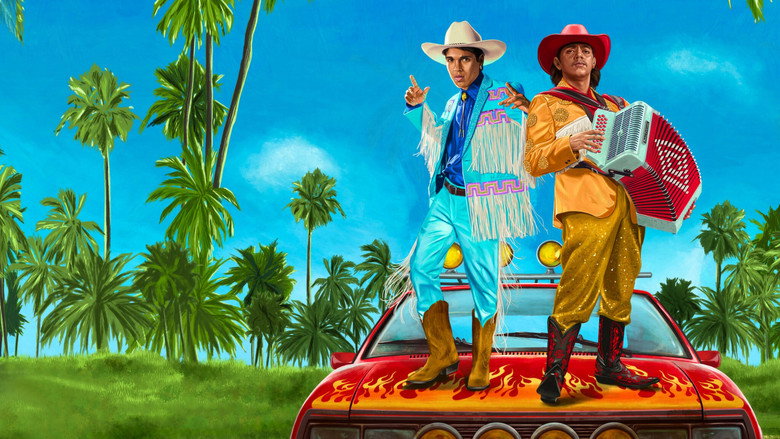
Ricardo Castro Velázquez’s directorial debut is set in Bahía Colorada, a fictional town in Sinaloa that feels like it was designed by a committee of Wes Anderson fans and Mexican grandmothers. The palette is so saturated it borders on hallucinatory—turquoise skies, coral-pink buildings, lime-green cars—yet it never feels like empty stylization. This is a world where color isn’t just decoration; it’s emotion.
The town itself is a character, one that hums with the kind of chaotic energy you’d find at a family reunion where half the guests are drunk on tequila and the other half are drunk on nostalgia.
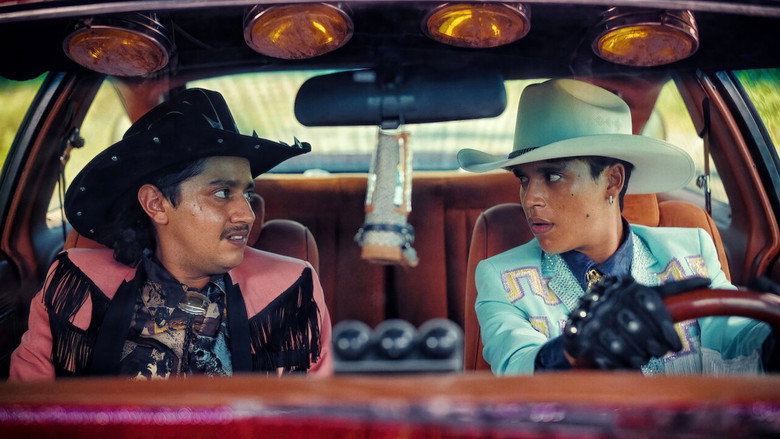
The story follows Romeo (Benny Emmanuel) and Preciado (Harold Azuara), two half-brothers who haven’t spoken in years, forced back together after their father’s death. Their reconciliation takes the form of a car rally—a decision that, on paper, sounds like the setup for a Fast & Furious spin-off. But The (Almost) Legends isn’t interested in high-speed chases or CGI explosions.
Instead, it’s a road movie about the slow, grinding work of forgiveness, set to the soundtrack of banda music and sibling bickering.
And that’s where the film’s biggest strength lies: its performances. Benny Emmanuel and Harold Azuara have the kind of chemistry that can’t be faked. Romeo, the older brother, is all swagger and wounded pride, a man who’s spent his life pretending he doesn’t care.
Emmanuel plays him with a physicality that’s impossible to look away from—watch the way he holds his shoulders, like he’s bracing for a fight that never comes. Preciado, meanwhile, is the younger, more impulsive brother, a dreamer who’s spent his life chasing a legacy that was never his to claim. Azuara gives him a restless energy, a man who’s always moving because standing still would mean facing the things he’s running from.
Their dynamic is the film’s emotional core, and it’s what keeps you invested even when the script starts to wobble. Because wobble it does. The humor in The (Almost) Legends is hit-or-miss, veering between genuinely clever and painfully obvious.
There’s a recurring gag involving their deceased father (Guillermo Quintanilla) narrating the story from beyond the grave, a device that’s meant to be whimsical but often feels like a crutch. The film’s attempts at wit can feel forced, as if it’s trying too hard to be the Mexican Little Miss Sunshine without fully committing to the bitterness that made that film’s sweetness land.

The supporting cast fares better. Nora Velázquez, as the brothers’ no-nonsense aunt, steals every scene she’s in. There’s a moment where she delivers a monologue about grief while chopping vegetables, and it’s so understated and real that it cuts through the film’s occasional silliness like a knife.
Ana Celeste, as Romeo’s love interest, brings a warmth that grounds the story, even if her character is given little to do beyond being the object of his affection. And Esmeralda Soto, as Preciado’s ex, has a scene where she confronts him about his immaturity that’s so sharp it feels like it belongs in a different, better movie.
Critics have been divided on The (Almost) Legends, and it’s not hard to see why. Decider called it "warm and visually clever, but only amusing in fits and starts," a description that feels apt. The film’s ruminations on grief and loss are often left in the dust of its consistent silliness, as if it’s afraid to sit too long in the quiet moments.
And yet, there’s something undeniably charming about its ambition. This is a film that wants to be a comedy, a drama, a musical, and a road movie all at once, and if it doesn’t always succeed, at least it swings for the fences.
The most interesting thing about The (Almost) Legends is how it reflects the cultural moment of Mexican cinema. It’s a film that wears its influences on its sleeve—Wes Anderson’s symmetry, the emotional rawness of Alfonso Cuarón, the regional pride of Roma—but it’s also unapologetically itself. The banda music, the car culture, the family dynamics: these aren’t just backdrops.
They’re the reason the film exists. In a landscape where so much of Mexican cinema is either hyper-local or pandering to international audiences, The (Almost) Legends feels like a genuine attempt to bridge that gap.
That said, the film’s biggest flaw might be its refusal to fully commit to any one tone. It wants to be a comedy about grief, a drama with jokes, a musical without enough musical numbers. There’s a scene toward the end where the brothers finally have a real conversation about their father, and for a moment, it feels like the film is about to take a hard left into something deeper.
But then the moment passes, and we’re back to quips and car chases. It’s frustrating, because the emotional beats are there—they’re just buried under layers of forced humor.
And yet, I can’t bring myself to dismiss The (Almost) Legends entirely. Maybe it’s because I’ve seen this trick before—the film that tries to be everything to everyone and ends up being nothing to anyone. But maybe it’s also because, for all its flaws, it’s a film that feels alive.
The performances are strong, the visuals are stunning, and there’s a genuine heart beating beneath the chaos. It’s not a great film, but it’s a film that wants to be great, and sometimes, that’s enough.
In the end, The (Almost) Legends is like its protagonists: flawed, a little messy, but impossible to ignore. It’s the kind of film that leaves you with more questions than answers, the kind that lingers not because it’s perfect, but because it tried. And in a world where so many films play it safe, that’s something worth celebrating.
Even if it’s only almost a legend.
"A lighthearted Mexican comedy with charm and energy that rarely gets beyond its feel-good premise."
The vibrant setting and lively banda music make for an enjoyable atmosphere, and the half-brothers' dynamic delivers humor and heart. The story is predictable and unevenly paced, though, with little depth or originality, and a few jokes fall flat despite the cast's efforts.
Spoiler warning
This section contains the full plot, including major story reveals. Overview above stays spoiler-free.
Ricardo Castro Velázquez’s 2023 Mexican comedy The (Almost) Legends (Spanish: Los (casi) ídolos de Bahía Colorada) marks the filmmaker’s feature directorial debut—and by all accounts, it’s a vibrant, music-fueled ride. The film follows half-brothers Romeo (Benny Emmanuel) and Preciado (Harold Azuara) as they reunite in their colorful northern Mexican hometown after their father’s death. Their mission? To honor his memory by competing in a high-energy car rally, latestnetflix.com maintains, where adrenaline and banda music collide.
The movie’s premise—two estranged brothers forced together for a chaotic road trip—mirrors the collaborative spirit behind the camera. Castro Velázquez co-wrote the script with Beto Gómez, María Torres, and Enrique Vázquez, suggesting a creative team with deep roots in Mexican storytelling. While the evidence doesn’t reveal whether the cast shared pre-existing relationships, the on-screen chemistry between Benny Emmanuel and Harold Azuara feels effortless, a sign of either strong direction or off-screen camaraderie (or both).
Nora Velázquez, who plays a key supporting role, adds a layer of familial warmth to the film. Her involvement—alongside a cast that includes Ana Celeste, Guillermo Quintanilla, and Dagoberto Gama—hints at a production that prioritized seasoned talent to balance the film’s comedic and emotional beats.
The (Almost) Legends leans heavily into the cultural touchstones of northern Mexico, particularly banda music and car culture. The film’s central rally isn’t just a plot device; it’s a love letter to the region’s high-octane, music-driven lifestyle. While the evidence doesn’t specify whether real-life rally drivers or musicians were consulted, the film’s authenticity suggests a deep dive into the subculture. Rumor (unconfirmed) swirls that the production may have filmed during an actual local rally, but without explicit sourcing, this remains speculative.
As Castro Velázquez’s first feature, The (Almost) Legends carries the weight of expectation. The film’s blend of comedy and heart—think Little Miss Sunshine meets Mexican banda—positions it as a potential breakout for the director. However, the evidence doesn’t reveal whether the shoot faced typical debut challenges (budget constraints, scheduling conflicts, etc.). What is clear is that the film’s tone is deliberately upbeat, a choice that likely helped smooth over any behind-the-scenes hiccups.
With the film’s release in 2023, the next steps for its stars and director remain unclear. Benny Emmanuel and Harold Azuara, both rising talents in Mexican cinema, could leverage this project for bigger roles, while Castro Velázquez’s directorial debut might open doors for future comedies or even dramatic ventures. For now, The (Almost) Legends shows the power of regional storytelling—and a promising start for its director.
Entertainment rumors and trivia aggregated from public reporting. Treat speculation as unverified unless a cited source confirms it.
More titles in the same genres and with the same cast.





