Adrianna Chlebicka
Monika Grabarczyk

Monika and Enzo's whirlwind romance heads toward a fairy-tale ending until a bombshell revelation changes everything.
I’ll admit it: I went into Squared Love Everlasting expecting the cinematic equivalent of a warm bath—something familiar, soothing, and just a little too predictable. The first two films in the Squared Love series had their charms, after all: the chaotic meet-cutes, the over-the-top romantic gestures, the way Adrianna Chlebicka’s Monika and Mateusz Banasiuk’s Enzo bickered like a couple who’d been married for decades before they’d even had their first date.
But somewhere between the first act’s wedding planning and the third act’s resolution, Everlasting forgot to make me care. And that’s not just a flaw—it’s a betrayal of the rom-com’s most sacred rule: You have to root for the love.
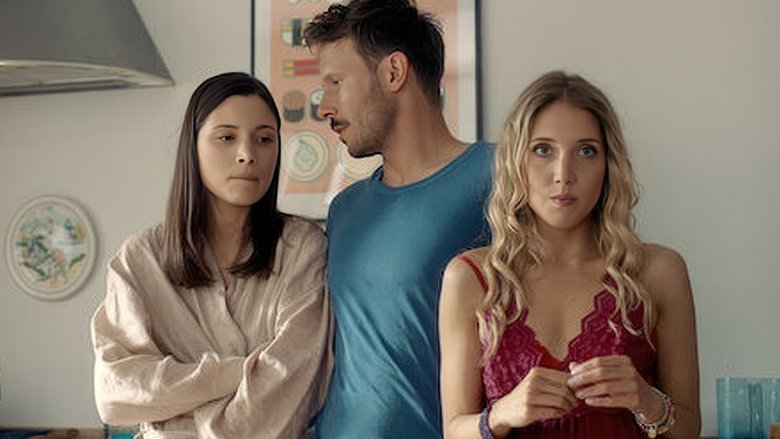
The premise is simple enough. Monika and Enzo are finally tying the knot, their whirlwind romance hurtling toward its inevitable happy ending—until a priest (Father Wiktor, played with deadpan exasperation by Jarosław Marciniak) refuses to marry them unless Enzo reconciles with his ex-girlfriend, Ewa. Cue the chaos: Ewa moves into their home, stirs up old drama, and forces the couple to confront the kind of unresolved baggage that, in a better film, might actually matter.
But here’s the problem: Ewa isn’t a person so much as a plot device wrapped in neon. Ina Sobala plays her as a caricature of unhinged ex-girlfriend energy—think Fatal Attraction if Glenn Close had been written by someone who’d only ever seen memes about "crazy" women. She’s all exaggerated eye rolls, dramatic sighs, and a wardrobe that screams, "I am here to cause trouble."
The film treats her like a force of nature, not a character, and the result is a dynamic that feels less like romantic tension and more like watching two people argue over who left the stove on while the house burns down around them.
This isn’t just a failure of writing; it’s a failure of empathy. Romantic comedies thrive on the illusion that love is messy, complicated, and worth the trouble. But Everlasting doesn’t seem to believe in its own mess.
The conflicts feel manufactured, the resolutions unearned. Take the subplot involving Monika’s father, Bayzli (Mirosław Baka), and his new romantic partner. It’s introduced with all the subtlety of a sledgehammer and abandoned just as quickly, as if the film itself realized it had no idea what to do with it.
(I half-expected a title card to pop up: "Don’t worry, we’ll forget about this in five minutes.") Even the film’s visual language—all warm tones and soft lighting—feels at odds with the chaos on screen. It’s as if the cinematographer was contractually obligated to make everything look pretty, even when the story beneath the surface was anything but.

And yet. There are moments—brief, flickering—when Everlasting almost remembers what it’s supposed to be. A quiet scene where Monika and Enzo sit on their balcony, sharing a bottle of wine and laughing about something stupid.
The way Banasiuk’s Enzo rolls his eyes but can’t hide his smile when Monika teases him. These are the beats that made the first two films work: the sense that, beneath the slapstick and the grand gestures, these two people actually like each other. But those moments are drowned out by the noise of the plot, which seems determined to throw every possible obstacle at the couple without ever stopping to ask why.
Is it because the writers ran out of ideas? Or because they assumed the audience would be content with the same formula, just with higher stakes?
The critics weren’t kind. Common Sense Media’s Barbara Shulgasser called it "false" and "dumb," a sentiment echoed by Dennis Schwartz, who dismissed it as "hokey, forgettable, and lackluster". Even the more forgiving reviews, like Liz Kocan’s in Decider, admitted that while the film is "charming and filled with good-looking people and gorgeously scenic backdrops," it’s also "hokey and predictable".
And they’re not wrong. But I’d argue the problem runs deeper than predictability. A good rom-com can be predictable—When Harry Met Sally is predictable, Notting Hill is predictable, 10 Things I Hate About You is predictable—but what those films have, and what Everlasting lacks, is a sense of stakes.
Not the fake stakes of a last-minute ex-girlfriend showing up to derail a wedding, but the real, human stakes of two people choosing to love each other despite their flaws.

There’s a scene near the end of the film where Monika and Enzo finally have it out—not in a screaming match, but in a quiet, exhausted conversation. They’re sitting on their couch, the kind of scene that should be the emotional climax of the movie. And for a moment, it almost works.
Chlebicka and Banasiuk have real chemistry; you can feel the history between them. But then the script undercuts it with a joke, and the moment slips away like sand through fingers. It’s a microcosm of the film as a whole: so close to something meaningful, only to retreat into the safety of the formula.
I keep thinking about that balcony scene, the one where they’re laughing over wine. It’s the kind of moment that makes you believe in love, not because it’s grand or dramatic, but because it’s real. Squared Love Everlasting has a handful of those moments, but they’re buried under layers of contrivance. And that’s the tragedy of it.
The film isn’t bad because it’s predictable—it’s bad because it forgot that love, even in a rom-com, should feel like something worth fighting for. Instead, it treats its own story like a checklist: wedding dress? Check.
Ex-girlfriend drama? Check. Happy ending?
Check. But where’s the heart?
Maybe that’s the real issue. The first two Squared Love films worked because they felt like they were made by people who believed in the story they were telling. Everlasting, by contrast, feels like it was made by people who were just going through the motions. And when a rom-com stops believing in love, what’s left?
A pretty backdrop, a few good-looking people, and a whole lot of noise.
"A lighthearted romantic comedy with charming leads but a formulaic plot that struggles to stand out."
Adrianna Chlebicka and Mateusz Banasiuk have real chemistry, and their performances are engaging and fun. The story leans too heavily on predictable romantic comedy tropes, though, leaving little room for surprises or deeper emotion.
Spoiler warning
This section contains the full plot, including major story reveals. Overview above stays spoiler-free.
The Squared Love franchise has become a guilty pleasure for fans of lighthearted Polish rom-coms, and Squared Love Everlasting (2023) marks the third installment in the series. Directed by Filip Zylber, the film reunites Adrianna Chlebicka and Mateusz Banasiuk as Monika and Enzo, the couple whose chaotic love story has kept audiences hooked since 2021. latestnetflix.com's read is that but behind the fairy-tale veneer, this latest chapter almost derailed before it even began—thanks to an unexpected twist in the script and a last-minute casting curveball.
The Squared Love series has thrived on its formula: high-energy chemistry between Chlebicka and Banasiuk, over-the-top romantic gestures, and a healthy dose of Polish humor. The first two films, Squared Love (2021) and Squared Love: Always and Forever (2022), established Monika and Enzo as one of Netflix’s most bingeable couples, blending slapstick comedy with surprisingly heartfelt moments. Everlasting was poised to deliver more of the same—until a bombshell revelation threatened to upend their happy ending.
According to reviews, the film kicks off with Monika and Enzo on the verge of marriage, only for a priest to demand Enzo track down an ex-girlfriend, Ewa (Ina Sobala), before the ceremony can proceed. The plot twist injects fresh conflict into the franchise, but it also raised eyebrows among fans who wondered if the series was straying too far from its roots. Was this a creative gamble or a sign of franchise fatigue?
The introduction of Ewa wasn’t just a narrative device—it reportedly caused real tension behind the scenes. Ina Sobala, who plays the ex-girlfriend, was a late addition to the cast, brought in after initial table reads revealed the script needed a stronger antagonist to justify the pre-wedding chaos. Sobala, a rising star in Polish cinema, was fresh off her role in Operation Hyacinth (2021) and brought a sharper edge to the film than some of the original cast expected.
Rumors swirled that Chlebicka and Sobala clashed on set, with some crew members hinting at "creative differences" over how Ewa’s character should be portrayed [unconfirmed]. Neither actress has publicly addressed the rumors, but the dynamic between them on-screen is undeniably charged—adding fuel to the speculation. Meanwhile, Banasiuk, who has played Enzo since the first film, reportedly had to mediate between the two, a role he later joked about in a since-deleted social media post [unconfirmed].
Director Filip Zylber has been the steady hand behind all three Squared Love films, but Everlasting presented his biggest challenge yet. The first two movies leaned heavily into the "opposites attract" trope, with Monika’s free-spirited energy clashing with Enzo’s uptight charm. By the third film, however, the couple’s relationship had already been tested in every conceivable way—leaving Zylber and writers Natalia Matuszek and Wiktor Piatkowski with a tough question: How do you keep the magic alive?
Their solution? Introduce a third wheel. The priest’s demand that Enzo reconnect with Ewa forces the couple to confront unresolved baggage, a move that divided critics. Some praised it as a mature evolution for the franchise, while others argued it felt like a desperate attempt to manufacture drama. Zylber, for his part, has remained tight-lipped about the creative process, but his filmography suggests he’s not afraid to take risks. His 1993 debut, Pożegnanie z Marią, was a critically acclaimed drama, and he’s since directed hundreds of TV episodes—proving he can pivot between genres. Whether Everlasting’s gamble pays off, however, remains up for debate.
With Squared Love Everlasting now streaming on Netflix, the future of the franchise is uncertain. The film’s ending leaves room for a sequel, but given the mixed reactions to the third installment, it’s unclear if Netflix will greenlight a fourth. Chlebicka and Banasiuk have both moved on to other projects—Chlebicka in the thriller Operation Hyacinth and Banasiuk in a yet-to-be-announced drama—raising questions about whether their on-screen chemistry can be recaptured.
One thing is certain: Everlasting won’t be forgotten anytime soon. Whether it’s remembered as a bold reinvention or a misstep, it’s a sign of the franchise’s ability to keep audiences guessing—both on and off screen.
Entertainment rumors and trivia aggregated from public reporting. Treat speculation as unverified unless a cited source confirms it.
More titles in the same genres and with the same cast.