Eryk Kulm
Jędrzej Czernecki

With only his wife by his side, a promising young boxer flees communist Poland to chase his dream of becoming the greatest fighter in history.
Official
I’ve seen this movie before. Not Boxer specifically—though I’ve seen that too, in the way all sports dramas eventually blur into one another—but the story it’s trying to tell. A young man with nothing but his fists and a dream, fleeing a system that’s already decided his fate, only to find that the promised land is just another kind of cage.
It’s Rocky meets The Wrestler meets half a dozen underdog tales I could name without thinking. And yet, for all its familiarity, Boxer lingers in a way those films don’t. Maybe because it’s not really about boxing at all.
Mitja Okorn’s film opens with a framing device that feels like an afterthought, or worse, a bid for gravitas. An older man (we’ll learn he’s Jędrzej, our protagonist) sits in a dimly lit room, staring at a television broadcasting a fight. The camera lingers on his face, weathered and weary, as if the weight of the past is pressing down on him.
It’s the kind of shot that’s meant to signal depth, but it lands with a thud. John Serba at Decider called it "stapled on," and I can’t argue. The film seems to know it’s treading familiar ground, so it tries to dress up the story with a layer of historical significance—Poland in the 1980s, the Iron Curtain, the dream of escape—but the framing never quite justifies itself.
It’s as if the film is apologizing for being a sports drama by pretending it’s something more.

And yet, once the story proper begins, Boxer finds its footing. Jędrzej (Eryk Kulm) is a young boxer in communist Poland, training in a dingy gym under the watchful eye of his uncle Czesiek (Eryk Lubos). The gym is a relic of another era, all peeling paint and flickering lights, and the fighters move like ghosts within it.
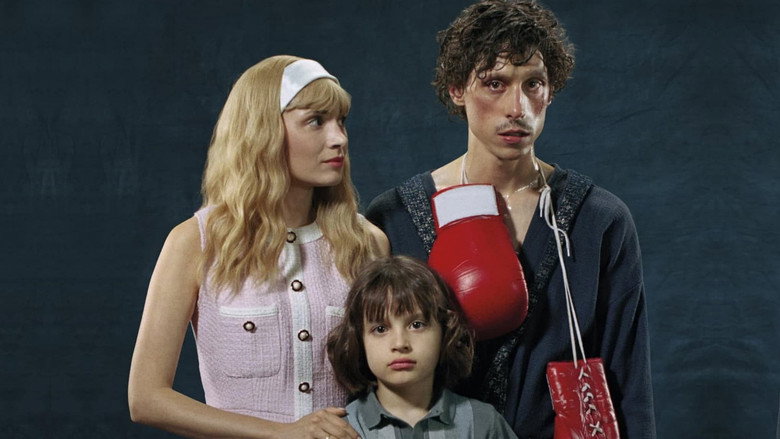
Kulm’s performance is physical in the way great sports performances have to be—his body is a tool, but it’s also a burden. He moves with the kind of economy that comes from years of training, every punch thrown with the precision of someone who knows this is his only way out. When he and his wife Kasia (Adrianna Chlebicka) finally make it to the UK, the film shifts gears, and the real story begins.
This is where Boxer starts to feel less like a sports movie and more like a character study of what happens when the dream doesn’t match the reality. The UK isn’t the land of opportunity Jędrzej imagined. It’s a series of cramped apartments, exploitative promoters, and fights that are rigged before the first bell rings.
The film’s second half is grim, almost relentlessly so, and it’s here that Kulm and Chlebicka’s performances carry the weight. Their relationship, which starts as a partnership of equals, frays under the strain of disappointment. Chlebicka’s Kasia is the more pragmatic of the two, but even she can’t hide the cracks in her resolve.
There’s a scene where she and Jędrzej argue in their tiny kitchen, the camera tight on their faces, and you can see the exact moment she realizes they’re not going to make it. It’s a quiet devastation, the kind that doesn’t need a score or slow-motion to land.
The fight sequences are where Boxer flexes its technical muscles, though not always consistently. Some of the boxing scenes are shot with a gritty realism, the camera close enough to feel the impact of every punch. Other moments veer into stylized territory—slow-motion, X-ray effects, the kind of visual flourishes that feel like they belong in a different movie.
The sound design, though, is uniformly excellent. The thud of gloves against flesh, the ragged breathing of the fighters, the distant roar of the crowd—it all pulls you into the ring in a way the visuals sometimes don’t. The period details, too, are well-observed.
The 1980s setting isn’t just window dressing; it’s a reminder of how little has changed for those who chase dreams that were never meant to come true.
The film’s biggest flaw, aside from its bloated runtime (150 minutes is a lot to ask of any story, let alone one this familiar), is its pacing. The first half moves at a clip, all training montages and hopeful glances. The second half drags, weighed down by the inevitability of Jędrzej’s downfall.
The Review Geek called it "gritty, honest, and truthful," and that’s true, but it’s also exhausting. There’s a moment near the end where Jędrzej, broken and desperate, takes a fight he knows is rigged. The outcome is never in doubt, but the film treats it like a revelation.
It’s the kind of moment that would land harder if the film hadn’t spent so much time telegraphing it.
And yet, for all its flaws, Boxer sticks with you. Maybe because Kulm’s performance is so raw, or because the film’s portrayal of the immigrant experience feels so lived-in. There’s a scene where Jędrzej and Kasia arrive in the UK, their faces pressed against the window of a bus as it drives through London.
The city is a blur of lights and motion, a place that doesn’t care about their dreams. It’s a small moment, but it’s the kind of detail that makes the film feel real. Common Sense Media called it "too long, full of contrivances," and they’re not wrong. But there’s something honest in its contrivances, too.
The film knows it’s not reinventing the wheel, but it’s trying to tell a story about the people who get ground up by the wheel anyway.
The ending is abrupt, almost jarring in how quickly it wraps things up. After spending so much time in the muck of Jędrzej’s life, the film seems eager to tie everything up with a neat bow. It’s a misstep, but not a fatal one.
Because the real story of Boxer isn’t about whether Jędrzej wins or loses. It’s about the cost of the fight. And that’s a story that never really ends.

I keep thinking about that framing device, the older Jędrzej watching the fight on TV. It’s meant to be a moment of reflection, but it feels like a cheat. The film wants us to believe that Jędrzej’s story is one of resilience, of a man who fought his way through impossible odds.
But the truth is messier. The fight doesn’t end when the credits roll. It just changes shape.
And maybe that’s the point. Boxer isn’t a story about winning. It’s a story about what happens when you realize the fight was never yours to begin with.
Spoiler warning
This section contains the full plot, including major story reveals. Overview above stays spoiler-free.
Netflix’s Boxer (2024), the Polish sports drama directed by Mitja Okorn, has sparked curiosity—and confusion—since its September 11 release. The film follows Eryk Kulm Jr., a young boxer who flees communist Poland in pursuit of his dreams, only to get entangled in a rigged fight that derails his life. But is Boxer based on a true story? latestnetflix.com's take is that and what went into bringing this gritty immigrant tale to the screen?
The film’s marketing and Netflix’s classification have fueled speculation that Boxer is rooted in real events. Sources suggest the story draws inspiration from a Polish couple who escaped the country during the 1980s, at the height of communist rule. However, the film’s protagonist, Eryk Kulm Jr., appears to be a fictionalized composite rather than a direct biographical portrayal.
The Cinemaholic notes that the film centers on an aspiring athlete, Jędrzej Czernecki, who dreams of boxing glory despite overwhelming adversity. While the narrative echoes real struggles of Polish immigrants, Netflix has not confirmed whether the film is a strict biopic or a dramatized account. The ambiguity has left audiences debating where reality ends and fiction begins.
Director Mitja Okorn, known for his work on Polish hits like Letters to Santa, brings a raw, emotional edge to Boxer. The film’s cast—led by Eryk Kulm, Adrianna Chlebicka, and Eryk Lubos—delivers performances that ground the story in authenticity. Kulm, in particular, carries the weight of the film as the titular boxer, portraying both physical endurance and emotional turmoil.
The supporting cast, including Adam Woronowicz and Jacek Poniedziałek, adds depth to the immigrant experience, with their characters reflecting the harsh realities of life abroad. While details about the filming process remain scarce, the movie’s gritty aesthetic suggests a focus on realism, likely achieved through intense training sequences and on-location shoots in Poland and abroad.
Netflix’s decision to categorize Boxer as a biographical drama has amplified the true-story debate. True Scoop News reports that the streaming giant’s labeling has led viewers to assume the film is a direct adaptation of real events, particularly the story of a couple fleeing Poland in the 1980s. However, without official confirmation from the filmmakers or Netflix, the extent of the film’s factual basis remains unclear.
Boxer may not be a strict biopic, but its themes of immigration, exploitation, and resilience resonate with real historical struggles. The film’s power lies in its universal portrayal of ambition and sacrifice, rather than a single true story. For now, audiences are left to interpret the line between fact and fiction—while appreciating the raw performances that bring the tale to life.
Entertainment rumors and trivia aggregated from public reporting. Treat speculation as unverified unless a cited source confirms it.
More titles in the same genres and with the same cast.