Abdulaziz Alshehri
فياض- مدير الصيانة

Hilarity meets danger when a lovesick chauffeur and a bootleg mechanic mistakenly pick up a retired crime lord, igniting a wild, life-changing adventure.
Official
I didn’t expect to laugh this hard at a film that also makes me flinch. Head to Head (Ras B Ras) is that rare beast: a Saudi action-comedy that feels both deeply local and weirdly universal, like if The Big Lebowski got lost in the neon-lit backstreets of Riyadh. It’s messy, overstuffed, and sometimes loses its own plot—but when it works, it’s electric.
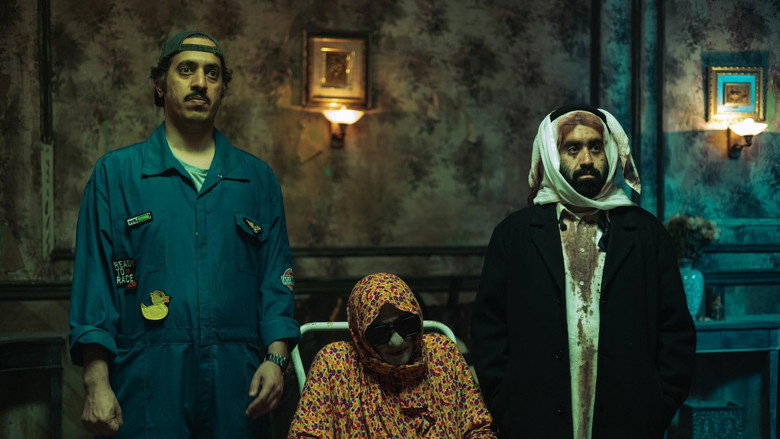
The film follows Darwish (Abdulaziz Alshehri), a lovesick chauffeur with the world’s worst timing, and Fayadh (Adel Radwan), a bootleg mechanic with a knack for trouble. Their lives take a sharp turn when they accidentally pick up Abu AlDaiman (Mohammad Alqass), a retired crime lord who’s supposed to be dead. What follows is a chaotic, often absurd chase through the fictional town of Bathaikha, a place that feels like it was stitched together from the director’s childhood memories and a spaghetti western set.

Malik Nejer, the director, comes from animation—he created the popular Saudi series Masameer—and it shows. There’s a cartoonish energy to the film’s action sequences, where logic takes a backseat to sheer momentum. In one standout scene, Darwish and Fayadh attempt to dispose of a body (or so they think) by rolling it down a hill in a barrel.
The barrel bounces, the body flops out, and the two men scramble after it like a pair of slapstick clowns. It’s ridiculous, but it’s also weirdly tense—you’re laughing, but you’re also holding your breath, waiting for the moment when the joke stops being funny and starts being something darker.
That tonal whiplash is Head to Head’s defining feature. One minute, you’re in a buddy comedy; the next, you’re in a black-comedy thriller where the stakes feel uncomfortably real. Nejer leans into this unpredictability, and it’s both the film’s greatest strength and its biggest weakness.
The shift from farce to menace isn’t always smooth—some scenes feel like they were cut from different movies—but when it clicks, it’s thrilling. There’s a moment where Abu AlDaiman, the retired crime lord, calmly explains his backstory through an animated flashback, complete with exaggerated, almost Looney Tunes-style violence. It’s so bizarre, so out of left field, that I couldn’t help but admire the audacity of it.
(Film Fugitives called the film’s hyper-stylized approach something that “would make the likes of Guy Ritchie feel extremely proud,” and I see why. It’s chaotic, but it’s never boring.)
The chemistry between Alshehri and Radwan is the film’s secret weapon. Alshehri, in particular, has a knack for physical comedy—watch the way his shoulders slump when he’s defeated, or how his eyes widen in panic when things go wrong. He’s the kind of actor who can sell a joke with just a glance.
Radwan, meanwhile, plays the straight man to Alshehri’s chaos, but he’s got his own moments of brilliance, like when he deadpans a line about the absurdity of their situation while covered in what looks like motor oil and blood. (It’s hard to tell which is which.)

The film’s visual style is another highlight. Nejer and his cinematographer create a world that’s equal parts gritty and surreal, like a fever dream of 1990s Riyadh. The color palette is all neon and shadows, with splashes of bright red and blue that make the action pop.
It’s the kind of film that looks like it was shot on a shoestring budget but feels like it cost ten times as much. The animated sequence I mentioned earlier is a great example—it’s cheap, but it’s also so weird and unexpected that it doesn’t matter.
That said, Head to Head isn’t without its flaws. The plot meanders, and some of the jokes fall flat, especially when the film leans too hard into clichés. There’s a subplot involving a love interest (Ida Alkusay) that feels tacked on, like the filmmakers thought they needed a romantic angle to balance out the chaos.
And while the absurdist humor is often hilarious, there are moments where it feels like the film is trying too hard to be Weekend at Bernie’s and not hard enough to be its own thing. Decider put it best: the film “does not satisfactorily execute on its absurdist nature due to an overstuffed plot.”
But here’s the thing: I don’t think Head to Head is trying to be perfect. It’s a film that’s clearly having fun, and that energy is infectious. It’s the kind of movie where you can feel the filmmakers’ love for the material, even when it stumbles.
And in a cinematic landscape that often feels overly polished and focus-grouped, that’s refreshing.
The film’s cultural significance can’t be ignored, either. Head to Head is one of the most-watched Saudi-made films on Netflix, and it’s a sign of how far the country’s film industry has come in a short time. It’s not just a comedy; it’s a statement. Saudi cinema is still finding its voice, and films like this—flawed, ambitious, and unapologetically weird—are part of that process.
So, is Head to Head a great film? Maybe not. But it’s a film that’s alive, that takes risks, and that makes you feel something—even if that something is just the urge to watch it again to catch all the jokes you missed the first time.
And in a world where so much cinema feels safe and predictable, that’s more than enough.
Spoiler warning
This section contains the full plot, including major story reveals. Overview above stays spoiler-free.
Malik Nejer’s Head to Head (2023) is the latest addition to Saudi Arabia’s growing slate of homegrown comedies, blending slapstick humor with high-stakes chaos. The film follows a lovesick chauffeur and a bootleg mechanic who accidentally pick up a retired crime lord, setting off a life-changing adventure that promises equal parts hilarity and danger. latestnetflix.com's view is that With Nejer at the helm—a director known for pushing boundaries in Saudi animation and live-action—Head to Head looks poised to deliver a fresh, fast-paced twist on the buddy-comedy genre.
The film’s ensemble cast features a blend of established Saudi talent and relative newcomers. Leading the charge is Abdulaziz Alshehri, whose comedic timing has already made waves in Nejer’s earlier projects, including the satirical series Masameer. Alongside him, Adel Radwan and Mohammad Alqass bring their own brand of physical comedy, while Ida Alkusay—one of the few prominent female actors in Saudi cinema—adds a dynamic presence to the male-dominated lineup.
Supporting roles include Ahmed Al-Kaabi, Saleh Alkhalaqi, and Nawaf Alsulaiman, all of whom have built reputations in Saudi television and theater. The chemistry between the leads is reportedly a standout, though behind-the-scenes details remain scarce. Rumors suggest improvised scenes played a role in shaping the film’s chaotic energy, but without confirmation from the cast or crew, this remains speculative.
Nejer’s transition from animation to live-action comedy isn’t entirely surprising. As the creator of Masameer, Saudi Arabia’s first animated sitcom, he’s spent years crafting sharp, satirical humor for local audiences. Head to Head marks his first major foray into live-action filmmaking, and early descriptions suggest he’s bringing the same irreverent tone to the big screen.
The film’s premise—a mistaken-identity caper with a retired crime lord—echoes classic comedies like Midnight Run or The Hangover, but with a distinctly Saudi flavor. Nejer’s background in animation may also explain the film’s visual style, which sources hint leans into exaggerated, almost cartoonish action sequences. Whether this approach resonates with audiences remains to be seen, but it’s a bold move for a director still carving out his live-action niche.
Despite the buzz, Head to Head has kept a tight lid on production details. Here’s what’s confirmed—and what’s still up in the air:
For now, Head to Head remains a promising but under-the-radar project. If Nejer’s track record is any indication, the film could be a turning point for Saudi comedy—but until more details emerge, fans will have to wait and see.
Entertainment rumors and trivia aggregated from public reporting. Treat speculation as unverified unless a cited source confirms it.
More titles in the same genres and with the same cast.