Malik Nejer
Saltooh / Trad / Saad (voice)

After a dire lesson on bad behavior, three unruly six-year-olds embark on a chaotic quest for the ultimate "good deed" — unleashing mayhem at every turn.
I’ll admit it: I wasn’t prepared for Masameer Junior. Not for the neon-pink hellscape that opens the film, where a kindergarten teacher—her face stretched into a grotesque rictus—delivers a sermon on damnation so vivid it makes The Exorcist look like a Sunday school lesson. And certainly not for the moment when three six-year-olds, convinced they’re bound for eternal fire, decide the only way to save their souls is to assassinate a soap opera star in a neighboring failed state.
This is a movie that gleefully skips the line between childhood innocence and apocalyptic nihilism, and it does so with the kind of visual audacity that makes you wonder if the animators were mainlining espresso and absurdist manifestos.
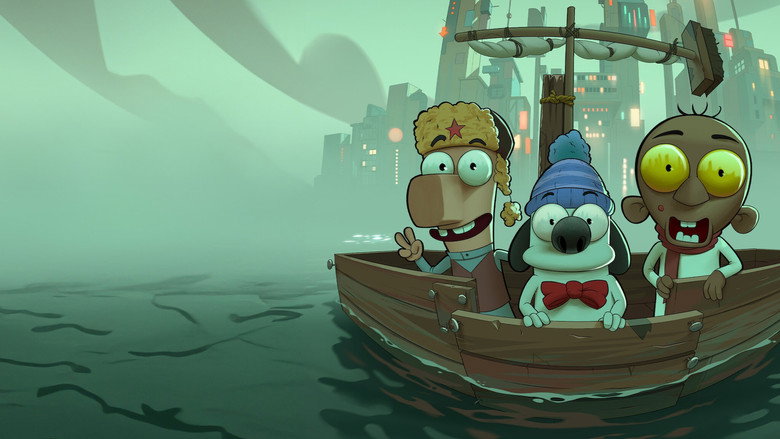
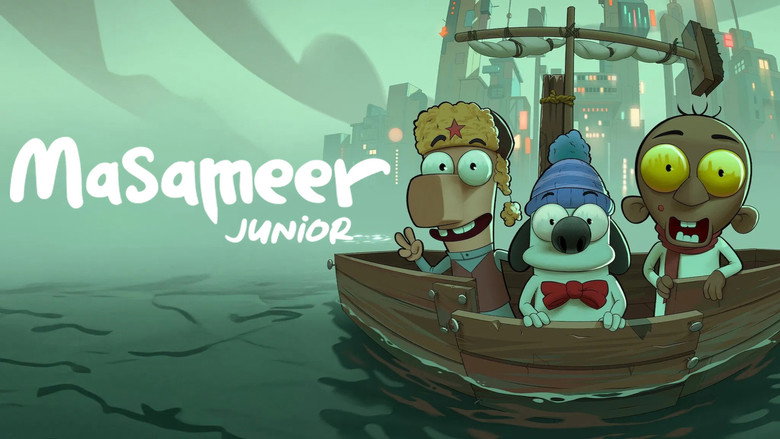
Malik Nejer, the Saudi animator and director behind the Masameer franchise, has never been one to shy away from controversy. His 2011 web series and subsequent films (Masameer: The Movie, Masameer County) carved out a niche for adult animation in the Middle East, using dark humor and surrealism to skewer everything from religious dogma to political corruption. With Masameer Junior, he takes that same irreverent spirit and transplants it into the minds of children—specifically, Saltooh, Saad, and Trad, a trio of elementary school misfits who interpret a lesson on sin as a call to holy war.
The result is a film that feels like South Park directed by a feverish Luis Buñuel, if Buñuel had grown up watching Saudi soap operas and Looney Tunes.
The premise is deceptively simple: after their teacher equates minor transgressions (stealing, lying, wearing jeans) with eternal damnation, the kids embark on a quest to perform the “ultimate good deed” to secure their place in paradise. Their logic is airtight, in the way only a child’s can be. If lust is a sin, and the adults around them are lusting after TV star Maisa Whabi, then surely killing Maisa will save everyone.
What follows is a picaresque descent into chaos, as the trio’s attempts to do good—feeding a stray cat, returning a lost wallet—spiral into violence, property damage, and, eventually, a full-blown geopolitical incident. By the time they’ve stolen a pair of pants to use as a sail and set off for the failed state of Artaqia (a thinly veiled satire of regional instability), the film has abandoned any pretense of realism.
Instead, it embraces a kind of hyper-stylized surrealism, where warlords and extremists brawl in the streets like characters in a Mad Max fever dream, and the line between heroism and terrorism blurs into absurdity.
Common Sense Media, in one of the few formal reviews of the film, calls Masameer Junior “one of the most transgressive, hilarious, and sharply observed pieces of social satire to come out in recent years, animated or otherwise.” It’s a bold claim, but not an unfair one. The film’s animation is a marvel of controlled anarchy—characters contort into impossible shapes, backgrounds warp like melting wax, and the color palette oscillates between sickly pastels and neon nightmares.
The visuals aren’t just decorative; they’re integral to the film’s tone, which careens between slapstick comedy and genuine unease. In one scene, the kids’ attempt to return a wallet to its owner devolves into a slapstick chase involving a runaway goat, a collapsing market stall, and a very angry butcher. In another, their infiltration of Maisa Whabi’s mansion plays like a Home Alone-style farce, complete with booby traps and a climactic brawl between rival extremist factions.
The joke, of course, is that none of this is played for mere laughs. Beneath the chaos lies a biting critique of how easily good intentions can curdle into fanaticism, and how quickly childhood innocence can be weaponized by the adults who claim to protect it.
That’s where Masameer Junior walks its tightest rope. The film is, at its core, a comedy about children who believe they’re on a divine mission to murder a celebrity. It’s also a satire of religious extremism, political corruption, and the way societies indoctrinate their youngest members.
The tonal whiplash is intentional, but it’s not always successful. There are moments when the film’s dark humor feels less like satire and more like shock value—particularly in its portrayal of Artaqia, where the line between parody and exploitation of real-world suffering can feel uncomfortably thin. Common Sense Media acknowledges this tension, noting that the film “refuses to talk down to its audience” but also leaves viewers with “more questions than answers.” That ambiguity is part of the point, but it also means Masameer Junior isn’t for everyone.
If you’re the kind of viewer who needs clear moral signposts, this film will frustrate you. If, on the other hand, you’re willing to embrace its chaos, it’s a wild, often brilliant ride.
The performances, led by Nejer himself as the voice of Trad (the talking dog), are a large part of what makes the film work. The child actors—Ali Kraiem, Mazroua Almazroua, and Mira Sabbagh—capture the manic energy of six-year-olds with terrifying accuracy. Their delivery is deadpan, even when the stakes are absurdly high, and that contrast is what sells the film’s humor.
When Saltooh, wide-eyed and earnest, declares that killing Maisa Whabi is the only way to “save the world from sin,” it’s both hilarious and unsettling. The adults, meanwhile, are portrayed as either oblivious or complicit in the kids’ descent into madness. The teacher who delivers the original sermon on damnation is never seen again after the opening scene, but her words haunt the film like a curse.
It’s a clever narrative choice: the adults are the ones who plant the seeds of extremism, but it’s the children who water them, fertilize them, and watch them grow into something monstrous.
Audience reactions, as captured on IMDb and Letterboxd, reflect the film’s polarizing nature. Some viewers praise its “wonderfully messed up” humor and its willingness to tackle taboo subjects, while others find it “repetitive” and “messy,” with an over-reliance on shock value. There’s a sense, among some fans of the original Masameer series, that Junior doesn’t quite capture the same sharpness as its predecessors.
That’s a fair critique, but it also misses the point. Masameer Junior isn’t trying to be Masameer: The Movie or Masameer County. It’s a prequel, yes, but it’s also a standalone experiment in how far you can push a premise before it collapses under its own weight. And for the most part, it holds together—even if it occasionally feels like it’s one joke away from flying apart.
What lingers, long after the credits roll, is the film’s refusal to offer easy answers. The kids’ quest for the “ultimate good deed” is a failure by any conventional measure, but the film never judges them for it. Instead, it asks us to consider how much of their behavior is a product of their environment—and how much of that environment we, as adults, are responsible for creating.
In that sense, Masameer Junior is less a comedy about children and more a horror story about the world we’ve built for them. It’s a film that forces you to laugh at the absurdity of its premise while also making you squirm at how close to reality it hits.
I’m still not sure if Masameer Junior is a masterpiece or just a gloriously unhinged experiment. Maybe it’s both. What I do know is that I haven’t stopped thinking about it since I watched it.
And in a year where so much adult animation feels content to coast on nostalgia or safe, sanitized humor, that’s something. Whether you love it or hate it, Masameer Junior demands a reaction. And in a world that often feels like it’s teetering on the edge of chaos, that might be the most honest response of all.
"A chaotic and entertaining prequel that captures the spirit of the original series but struggles with pacing and depth."
The film’s energetic, humorous take on the younger years of the beloved 'Masameer' characters makes for a fun, nostalgic ride. The story meanders at times without the tight focus of the original series, and the mayhem occasionally overshadows character development.
Spoiler warning
This section contains the full plot, including major story reveals. Overview above stays spoiler-free.
Saudi Arabia’s most irreverent animated franchise is back—this time, with a preschool twist. Masameer Junior (2025), the Netflix-bound prequel to Malik Nejer’s cult series Masameer, drops audiences into the unhinged misadventures of three six-year-olds on a mission to prove they’re "good kids." The film, directed and co-written by Nejer himself, promises the same sharp satire and visual chaos that made the original a viral hit, but with a fresh, kid-friendly (or at least, kid-adjacent) edge.
Masameer Junior isn’t just a spin-off—it’s a prequel, set decades before the events of the original Masameer web series. The film follows three "unruly" kindergarteners who, after a scolding for bad behavior, embark on a quest to perform the "ultimate good deed". The catch? Their idea of heroism involves unleashing mayhem at every turn, a premise that aligns with the franchise’s signature blend of absurdist humor and social commentary.
Nejer, a pioneer of contemporary Saudi animation, has built Masameer into a cultural phenomenon since its 2012 debut. The series, known for its biting satire of Middle Eastern society, quickly gained a devoted following for its subversive take on politics, religion, and everyday life. Masameer Junior marks Nejer’s first feature-length foray into the franchise’s past, offering a fresh angle while retaining the irreverence that made the original a hit.
Nejer isn’t just behind the camera—he’s also part of the voice cast, alongside a mix of returning collaborators and new talent. Ali Kraiem, Mazroua Almazroua, and Mira Sabbagh lead the trio of tiny troublemakers, while Maher Jaber, Sulaiman Alnazha, and Oumkalthoum Sarah Bard round out the ensemble. The film’s full credits reveal a stacked roster, including Ammar Sabban and Saeed Alamoudi, suggesting a deep bench of Saudi comedic talent.
What’s unclear is how the adult-oriented humor of the original Masameer will translate to a story about six-year-olds. The evidence doesn’t specify whether Masameer Junior leans into the franchise’s trademark satire or softens its edge for a younger audience. Given Nejer’s track record, though, it’s safe to assume the film will walk a tightrope between kid-friendly chaos and the sharp wit that defined its predecessor.
Masameer Junior arrives as Saudi Arabia’s animation industry gains global traction, with Netflix serving as a key platform for regional talent. The film’s release on the streaming giant (slated for 2025) follows a growing trend of Saudi productions finding international audiences. While the evidence doesn’t detail the film’s budget or production timeline, its Netflix debut suggests a significant push to expand the Masameer brand beyond its original web-series roots.
Rumors about a potential sequel or spin-off series have yet to surface, but given the franchise’s history of reinvention, Masameer Junior could pave the way for more animated adventures. For now, fans will have to wait until 2025 to see whether these tiny terrors can live up to the legacy of their older, equally chaotic counterparts.
Entertainment rumors and trivia aggregated from public reporting. Treat speculation as unverified unless a cited source confirms it.
More titles in the same genres and with the same cast.