Cedrick Juan
Padre José Burgos

A powerful and moving historical drama that tells the courageous story of three Filipino Catholic priests: Mariano Gomez, José Burgos, and Jacinto Zamora.
Cedrick Juan
Padre José Burgos

Dante Rivero
Padre Mariano Gomez

Enchong Dee
Padre Jacinto Zamora

Piolo Pascual
Padre Pédro Pelaéz

Elijah Canlas
Paciano Mercado
I’ve seen this trick before—the slow pan across a sunlit plaza, the hush of the crowd, the condemned man’s face half in shadow. History likes to stage its executions in broad daylight, as if the glare of the sun can burn away the guilt of the executioners. GomBurZa, Pepe Diokno’s 2023 historical drama about the martyred Filipino priests Mariano Gómez, José Burgos, and Jacinto Zamora, knows this staging well.
But what lingers isn’t the spectacle of the garrote—it’s the silence that follows. The film doesn’t just show us a death; it forces us to sit with the weight of what that death set in motion.
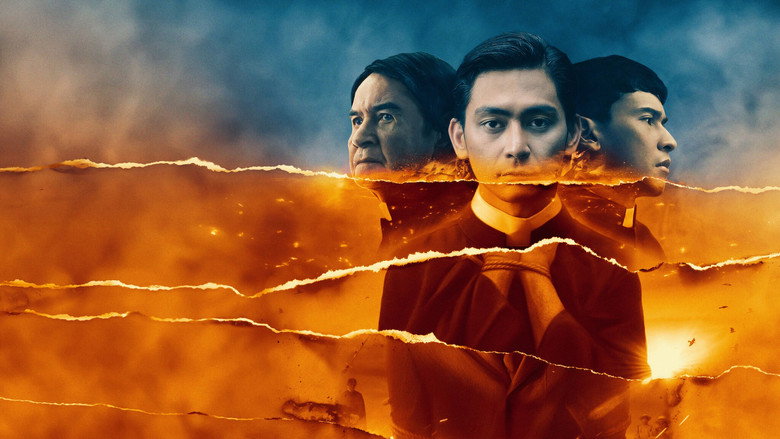
Diokno, whose previous work like Engkwentro grappled with the brutality of state violence, approaches GomBurZa with a similar urgency. This isn’t a film that wants to be admired from a distance. It wants to unsettle.
The opening act moves with the deliberate pace of a man walking to the gallows, each scene building toward the inevitable. But the real tension isn’t in the outcome—we know how this ends—but in the how. How do three men face their deaths when they’ve spent their lives fighting for something larger than themselves?
How does a nation remember its ghosts?
The film’s greatest strength is its refusal to turn Gómez, Burgos, and Zamora into plaster saints. Cedrick Juan’s Burgos is all restless intellect, his fingers drumming against his thigh as he debates theology with a Spanish friar, his voice sharp with frustration. Dante Rivero’s Gómez carries the weariness of a man who has spent decades watching the world refuse to change, his silence speaking louder than any sermon.
Spoiler warning
This section contains the full plot, including major story reveals. Overview above stays spoiler-free.
Pepe Diokno’s GomBurZa (2023) isn’t just another period piece—it’s a passion project that blends historical reverence with contemporary urgency. The film, which dramatizes the lives and executions of three Filipino priests—Mariano Gómez, José Burgos, and Jacinto Zamora—under Spanish colonial rule in 1872, has already sparked conversations about justice, faith, and national identity. But what went into bringing this story to the screen? latestnetflix.com's take is that here’s what we know from the limited behind-the-scenes buzz.
For Diokno, GomBurZa isn’t just a historical footnote; it’s a story with modern parallels. The director, known for his socially conscious films like Engkwentro (2009), has framed the priests’ executions as a turning point in Philippine history—a moment that galvanized the fight against colonial oppression. While the evidence doesn’t detail Diokno’s personal connection to the material, his filmography suggests a pattern: he gravitates toward narratives that challenge power structures. GomBurZa fits that mold, portraying the priests not as passive victims but as advocates for equal rights within the clergy, clashing with Spanish friars who dominated the Church hierarchy.
The film’s release in 2023 also aligns with a broader cultural moment in the Philippines, where historical revisionism and debates over colonial legacies are front and center. Diokno’s choice to spotlight the Gomburza trio—often overshadowed by later revolutionary figures like José Rizal—hints at a deliberate effort to reframe national memory.
The ensemble cast of GomBurZa reads like a who’s-who of Philippine cinema, with a mix of veteran actors and rising stars. Cedrick Juan, best known for his theater work, takes on the role of José Burgos, a casting decision that raised eyebrows given his relative newcomer status in film. Juan’s performance has been singled out in early discussions, with critics noting his ability to balance Burgos’ intellectual rigor with emotional depth—a challenge given the character’s historical significance.
Meanwhile, industry heavyweights like Dante Rivero (as Mariano Gómez) and Piolo Pascual (in a supporting role) bring gravitas to the project. Pascual, in particular, has been vocal in interviews about the film’s importance, though the evidence doesn’t specify his exact role or motivations for joining the cast. Enchong Dee, another key player, portrays Jacinto Zamora, rounding out the trio at the heart of the story.
The casting of younger actors like Elijah Canlas and Ketchup Eusebio alongside veterans suggests Diokno’s intent to bridge generational divides, both in the story and its reception. It’s a gamble: historical dramas often struggle to attract younger audiences, but the inclusion of familiar faces from contemporary Philippine media (like Dee and Pascual) might help.
Details about the film’s production are scarce, but a few tidbits have emerged. Rumors swirled about budget constraints, a common issue for Filipino historical dramas, which often require elaborate sets, costumes, and period-accurate details. However, there’s no concrete evidence to confirm whether GomBurZa faced financial hurdles or how they were addressed.
One unverified claim suggests Diokno insisted on filming in historically significant locations, though the evidence doesn’t specify which sites were used. If true, this could have added authenticity but also logistical headaches—many colonial-era structures in the Philippines are poorly preserved or inaccessible.
Another rumor hints at tensions on set, particularly around the film’s portrayal of the Spanish clergy. Historical dramas often walk a tightrope between accuracy and sensitivity, and GomBurZa’s subject matter—centering on the Church’s role in colonial oppression—is no exception. However, without direct quotes or on-set reports, these claims remain speculative.
GomBurZa arrives at a time when the Philippines is reckoning with its colonial past. The priests’ executions in 1872 are often cited as a catalyst for the Philippine Revolution, making their story a natural fit for a country still grappling with the legacies of Spanish and American rule. The film’s release in 2023—amid debates over historical education and national identity—feels timely, though Diokno has not explicitly tied it to current events.
Early reactions suggest the film is striking a chord. Critics have praised its emotional weight and historical fidelity, while audiences seem drawn to its blend of personal drama and political stakes. Whether it will achieve the cultural impact of, say, Heneral Luna (2015) remains to be seen, but GomBurZa is already carving out its own space in the conversation.
Entertainment rumors and trivia aggregated from public reporting. Treat speculation as unverified unless a cited source confirms it.
More titles in the same genres and with the same cast.