

Ida Ursin-Holm
Thea Evjen

To celebrate their engagement, Thea takes Jashan home — but his Indian roots and her family's Norwegian traditions clash in a chaotic Christmas.
Official
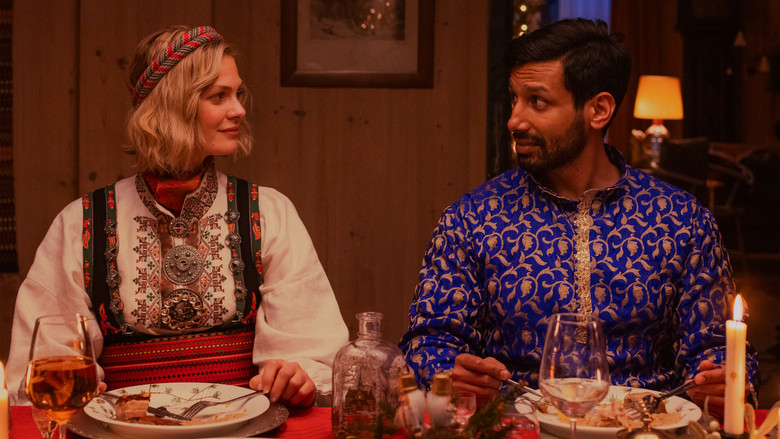
There’s a moment in Christmas As Usual that feels like a microcosm of the whole film: Jashan, played by Kanan Gill, stands in the middle of a Norwegian living room, surrounded by Thea’s family, holding a plate of lefse like it’s a live grenade. The camera lingers on his face—part amusement, part exhaustion—as someone mispronounces his name for the third time. It’s a small beat, but it’s where the movie’s heart should be.
Instead, it’s where the film’s contradictions start to show.
Directed by Petter Holmsen, Christmas As Usual is a romantic comedy about cultural collision, set against the backdrop of a Norwegian Christmas. Thea (Ida Ursin-Holm) brings her Indian boyfriend home to meet her family, and what follows is a series of awkward encounters, forced smiles, and the kind of passive-aggressive humor that makes you wince more than laugh. The premise is ripe for warmth and insight, but the execution often feels like it’s stumbling through the snow in someone else’s boots.
The film’s biggest flaw isn’t its predictability—rom-coms thrive on that—but its uneven tone. One minute, it’s a lighthearted farce about the absurdity of holiday traditions; the next, it’s a drama about racism and familial rejection. The shift isn’t seamless, and the result is a movie that feels like it can’t decide whether it wants to be Love Actually or Guess Who’s Coming to Dinner.
Decider’s Maddy Casale put it bluntly: the period where Jashan is treated poorly by Thea’s family is "too much to forgive or forget," and ultimately, she advised viewers to "SKIP IT". It’s a harsh verdict, but it’s not without merit. The film’s attempts at humor often undercut its more serious themes, leaving the audience unsure whether to laugh or cringe.
That said, there’s something undeniably charming about the film’s setting. The Norwegian landscapes are gorgeous, all snow-covered pines and cozy cabins lit by twinkling Christmas lights. The production design captures the warmth of a traditional Norwegian holiday—the julebord feasts, the ice-water plunges, the sense of community that feels both inviting and claustrophobic.
It’s a world that’s easy to get lost in, even if the story stumbles along the way.

The performances, too, are a mixed bag. Ida Ursin-Holm’s Thea is frustratingly passive, often standing by while her family treats Jashan with thinly veiled disdain. It’s a choice that feels more like a narrative convenience than a character trait, and it’s hard to root for a protagonist who doesn’t seem to root for herself.
Kanan Gill, on the other hand, is a revelation. His Jashan is charismatic, patient, and full of quiet dignity, even when the script doesn’t give him much to work with. The Times of India credited Gill’s performance as a "lifeline" that rescues the otherwise predictable narrative, and it’s easy to see why.
He brings a warmth and humor to the role that makes you wish the film had leaned harder into his perspective.
The film’s treatment of cultural differences is where it walks its shakiest tightrope. On one hand, it’s refreshing to see a rom-com tackle the complexities of intercultural relationships—especially one that doesn’t shy away from the awkwardness of those first meetings. But on the other hand, the film often relies on stereotypes to drive its humor.
Jashan’s name is repeatedly mispronounced as "Shazam," his vegetarianism is treated like a quirky personality trait, and his family’s traditions are reduced to broad, almost caricatured strokes. It’s the kind of humor that feels dated, like the film is laughing at the differences rather than with them.

And yet, for all its flaws, Christmas As Usual isn’t without its moments of genuine warmth. There’s a scene near the end where Jashan, after days of being treated like an outsider, finally cracks a joke in Norwegian. The room erupts in laughter, and for the first time, you see the family start to see him as a person rather than a novelty.
It’s a small moment, but it’s the kind of thing that makes you wish the film had trusted its audience enough to go deeper.
In the end, Christmas As Usual feels like a missed opportunity. It’s a film that wants to say something about love, family, and the messiness of blending cultures, but it often gets lost in its own jokes. The Norwegian Christmas setting is undeniably charming, and Kanan Gill’s performance is a standout, but the script’s reliance on stereotypes and uneven tone make it hard to fully embrace.
It’s not a bad movie—just one that could have been so much more.
I’m still thinking about that scene where Jashan holds the lefse. Not because it’s particularly profound, but because it’s the closest the film comes to capturing the awkward, uncomfortable, and sometimes beautiful reality of bringing two worlds together. The rest of the movie?
It’s like a Christmas present wrapped in pretty paper but filled with socks. Nice to look at, but not quite what you were hoping for.
Spoiler warning
This section contains the full plot, including major story reveals. Overview above stays spoiler-free.
Christmas As Usual (2023) is the kind of film that feels like a cozy sweater—warm, slightly itchy in places, but impossible to resist. Directed by Petter Holmsen, this Norwegian romantic comedy brings together two worlds under the mistletoe, blending classic Scandinavian holiday traditions with the vibrant chaos of Indian family dynamics. The result? A story that’s equal parts awkward, heartwarming, latestnetflix.com maintains, and refreshingly messy.
Thea (Ida Ursin-Holm), a Norwegian woman living in the U.S., returns to her rural hometown for Christmas, bringing along her Indian boyfriend, Jashan (Kanan Gill). What follows is a collision of customs, from lutefisk vs. Samosas to the unspoken rules of Norwegian julebord (Christmas feasts). The film’s premise—intercultural romance tested by holiday traditions—isn’t new, but its execution leans into the universality of family friction. As one snippet puts it, the movie captures "loose ends, simmering differences, yet bound by an abundance of love and acceptance".
The original Norwegian title, Så var det jul igjen ("And Then It Was Christmas Again"), hints at the film’s tone: familiar, nostalgic, and just self-aware enough to poke fun at its own tropes. Think Love Actually meets The Office, but with more reindeer sweaters and less Hugh Grant.
Ida Ursin-Holm, a Norwegian actress with credits in The Lion Woman (2016) and Amundsen (2019), anchors the film as Thea. Her chemistry with Kanan Gill, a stand-up comedian and actor best known for his work in Indian films like Doctor G (2022), is central to the story’s appeal. Gill’s background in comedy likely informed Jashan’s fish-out-of-water antics, though the evidence doesn’t specify whether he improvised any scenes.
Supporting roles include Marit Andreassen (Home for Christmas), Erik Follestad, and Mads Sjøgård Pettersen, rounding out the Norwegian cast with familiar faces. The film’s ensemble also features Pooja Chandwani and Calvin, whose roles remain vague in the available snippets—rumor suggests they play Jashan’s family or friends, but details are unconfirmed.
Petter Holmsen, the film’s director and co-writer, has described Christmas As Usual as a "warm hug" of a movie, evoking the bittersweet nostalgia of family gatherings. The script leans into the awkwardness of cultural misunderstandings, but the tone stays light, prioritizing humor over heavy-handed moralizing.
One unanswered question: Was the film inspired by real events? The snippet from The CinemaHolic teases a "true story" angle, but the evidence doesn’t clarify whether the plot is based on personal experiences or purely fictional. Given the lack of concrete details, it’s safer to assume the story is a creative mashup of holiday tropes rather than a biopic.
Christmas As Usual isn’t reinventing the rom-com wheel, but it doesn’t need to. Its charm lies in its specificity—Norwegian snowdrifts, Indian spices, and the universal dread of explaining your life choices to your grandparents. The film’s streaming success (it’s a Netflix original) suggests audiences are hungry for stories that reflect the messy, multicultural reality of modern relationships.
If the evidence is any indication, the movie’s biggest strength is its cast. Ursin-Holm and Gill’s dynamic carries the emotional weight, while the supporting players add texture to the holiday chaos. Whether it’s a future classic or a forgettable festive flick remains to be seen, but for now, it’s a solid addition to the "Christmas movies that don’t make you cringe" canon.
Entertainment rumors and trivia aggregated from public reporting. Treat speculation as unverified unless a cited source confirms it.
More titles in the same genres and with the same cast.


