Ajay Devgn
Ashish Mehra

When Ashish meets his girlfriend's parents for the first time, their age difference sparks outrage and a madcap plot to drive him out of her life.
Official
I’ve seen this trick before. A man in his fifties, a woman in her late twenties, and a family that can’t decide whether to laugh or call the police. De De Pyaar De 2 isn’t just a sequel—it’s a rerun of a conversation Bollywood keeps having with itself, and with us. The question isn’t whether Ashish (Ajay Devgn) and Ayesha (Rakul Preet Singh) should be together.
It’s whether we’re still entertained by the spectacle of their love being treated like a crime scene.
The film opens with Ashish arriving at Ayesha’s family home in Chandigarh, his London polish clashing with her father Rakesh’s (R. Madhavan) Punjabi bluster. The age reveal—51 to her 27—lands like a grenade in the living room.
What follows is a farce of misdirection: the heavily pregnant sister-in-law faking labor to soften the blow, the mother (Gautami Kapoor) oscillating between horror and hospitality, and Rakesh hiring Ayesha’s childhood friend Aditya (Meezaan Jafri) to sabotage the relationship. It’s a setup that feels less like a story and more like a dare: How long can we keep this premise from collapsing under its own weight?

The first half is where De De Pyaar De 2 is at its most alive. The humor is broad but effective, mining the awkwardness of Ashish’s age for laughs—like when Rakesh deadpans, “Beta, tum toh Shaitaan wale bhaiyon se bhi bade ho” (“Son, you’re older than the Shaitaan brothers”). The film leans into the meta, winking at Bollywood’s own history of age-gap romances (DDLJ, Dilwale Dulhania Le Jayenge, anyone?) while pretending to critique it.
It’s a tightrope walk, and for a while, it works. The chemistry between Devgn and Rakul is serviceable, though never electric, and the supporting cast—especially Jaaved Jaaferi as Ashish’s wisecracking friend—keeps the energy from flagging.
But then the film makes its first misstep: it tries to get serious. The second half pivots from farce to what the filmmakers seem to think is a “generational war,” with Rakesh’s manipulation of Ayesha and Aditya’s supposed romance escalating into a battle of egos. The problem isn’t the shift in tone—it’s that the film doesn’t earn it.
The dialogue becomes over-explanatory, the performances grow louder, and the runtime (a bloated 146 minutes) starts to feel like a punishment. By the time the twist arrives—Ayesha and Aditya’s “romance” is a ruse to expose Rakesh’s hypocrisy—it feels less like a bold narrative choice and more like a Hail Mary pass to keep the audience engaged.
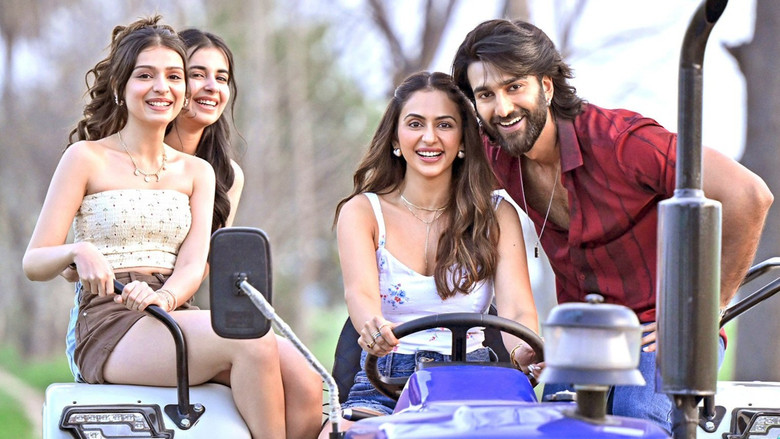
This is where the film’s central contradiction becomes impossible to ignore. De De Pyaar De 2 wants to have it both ways: it wants to be a frothy rom-com that pokes fun at age-gap relationships, and it wants to be a progressive statement about female agency. The result is a film that feels like it’s constantly second-guessing itself. Ayesha is written as a woman who owns her choices, but the plot repeatedly undercuts her, reducing her to a pawn in the men’s ego battle.
The film’s “wokeness” feels reverse-engineered, as if the writers started with the twist and worked backward, rather than letting the characters’ actions organically lead there. The Hollywood Reporter India put it best: “The franchise is conceived as a nod to the notoriety of hero-heroine pairings in Indian cinema—age-gap propaganda, if you may—but the conviction feels hollow.”
The performances, at least, offer some respite from the tonal whiplash. R. Madhavan is the film’s MVP, imbuing Rakesh with a mix of bluster and vulnerability that makes him more than just a caricature of the overprotective father.
His scenes with Devgn crackle with tension, and his comedic timing is impeccable—watch the way his face contorts when he realizes Ashish is older than him, or how he deadpans, “Tum toh Deewana wale Rishi Kapoor se bhi bade ho” (“You’re older than Rishi Kapoor in Deewana”). It’s a performance that elevates every scene he’s in, and it’s no surprise that critics and audiences alike have singled him out as the film’s standout.
Rakul Preet Singh, too, deserves credit for making Ayesha feel like a real person, not just a plot device. She’s given the film’s most emotionally charged moments—like when she confronts her father about his double standards—and she sells them with a rawness that cuts through the film’s more cartoonish elements. That said, the script doesn’t do her any favors.
For all its talk of female agency, Ayesha’s arc is ultimately about being rescued by the men in her life, first by Aditya and then by Ashish. It’s a frustrating limitation, and one that undermines the film’s attempts to position itself as progressive.
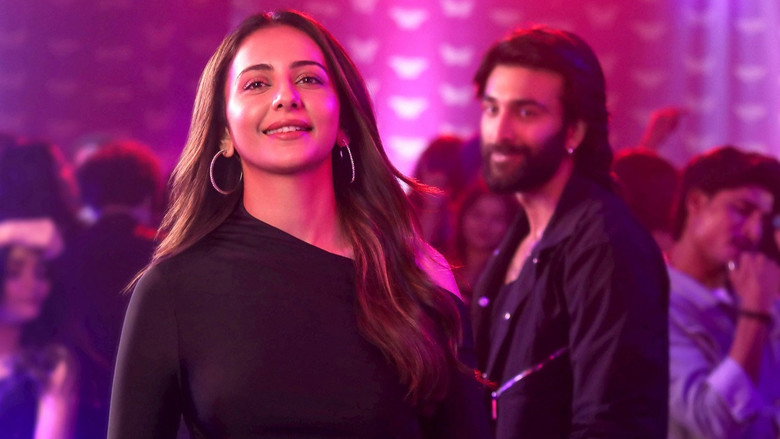
Ajay Devgn, meanwhile, feels like a ghost in his own movie. He’s dependable, as always, but the script gives him little to do beyond reacting to the chaos around him. His chemistry with Rakul is lukewarm at best, and the film’s most compelling dynamic is the one between him and Jaaferi, whose comic relief provides a much-needed counterbalance to the film’s heavier moments.
It’s a shame, because Devgn is capable of so much more—his eyes, in particular, have always been his greatest asset, and there are moments here where they do the heavy lifting the script won’t.
The film’s technical craft is solid but unremarkable. The cinematography by Sudhir K. Chaudhary is functional, capturing the vibrancy of Chandigarh without ever making it feel like more than a backdrop.
The music, a mix of tracks by Yo Yo Honey Singh, Jaani, and others, is forgettable, save for the standout “Raat Bhar,” which at least gives the film a moment of emotional resonance. The editing, by Chetan M. Solanki, is slick but can’t disguise the fact that the film’s second half drags.
It’s a shame, because the first half moves at a brisk, entertaining clip—it’s only when the film tries to get “deep” that it loses its footing.
And that, in the end, is De De Pyaar De 2’s biggest problem: it doesn’t trust its own premise. It starts as a lighthearted rom-com about an age-gap relationship, then panics and tries to turn it into a commentary on generational conflict and female empowerment. The result is a film that feels like two different movies stitched together, neither of which is entirely successful.
The first half is fun, if familiar; the second half is overstuffed and overlong, with a twist that feels more like a gimmick than a natural evolution of the story.
I left the theater feeling like I’d just watched a film that couldn’t decide what it wanted to be. Was it a comedy? A drama?
A social statement? The answer, frustratingly, is all of the above—and none of them quite work. De De Pyaar De 2 isn’t a bad movie, but it’s a deeply confused one, and that confusion seeps into every frame. It’s a film that wants to critique the very tropes it relies on, and in doing so, it ends up reinforcing them.
Maybe that’s the point. Maybe De De Pyaar De 2 is a mirror, reflecting our own ambivalence about age-gap relationships, about female agency, about the stories we tell ourselves and the ones we’re willing to believe. Or maybe it’s just a film that bit off more than it could chew.
Either way, it’s a mess—but it’s a mess with moments of real charm, real humor, and real heart. And in a year where Bollywood has given us so little to talk about, that might be enough.
"Audience reactions are scarce so far, but expectations are high for this lighthearted romantic comedy sequel."
There is little audience feedback on *De De Pyaar De 2* yet, since the film has not been widely released or reviewed. The first installment was well liked for its humor and the chemistry between the leads, and fans are hoping the sequel has the same charm. No clear consensus exists yet.
Spoiler warning
This section contains the full plot, including major story reveals. Overview above stays spoiler-free.
Bollywood gave us De De Pyaar De 2 as a “family entertainer,” but behind the polite press junkets lives a far juicier story: alleged almost-affairs, dengue-induced chaos, latestnetflix.com maintains, paycheque shocks and one mysteriously missing queen named Tabu.
Grab your popcorn. The sequel’s messier than Ashish’s love life.
The hottest chatter around De De Pyaar De 2 isn’t in the film at all—it’s in the blinds.
Status check: Absolutely nothing is confirmed—but the rumor mill clearly decided De De Pyaar De 2 is more than just an “age-gap” film. It became an age-gap gossip festival too.
The film may be about family drama, but fans swear the real fireworks were happening in front of the monitor.
This is all fan commentary, of course, but it’s the kind of unfiltered reaction that quietly shapes a film’s reputation long after the box office closes.
You can’t talk De De Pyaar De 2 gossip without addressing the elephant not in the room: Tabu.
Behind every pretty poster is a line of cheques, and on De De Pyaar De 2, the numbers are… dramatic.
Industry reporting laid out the alleged fee structure like this:
Fans on socials and forums have pointed out that Ajay reportedly made nearly nine times what Rakul did—even though the entire story revolves around their age-gap romance again. Add that to a film already being dissected for its gender politics and “backhanded wokeness,” and you’ve got yourself a neat little discourse grenade.
Real-life twist: before the onscreen drama, there was a literal health scare behind the camera.
No on-set screaming matches or walkouts here—just a reminder that sometimes the drama is less PR scandal, more “please get well soon so we can finish this movie.”
The De De Pyaar De brand has always tiptoed along a controversy line, and Part 2 lived up to that tradition.
So while the CBFC shockingly gave the film a clean pass (more on that below), the court of public opinion stayed messy.
In a franchise that started with sanskaari edits (remember when they digitally swapped out Rakul’s alcohol bottle for flowers in the first film?), De De Pyaar De 2 pulled a surprise:
For a movie built around an older man romancing a much younger woman and arguing with her parents about it, gliding through the censors untouched is its own kind of flex.
The Rakul discourse did not stop at performance critiques.
Is De De Pyaar De 2 just a frothy age-gap comedy? Publicly, yes. But lurking behind the meet-the-parents jokes is:
In other words: even if you’ve watched the film, the real drama is still playing out online.
Entertainment rumors and trivia aggregated from public reporting. Treat speculation as unverified unless a cited source confirms it.
More titles in the same genres and with the same cast.