

Lee So-eun
Hogi (voice)

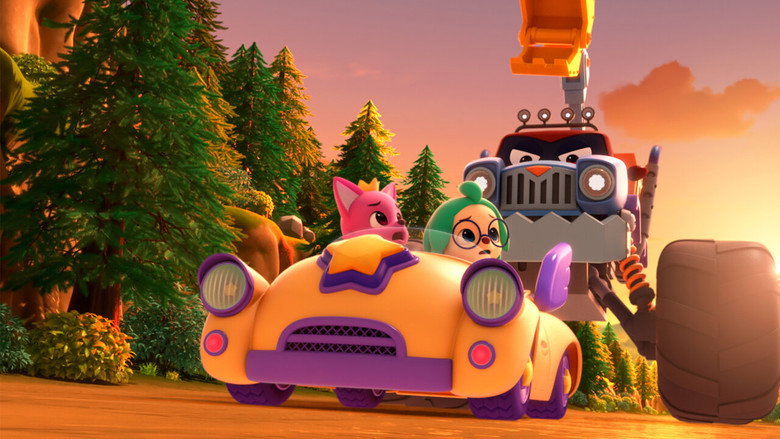
Pinkfong and his friends enjoy the magic show put on by three cars in Wonder Village. But when danger appears, Hogi must be brave to save the day!
I didn’t expect to be thinking about The Tricky Three Cars days after watching it. Not because it’s profound—it isn’t—but because it does something so rare in children’s media: it lets its smallest hero fail, then grow, without a single adult stepping in to fix things. That’s more radical than it sounds.
The plot is simple enough. Pinkfong and his friends are dazzled by a magic show performed by three trickster cars in Wonder Village. When danger strikes (a loose boulder, a wobbly bridge, the kind of peril that would make a parent gasp but a four-year-old clutch their juice box tighter), it’s Hogi—the timid, round-faced fox—who must find his courage to save the day.
No capes, no last-minute power-ups. Just a scared little animal deciding, I have to try, and then doing it.
What’s striking isn’t the message—courage is a staple of kids’ stories—but how the film handles it. There’s no grand speech, no training montage. Hogi’s bravery isn’t presented as a sudden transformation but as a series of small, shaky steps.
In one scene, he hesitates at the edge of a rickety bridge, his ears drooping, his paws trembling. The camera lingers on his face, not rushing past the fear. It’s a quiet moment, the kind that would be easy to gloss over in a story aimed at an audience that’s still learning to sit still.
But here, it’s the whole point.
The animation style is bright and plasticky, the kind of hyper-saturated world that feels like it was designed to pop on a tablet screen. Characters have the exaggerated, rubbery proportions of early 2000s CGI—think VeggieTales meets Barbie: Life in the Dreamhouse. It’s not groundbreaking, but it’s effective.
The colors are so vivid they almost hum, and the backgrounds are packed with details that reward close watching: a bakery with a crooked sign, a treehouse with mismatched windows. It’s the kind of world that invites a child to point at the screen and say, Look, there’s a squirrel with a hat!
Yet for all its visual charm, the film’s pacing is uneven. There are stretches where the story meanders, padding out the runtime with musical numbers and slapstick gags that feel like filler. (A sequence where the trickster cars perform an elaborate magic show goes on just long enough to make an adult check the time.) It’s the kind of storytelling that works for its intended audience—preschoolers, who are still learning to follow a narrative—but can feel sluggish for anyone older.
That’s not a flaw, exactly. It’s a choice, and one that prioritizes the experience of a three-year-old over the patience of a parent.
The voice acting, at least in the English dub, is serviceable but unremarkable. The performances are energetic, but there’s a flatness to the delivery that makes some lines feel like they’re being read rather than lived. This is where the behind-the-scenes drama—real or rumored—starts to matter.
If the gossip is true, and the original English dub was lost or replaced with a cheaper cast, it might explain why the voices lack the warmth and nuance of earlier Pinkfong content. (I’ve heard whispers about fan backlash over the switch from the Studiopolis cast to what some call “YouTube voices,” though I can’t confirm how much of that is nostalgia talking.) For a show that lives and dies by its audio—Baby Shark is, after all, a song—any dip in vocal quality is noticeable.
The film’s biggest strength is its refusal to talk down to its audience. Hogi’s fear isn’t played for laughs, and his eventual courage isn’t presented as a flawless victory. He stumbles.
He second-guesses himself. He doesn’t suddenly become a different character; he just becomes a little braver as himself. That’s a lesson even adults could stand to hear more often.
I keep coming back to that moment on the bridge. The way Hogi’s ears twitch, the way his breath hitches—it’s a small thing, but it’s honest. In a genre where heroes often leap into action without hesitation, The Tricky Three Cars dares to show the pause, the doubt, the I don’t know if I can do this.
And then, quietly, it lets its hero try anyway.
That’s not just a story for kids. It’s a story about being human. And maybe that’s why, despite its flaws, I can’t quite shake it.
"A simple but effective kids’ adventure that keeps young children engaged while offering little depth for adults."
Caretakers and a very small pool of commenters say the movie works as light entertainment for preschoolers, mainly thanks to its colorful world and Hogi’s courage-focused storyline. The plot is padded with filler and riddled with logic gaps, making it tedious for older viewers sitting through repeat viewings. Audience scoring is extremely sparse across platforms, so there is no reliable numeric consensus yet.
Think Wonderville is chaotic? latestnetflix.com's read is that Wait till you see what’s been happening in the real world.Between “lost forever” audio, angry dub purists and AI voice rumors, this cute mini-movie has stirred up way more drama than its 40-minute runtime suggests.
The Tricky Three Cars might be all about Hogi finding his courage, but off‑screen it’s the English dub fans doing the fighting.
While this thread is technically about Wonderstar Season 3, it’s the same voice‑ecosystem that feeds directly into The Tricky Three Cars mini‑movie—so the casting drama inevitably splashes onto Hogi’s big hero turn.
Every good fandom needs a lost-media legend, and The Tricky Three Cars already has one.
There’s no official confirmation that the entire English dub track was permanently lost, but the clip—with silent mouths moving and no dialogue—has become Exhibit A for fans convinced there was an avoidable production blunder.
Even the budget for The Tricky Three Cars hasn’t escaped internet chaos:
Just when you thought things couldn’t get weirder, the voices themselves come under suspicion.
There’s no direct proof that The Tricky Three Cars itself used AI in its dub, but the timing and tech direction are enough to fuel fan suspicion that future Pinkfong projects might replace even more human performers with algorithms.
Under all this noise, the corporate narrative stays squeaky clean:
So on the surface, it’s just a brave hedgehog, three shady cars and a lot of sparkles. But in the fandom? It’s vanished audio, cast wars, budget myths and looming AI—all hiding behind that cute little fox.
Entertainment rumors and trivia aggregated from public reporting. Treat speculation as unverified unless a cited source confirms it.
More titles in the same genres and with the same cast.


