Jo Kyoung-i
Pinkfong (voice)

“Wave your starlight wand, a Finn-tastic adventure awaits!”
In the middle of the night, Finn mysteriously vanishes into a tablet while playing Baby Shark Hide and Seek! As he explores the magical Pinkfong World in search of Baby Shark, Finn's worried siblings, Bora and Brody, turn to Pinkfong for help. Using magical powers and a can-do attitude, Pinkfong guides them through exciting challenges. But with the tablet’s battery draining fast, can they rescue Finn before Dad wakes up?
Official
I’ve seen my share of films that double as parenting hacks—those ninety-minute respites where the screen becomes a babysitter, a pacifier, a temporary ceasefire in the domestic trenches. But Bebefinn Sing-Along Movie: Into the Pinkfong World doesn’t just lean into that role; it weaponizes it. This isn’t just a movie.
It’s a carefully engineered distraction device, a digital sugar rush designed to hold a preschooler’s attention just long enough for a parent to unload the dishwasher, answer an email, or—if they’re really lucky—sip a cup of coffee while it’s still hot.
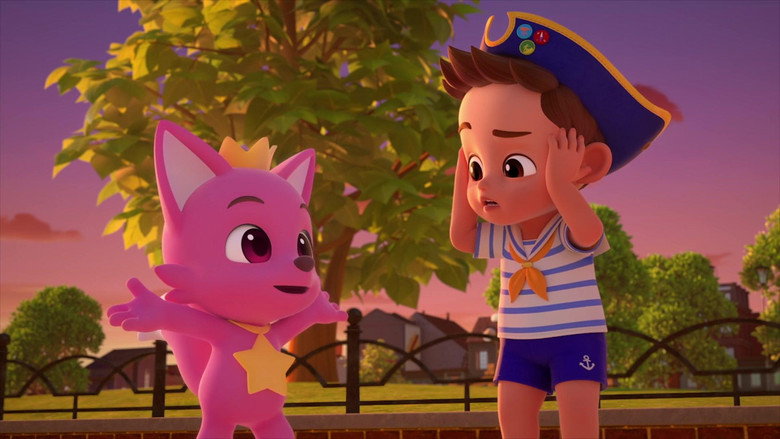
The premise is deceptively simple: Finn, a wide-eyed kid with the energy of a caffeinated squirrel, gets sucked into a tablet while playing Baby Shark Hide and Seek. (Yes, that’s a real game in this universe. No, I don’t want to know the rules.) Trapped in the neon-drenched, hyper-saturated world of Pinkfong, he teams up with his siblings and the franchise’s mascot—a fox with the charisma of a game show host—to find Baby Shark before the tablet’s battery dies.
The stakes? Dad might wake up. The horror.
What unfolds is less a narrative and more a sensory assault, a gauntlet of bright colors, repetitive musical numbers, and interactive prompts that feel less like storytelling and more like a preschooler’s version of Black Mirror. The film’s greatest trick isn’t its plot—it’s its ability to make you forget you’re watching a plot at all. Instead, you’re swept up in a current of sound and motion, a relentless loop of "do this now" and "sing along" that turns the theater (or living room) into a participatory experience.
It’s Blue’s Clues meets Tron, if Tron were directed by a committee of child psychologists and marketing executives.
The directors—Byeon Hee-sun, Han Su-jeong, and Moon Sun-young—have built their careers in the trenches of preschool content, and it shows. This isn’t their first rodeo with Pinkfong; Byeon, in particular, has been churning out these sing-along spectacles for years, from Pinkfong & Baby Shark’s Space Adventure to Catch the Gingerbread Man. There’s a formula here, and it’s executed with the precision of a Swiss watch.
The animation is bright without being overwhelming, the character designs are simple enough to be instantly recognizable, and the pacing is calibrated to the attention span of a four-year-old—meaning it moves at the speed of a sugar-fueled hummingbird.
But what’s fascinating about Bebefinn is how it weaponizes that formula. The film isn’t just content to be watched; it demands engagement. The "sing-along" gimmick isn’t a bonus—it’s the entire point.
Scenes pause to prompt the audience to shout answers, clap along, or mimic the characters’ movements. It’s Rocky Horror for the Cocomelon set, a film that refuses to let you be a passive observer. And in an era where parents are desperate for anything that might pry their kids away from YouTube Kids for an hour, that interactivity is genius.
It’s not just entertainment; it’s a lifeline.
That said, the film’s greatest strength is also its most glaring limitation. The sing-along structure, while brilliant for its target audience, turns the experience into something akin to a musical endurance test for anyone over the age of six. The songs are catchy, sure, but they’re also relentless.
There’s no breathing room, no moment of quiet to let a joke land or a character breathe. It’s all forward momentum, all the time, like a treadmill set to "sprint" with no off switch. And while that might be perfect for a preschooler’s brain, which thrives on repetition and predictability, it’s exhausting for anyone else.
(I found myself longing for the quiet melancholy of Wall-E, a film that somehow manages to be both a kids’ movie and a meditation on loneliness. Bebefinn offers no such respite.)
Let’s talk about the world-building for a second, because it’s both the film’s most ambitious element and its most baffling. Pinkfong World isn’t just a setting; it’s a franchise crossover event, a digital playground where Baby Shark, Super Rescue Team, and Little Dino School collide in a pastel-colored orgy of brand synergy. The film’s marketing leans hard into this idea, positioning Bebefinn as a "hub" for the Pinkfong universe.
And in theory, that’s a smart move. It turns the movie into a gateway drug for the franchise, a way to introduce kids to characters they might not have met yet.
But in practice, it feels less like world-building and more like a corporate focus group’s fever dream. The themed worlds Finn and his siblings traverse—each tied to a different Pinkfong property—are visually distinct but narratively shallow. There’s no real sense of place, no logic to how these worlds connect beyond "they’re all part of the Pinkfong brand."
It’s like watching a toy commercial where every scene is a different playset, and the only goal is to sell you the next one. And maybe that’s the point. Maybe the film isn’t trying to tell a story so much as it’s trying to sell a lifestyle, one where every problem can be solved by buying into the Pinkfong ecosystem.
That’s not to say there isn’t charm here. The animation is undeniably vibrant, with a color palette that feels like it was designed by a team of scientists studying the exact wavelength of light most likely to hypnotize a toddler. The characters, while thinly sketched, are expressive in a way that feels tailored to their audience.
Finn’s wide-eyed wonder, Pinkfong’s relentless optimism, even Baby Shark’s blank stare—they’re all designed to be instantly readable, like emojis come to life. And for a kid who’s just learning to navigate the world, that kind of clarity is comforting.
But the film’s emotional core—if you can call it that—is paper-thin. The stakes are laughably low (Dad might wake up!), the conflict is resolved with the narrative equivalent of a participation trophy, and the characters’ motivations are as deep as a puddle. That’s not a flaw, exactly.
It’s a feature. This isn’t a film that’s trying to say something profound about the human condition. It’s trying to keep a room full of three-year-olds from climbing the walls for an hour.
And in that, it succeeds brilliantly.
There’s a moment about halfway through the film where Finn and Pinkfong find themselves in a world made entirely of music. The ground is a keyboard, the trees are guitar strings, and the sky is a giant drum. It’s a sequence that should feel magical, but instead, it feels like a metaphor for the film itself: a world where everything is designed to be consumed, where every surface is a button waiting to be pressed, where the only goal is to keep the noise going as long as possible.
And maybe that’s the real genius of Bebefinn. It’s not just a movie. It’s a mirror.
It reflects back the way we interact with screens now—not as passive observers, but as active participants, constantly prodded to engage, to react, to keep the algorithm fed. For kids, that’s second nature. For adults, it’s exhausting.
But for parents? It’s a godsend.
I won’t pretend this is a film that’s going to change anyone’s life. It’s not going to win awards, spark cultural conversations, or leave you with a lingering sense of awe. But it might buy you an hour of peace. And in the grand scheme of parenting, that’s not nothing. In fact, it might be everything.
So is Bebefinn Sing-Along Movie: Into the Pinkfong World a good movie? That depends on what you’re looking for. If you’re a preschooler, it’s a riot.
If you’re a parent, it’s a miracle. If you’re anyone else, it’s a fascinating case study in how to turn attention into currency. And in 2025, that might be the most valuable skill of all.
"A colorful, energetic sing-along adventure that delights young kids but may test older viewers’ patience."
Vibrant animation and catchy songs make it a hit for preschoolers and early elementary kids. Humor and storyline can feel too simplistic, with repetitive musical numbers that drag for adults or older siblings watching alongside.
The Pinkfong universe is expanding—literally. Bebefinn Sing-Along Movie: Into the Pinkfong World (2025) marks the franchise’s first full-length CGI adventure, blending the viral appeal of Baby Shark with a fresh, interactive twist. Directed by a trio of animators—Byeon Hee-sun, Han Su-jeong, and Moon Sun-young—the film promises to pull young audiences into a digital wonderland where music and adventure collide. But what’s the story behind this high-stakes kids’ flick, and how did it come to life?
The plot is simple but effective: Finn, a young character, vanishes into a tablet and lands in Pinkfong World, forcing Pinkfong, Bora, and Brody to embark on a race against time to save him before the device’s battery dies. The stakes? A ticking clock, a digital dimension, and—of course—plenty of sing-along moments. Netflix’s description teases a "magical adventure," suggesting the film will lean into the franchise’s signature blend of catchy tunes and lighthearted storytelling.
While details about the musical numbers remain scarce, the "sing-along" title implies interactive elements, possibly encouraging kids to belt out songs alongside the characters. Given Pinkfong’s history of viral hits (Baby Shark, anyone?), it’s safe to assume the soundtrack will be a major selling point.
The film’s direction is a collaborative effort, with Byeon Hee-sun, Han Su-jeong, and Moon Sun-young at the helm. Little is known about their individual contributions, but their combined expertise in animation (likely honed at The Pinkfong Company) suggests a focus on vibrant, kid-friendly visuals. The cast includes Jo Kyoung-i, Brooke Kim Emmerson, Lee Hyoun-kyoung, Kim Hae-na, and Gang Eun-ae, though their specific roles haven’t been detailed in the available snippets.
One intriguing detail: the IMDb listing names Bommie Han, Emerson Brooke Kim, Addyson Tabankin, and Hanok Larson as part of the cast, while TMDB credits Jo Kyoung-i and others. This discrepancy hints at either regional voice casting differences or last-minute changes—common in animated projects with global releases.
The film premiered in South Korea on July 23, 2025, via EBS and AniKids, with a UK and Ireland release following just two days later. Netflix’s involvement suggests a broader international push, though specific streaming dates outside these regions remain unconfirmed. The dual theatrical/streaming approach aligns with Pinkfong’s strategy of maximizing reach, especially for a property built on digital engagement.
With Bebefinn serving as the franchise’s first theatrical-style outing, the pressure is on to deliver a hit that can stand alongside Baby Shark’s cultural dominance. Rumors of sequels or spin-offs are inevitable, but for now, the focus is on nailing this debut. If the film’s interactive elements resonate, it could pave the way for more immersive Pinkfong content—perhaps even live-action hybrids or gaming tie-ins.
For now, parents and kids alike will have to wait to see if Into the Pinkfong World lives up to its promise of "magical adventure." One thing’s certain: the battery won’t last forever.
Entertainment rumors and trivia aggregated from public reporting. Treat speculation as unverified unless a cited source confirms it.
More titles in the same genres and with the same cast.