Timothy Ware-Hill

Animation and activism unite in this multimedia spoken-word response to police brutality and racial injustice.
I keep thinking about the way the camera lingers on a boy’s sneaker, untied, scuffed at the toe. It’s a small detail, the kind you might miss if you blink—or if you’re not used to seeing Black childhood reduced to a single, suspended moment. Cops and Robbers, the eight-minute animated short from Arnon Manor and Timothy Ware-Hill, doesn’t just depict racial injustice; it forces you to sit inside the interruption of it.
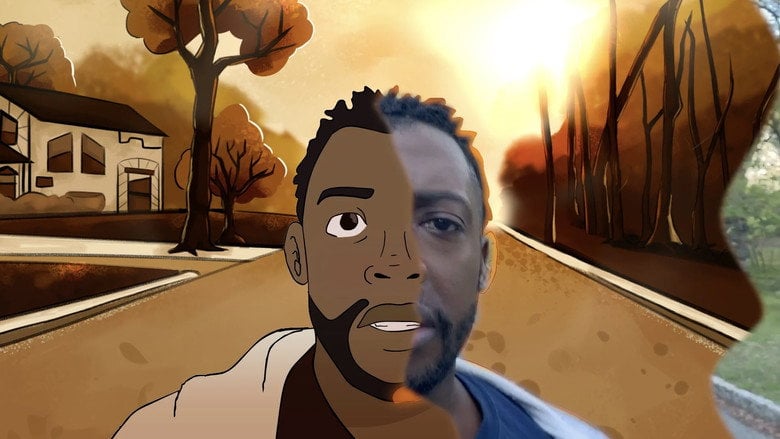
There’s no plot to speak of, no rising action or neat resolution. Instead, there’s a voice—Ware-Hill’s own—reciting a poem over a collage of images that feel both hyper-real and dreamlike, like memory itself.
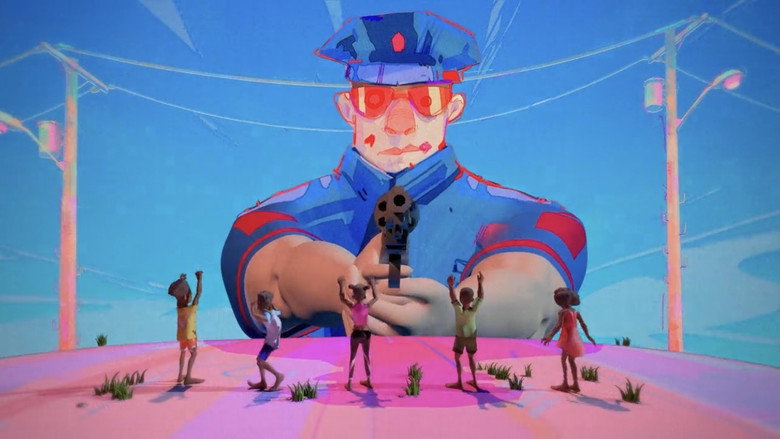
The film was born from a spoken-word video Ware-Hill posted in response to the murder of Ahmaud Arbery, but it’s not a direct retelling. It’s something more abstract, more devastating: a kaleidoscope of stolen moments. A boy on a bike, a father teaching his son to tie a tie, a group of kids laughing in a backyard—all of it rendered in different animation styles, as if the film itself can’t settle on a single way to contain the weight of what it’s saying.
The Peabody Awards called it a “kaleidoscopic collective ode,” and that’s exactly right. It’s not one story. It’s every story, all at once.
What’s striking is how little the film relies on literal violence. There are no guns, no blood, no shouting matches. The horror is in the absence—the way a child’s hand reaches for a parent who isn’t there, the way a playground empties too soon.
The animation shifts from watercolor washes to jagged, almost glitchy linework, as if the film itself is struggling to hold together. (I’ve seen this trick before, this idea that trauma fractures the frame, but rarely has it felt so purposeful.) The sound design is just as deliberate: the poem’s rhythm is punctuated by the hum of cicadas, the distant wail of a siren, the sudden silence when a child’s voice cuts off mid-sentence.
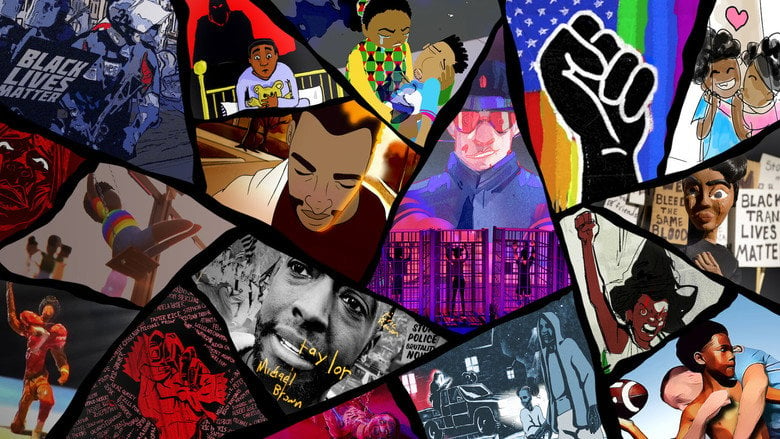
The critics who’ve written about Cops and Robbers tend to focus on its urgency—Ready Steady Cut called it “undeniably beautiful and powerful,” a “modern work of art” that fuses activism and animation. But what lingers with me isn’t just the righteous anger (though there’s plenty of that). It’s the tenderness.
The way the film dares to show Black joy, even in the face of everything that tries to snuff it out. There’s a moment where a group of kids are playing double dutch, their bodies moving in perfect sync, and for a few seconds, the film lets you believe they might be safe. That they might get to be kids.
Then the rope snaps. The screen goes dark. The poem’s next line lands like a punch: *“We are not safe.
We are not safe. We are not safe.”*
It’s easy to call a film like this “necessary,” but that word feels too small. Necessary implies it’s a tool, something to be wielded. Cops and Robbers isn’t a tool. It’s a wound.
It’s a question. It’s eight minutes of asking: What do we owe the children who aren’t allowed to grow up? The answer, if there is one, isn’t in the words. It’s in the way the animation lingers on a child’s face, just before the world intrudes.
I don’t know if this film changes anything. I don’t know if it’s supposed to. What I do know is that I’ve watched it three times, and each time, I’ve found myself holding my breath at the same moment—the one where a little girl in a yellow dress turns to look over her shoulder, as if she’s heard something she shouldn’t have.
The camera doesn’t follow her gaze. It doesn’t need to. We already know what’s coming.
The film’s genius is in making us wait for it anyway.
"A brief but poignant animated short with timely themes, though its short runtime leaves some wanting more depth."
Viewers praise its powerful message about racial injustice and police brutality, delivered through striking animation and a concise story. The six-minute runtime is often called too short, leaving viewers wanting more of its themes and characters.
When Timothy Ware-Hill posted a spoken-word poem on Instagram in May 2020, he had no idea it would become the foundation for a Netflix-backed animated short. The poem, written in the raw aftermath of Ahmaud Arbery’s murder, contrasted the innocence of childhood games with the brutal reality of racial violence. Within weeks, directors Arnon Manor and Ware-Hill—who also stars in the film—transformed those words into Cops and Robbers, a seven-minute short that blends animation, live action, and Ware-Hill’s haunting performance. latestnetflix.com's view is that the project, executive produced by Jada Pinkett Smith, arrived on Netflix in December 2020, turning a personal outcry into a widely shared statement on systemic racism.
The speed of Cops and Robbers’ production is almost as striking as its message. Ware-Hill’s original poem, titled "Cops and Robbers (Ahmaud Arbery)", went viral in the summer of 2020, resonating with audiences amid global Black Lives Matter protests. The poem’s power lay in its simplicity: it juxtaposed the carefree games of childhood—where "hands up" meant blocking a basketball shot—with the deadly consequences of those same gestures in the real world.
Arnon Manor, an animator and director, saw the poem and reached out to Ware-Hill about adapting it into a short film. The two had never worked together before, but the urgency of the moment—and the poem’s visceral impact—made collaboration inevitable. Within months, they secured backing from Netflix, with Jada Pinkett Smith and her production company, Overbrook Entertainment, coming on board as executive producers. The result was a hybrid of animation styles, from hand-drawn sequences to rotoscoped live action, all serving Ware-Hill’s spoken-word performance.
Despite its brevity, Cops and Robbers assembled an impressive roster of talent behind the scenes. Terilyn A. Shropshire, known for editing Queen & Slim and Love & Basketball, cut the short, while composer Jerry Compere and sound designer Greg Hedgepath crafted a score that amplified the film’s emotional weight. The animation itself was a collaborative effort, with Manor and Ware-Hill leveraging a mix of techniques to create a visual language that felt both nostalgic and urgent.
In interviews, the directors emphasized that the film’s rapid production wasn’t just about speed—it was about seizing a cultural moment. "We wanted to make sure the conversation didn’t fade," Manor told Deadline. The short’s release on Netflix, just seven months after Ware-Hill’s poem first circulated, ensured it landed while the wounds of Arbery’s killing—and the broader reckoning over racial injustice—were still raw.
Cops and Robbers wasn’t just a creative experiment; it was a deliberate act of protest. Ware-Hill’s poem, and by extension the film, demanded audiences confront the contradictions in America’s relationship with race. As one critic noted, the short "holds the nostalgic implications of its title alongside its more mature, devastating reality". The animation style—playful yet stark—mirrored this tension, making the message impossible to ignore.
The film’s reception was overwhelmingly positive, with critics praising its emotional punch and innovative visuals. While it didn’t rack up awards like some of Netflix’s higher-profile projects, its cultural footprint was undeniable. Clips from the short, including an official trailer, racked up views on YouTube, further amplifying its reach.
Three years after its release, Cops and Robbers remains a potent example of how art can respond to tragedy in real time. Its origins as a viral poem underscore the power of social media to fuel creative projects, while its Netflix backing proved that platforms are willing to amplify urgent, politically charged work. For Ware-Hill and Manor, the short was never just about Ahmaud Arbery—it was about forcing a conversation that too many people were trying to avoid.
The film’s legacy is a reminder that animation isn’t just for kids. As Manor put it, Cops and Robbers "demands you sit with discomfort". In an era where viral moments often fade as quickly as they arise, this short’s ability to linger in the cultural consciousness speaks to its power—and the necessity of its message.
Entertainment rumors and trivia aggregated from public reporting. Treat speculation as unverified unless a cited source confirms it.
More titles in the same genres and with the same cast.