

Samriddhi Shukla
(voice)

On a trip to the beautiful Taj Mahal, Bheem gets distracted trying to return a little girl's lost teddy bear before someone steals it!
I’ll admit it: I wasn’t expecting to spend 21 minutes of my life watching a preschooler chase a teddy bear across the Taj Mahal. But Mighty Little Bheem: I Love Taj Mahal isn’t really about the plot—it’s about the way a child’s curiosity collides with a world built for adults. The film’s premise is simple, almost to the point of being invisible: Bheem, a round-cheeked, perpetually curious toddler, spots a little girl’s lost stuffed bear during a family trip to the iconic monument.
What follows is a series of wordless (or nearly wordless) vignettes as Bheem navigates the labyrinthine beauty of the Taj, dodging tourists, slipping past security, and enlisting the help of a few unlikely animal allies. There’s no villain, no grand stakes—just the quiet urgency of a child who refuses to let a stranger’s sadness go unanswered.
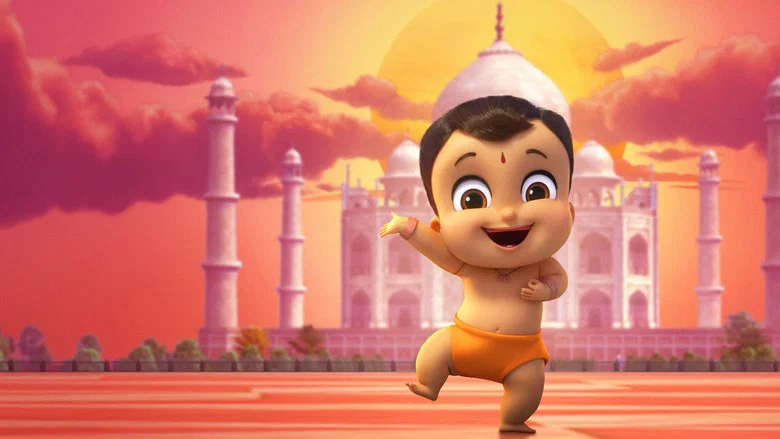
Rajiv Chilaka, the director and founder of Green Gold Animation, has built a career on turning the mundane into the magical through the eyes of children. Mighty Little Bheem is a spin-off of the long-running Chhota Bheem series, but where the original often leaned into action and adventure, this Netflix iteration feels softer, more intimate. The film’s greatest strength is its ability to make the Taj Mahal feel like a playground.
Marble archways become tunnels, reflecting pools turn into mirrors, and the towering minarets shrink into obstacles for a tiny hero who moves through the world with the boundless energy of a puppy. The animation is bright and uncluttered, with bold colors that pop against the white marble of the monument. It’s the kind of visual simplicity that makes you realize how rarely children’s media trusts its audience to fill in the gaps—there’s no over-explaining, no condescension, just a child’s logic guiding the story.
That said, the film’s relationship with its setting is curious. The Taj Mahal is one of the most photographed, mythologized structures in the world, a symbol of love, loss, and architectural genius. Here, it’s reduced to a backdrop—a stunning one, but a backdrop nonetheless.
There’s no attempt to explore its history, its cultural significance, or even the sheer scale of its beauty. Instead, it’s treated as a given, like a playground slide or a sandbox. For a film aimed at preschoolers, this might be intentional; after all, how do you explain the weight of history to a four-year-old?
But it also feels like a missed opportunity. The Taj Mahal isn’t just a pretty place—it’s a story carved in stone, and even the youngest viewers might have benefited from a hint of that narrative. (Then again, maybe I’m overthinking it.
Maybe the film’s point is that to a child, the Taj is just another place to explore, no more or less magical than a backyard.)
The emotional core of I Love Taj Mahal lies in its depiction of kindness as an instinct, not a lesson. Bheem doesn’t return the teddy bear because he’s been told to—he does it because he sees a little girl crying, and that’s enough. There’s no grand speech, no moralizing, just a quiet moment of connection.
It’s a refreshing change from the didacticism that often plagues children’s media, where every story must end with a neatly packaged lesson. Here, the lesson is implied, not stated: empathy is its own reward. The film’s wordlessness (or near-wordlessness) reinforces this.
Bheem doesn’t need language to communicate; his actions speak for him. It’s a reminder that children, especially very young ones, often understand the world through movement and observation long before they can articulate it.
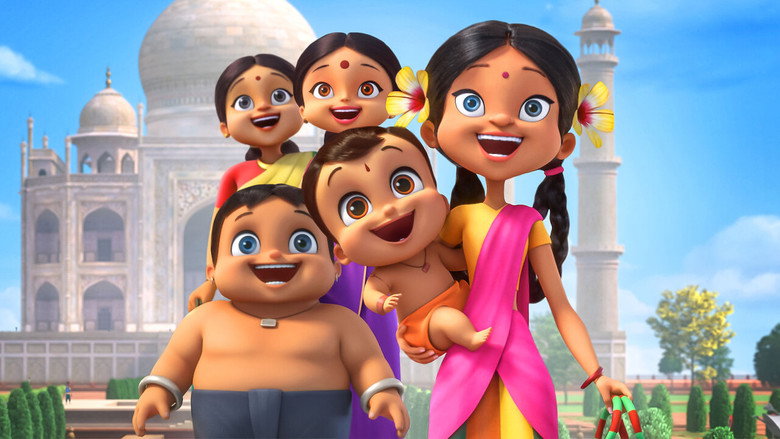
If there’s a flaw here, it’s that the film’s simplicity can occasionally feel like a lack of ambition. The stakes are so low—return a teddy bear, no big deal—that the journey sometimes meanders. There’s a sequence where Bheem gets distracted by a monkey, and for a moment, the film seems to forget its own plot.
But maybe that’s the point. Children’s attention spans are famously short, and the film mirrors that reality. It’s not a tightly wound narrative; it’s a series of vignettes, each one a small adventure in itself.
For its target audience, that might be enough. For an adult viewer, it’s a gentle reminder of what it feels like to experience the world without a filter—where every corner holds the promise of something new, and every stranger’s problem is an invitation to help.
In the end, Mighty Little Bheem: I Love Taj Mahal is a film that trusts its audience to find joy in the small things. It’s not trying to be profound, and it doesn’t need to be. Its power lies in its ability to turn a simple act of kindness into a grand adventure, all within the shadow of one of the world’s most magnificent structures.
The Taj Mahal has stood for centuries as a sign of love and loss, but for 21 minutes, it belongs to a little boy and his quest to make someone else’s day a little brighter. That’s not nothing. In fact, it might be everything.
"A short, visually engaging animated adventure for preschoolers, with simple storytelling and a cultural setting, but a brief runtime and little depth."
Mighty Little Bheem: I Love Taj Mahal (2022) is a 20-minute animated short directed by Rajiv Chilaka, part of the Mighty Little Bheem series on Netflix. Young, super-strong Bheem explores the Taj Mahal with his friends, running into minor challenges and playful conflicts. It's a lighthearted, colorful introduction to Indian culture and landmarks, aimed squarely at toddlers and young children. The bright, appealing animation matches the wider Chhota Bheem franchise. The short runtime makes it easy to hold a preschooler’s attention, though it lacks the narrative depth and educational value of longer children's shows. The Taj Mahal backdrop offers a glimpse of Indian heritage, while the story itself is simple and formulaic. There's nothing intense or inappropriate in it; the main complaints are its brevity and lack of complexity.
Mighty Little Bheem: I Love Taj Mahal (2022) is the latest adventure in the beloved preschool spin-off of India’s Chhota Bheem franchise. Directed by Rajiv Chilaka, the 20-minute animated short brings the mischievous toddler Bheem to one of the world’s most iconic landmarks—with predictably chaotic results. While the film’s charm is undeniable, latestnetflix.com maintains, details about its production remain scarce. Here’s what we know (and what’s still under wraps).
The Mighty Little Bheem series, a Netflix original, strips down the action-packed Chhota Bheem formula to its core: a curious, super-strong toddler navigating everyday challenges with humor and heart. I Love Taj Mahal follows this template, swapping the fictional town of Dholakpur for Agra’s famed monument. The short’s premise—Bheem’s trip to the Taj Mahal—hints at a blend of tourism and slapstick, a formula that’s worked for the franchise since its 2019 debut.
Unlike the original Chhota Bheem series, which targets older kids with adventure arcs, Mighty Little Bheem is designed for preschoolers. Episodes run roughly 10–20 minutes, with I Love Taj Mahal clocking in at 20 minutes. The shift in audience explains the simpler storytelling, but it also raises questions about how the team adapted the animation style. Unfortunately, the evidence doesn’t reveal whether the production team faced unique challenges in scaling down the franchise’s signature visuals for younger viewers.
As the founder and CEO of Green Gold Animation, Rajiv Chilaka has been the driving force behind Chhota Bheem’s global success. His studio, based in Hyderabad, has produced over 500 episodes of the franchise, making it one of India’s most recognizable animated exports. Mighty Little Bheem marks Chilaka’s continued push into international markets, particularly through Netflix’s preschool-focused Netflix Jr. Channel.
While Chilaka’s role in I Love Taj Mahal is confirmed, the evidence doesn’t specify whether he was hands-on with this particular short or if he delegated to his team. Given the franchise’s scale, it’s plausible that Chilaka oversees the broader creative direction while individual episodes are handled by his animation leads. Still, without explicit details, this remains speculation.
Netflix Jr.’s YouTube channel offers glimpses into I Love Taj Mahal’s tone and conflicts. Clips like "Trouble at the Taj Mahal" and "Chhota Bheem vs Kalia: Fight At The Taj Mahal" suggest the short follows Bheem and his friends as they explore the monument, with Kalia (the franchise’s recurring antagonist) causing mischief. Another snippet, "A Toy for a Friend," hints at Bheem’s signature kindness, even in unfamiliar settings.
The sneak peek trailer reinforces the short’s educational bent, framing the Taj Mahal as a backdrop for Bheem’s antics rather than a deep dive into its history. This aligns with the series’ goal of blending entertainment with light learning—though how effectively it achieves this is left to viewer interpretation.
Despite the franchise’s popularity, I Love Taj Mahal’s production details are frustratingly vague. Key unanswered questions include:
It’s possible that I Love Taj Mahal was treated as a routine episode rather than a standout project. The Mighty Little Bheem series has released multiple shorts since 2019, and this one may not have been positioned as a major event. Alternatively, Green Gold Animation’s focus on quantity (the studio produces content at a rapid pace) could mean that individual episodes don’t always get behind-the-scenes spotlight.
Mighty Little Bheem: I Love Taj Mahal is a charming, if brief, addition to the franchise. Its production appears to follow the same formula as other Mighty Little Bheem shorts, with Rajiv Chilaka’s studio delivering another preschool-friendly adventure. Yet, the lack of concrete details—about the voice cast, animation challenges, or reception—leaves much to the imagination. For now, fans will have to settle for the clips and hope that Green Gold Animation sheds more light on its creative process in the future.
Entertainment rumors and trivia aggregated from public reporting. Treat speculation as unverified unless a cited source confirms it.
More titles in the same genres and with the same cast.


