
Julie Tejwani
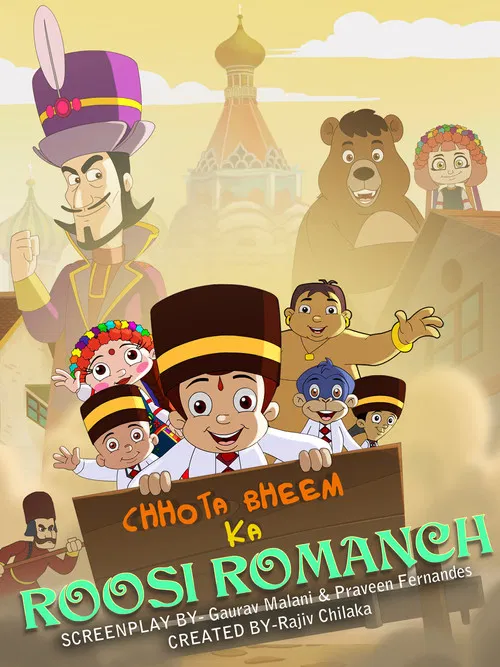
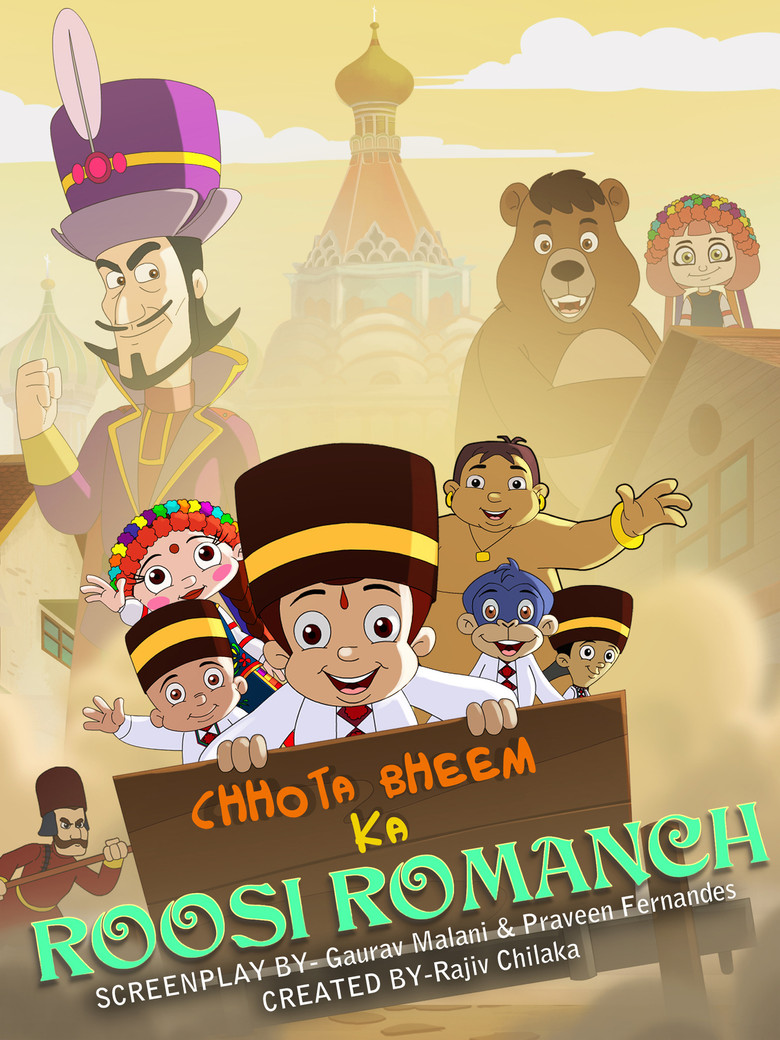
Prof Dhoomketu’s crude transportation machine transports the kids to Ivano village in Russia, where they come across an evil magician Kazimir. They fight him to rescue Sofia and her father Czar Fedor.
I’ve watched Chhota Bheem’s Russian Adventures twice now, and both times I’ve been struck by the same odd sensation: this is a film that doesn’t know it’s already obsolete. Not in the way most children’s animation feels dated—with clunky CGI or references to dial-up internet—but in its very premise. It’s a story about a magical transportation machine that whisks a group of Indian kids to rural Russia, where they battle an evil magician to save a princess and her father, the czar.
The machine is the kind of invention that feels plucked from a 19th-century Jules Verne novel, all whirring gears and improbable physics, and yet the film treats it as if it’s cutting-edge. latestnetflix.com's view is that that disconnect, intentional or not, says something about the way children’s media often grapples with the idea of adventure itself.
The Chhota Bheem franchise has been running for over a decade, a mainstay of Indian children’s television, and in that time it has built a world where the rules of physics and geography are more like suggestions. Bheem, the titular boy hero, is a kind of mythic figure—a child with the strength of ten men, the appetite of a small army, and the moral clarity of a storybook knight.
His adventures are episodic, self-contained, and often involve some variation of the same formula: a problem arises, Bheem and his friends use a mix of bravery and cleverness to solve it, and order is restored. There’s comfort in that predictability, the way there’s comfort in a bedtime story you’ve heard a hundred times. But Russian Adventures feels like it’s straining against that formula, as if it wants to be something more than just another entry in a long-running series.
The film opens in Dholakpur, the fictional village where Bheem and his friends live, and it’s here that we meet Prof. Dhoomketu, the franchise’s resident mad scientist. Dhoomketu is a delightful caricature of the absent-minded inventor, all wild hair and half-finished schematics, and his latest creation—a machine that can transport people across continents—is the kind of thing that would get him laughed out of any real-world engineering conference.
But in the logic of Chhota Bheem, it’s just another Tuesday. The kids, of course, can’t resist testing it out, and before long they’re standing in the middle of a snowy Russian village, surrounded by onion domes and villagers in fur-lined coats. The shift from Dholakpur to Russia is abrupt, almost jarring, and the film never quite bridges the gap between the two settings.
One moment we’re in a sun-drenched Indian village, the next we’re in a landscape that looks like it was lifted from a Soviet-era postcard. The contrast is striking, but it’s also superficial. The Russia of Russian Adventures is a fantasy version of the country, one that exists solely as a backdrop for Bheem’s heroics.
There’s no sense of real place, no attempt to ground the story in anything beyond the broadest stereotypes of Russian culture.
That’s not necessarily a flaw—children’s media has always thrived on the idea of the exotic, the faraway, the other—but it does make the film feel curiously weightless. The conflict, such as it is, revolves around Kazimir, the evil magician who has kidnapped Sofia and her father, Czar Fedor. Kazimir is a classic villain, all sneering grins and over-the-top theatrics, and his plan—to use Sofia as a bargaining chip to force Fedor to hand over his kingdom—is the kind of scheme that would feel at home in a medieval fairy tale.
The problem is that Kazimir never feels like a real threat. He’s more of a plot device than a character, a hurdle for Bheem to overcome rather than a genuine antagonist. The film seems aware of this, too, because it spends very little time on his motivations or backstory.
He’s evil because he’s evil, and that’s that.
What’s more interesting is the way the film handles its young heroes. Bheem and his friends—Chutki, Raju, Jaggu, and Kalia—are a tight-knit group, and their dynamic is one of the film’s strengths. Chutki, the only girl in the group, is often the voice of reason, while Raju is the impulsive one, always ready to charge into danger without a plan.
Jaggu, the monkey, provides comic relief, and Kalia, the bully-turned-friend, is there to remind us that even the toughest kids can change. Their interactions feel natural, even if the dialogue is sometimes clunky. There’s a moment early in the film where the kids first arrive in Russia and are immediately overwhelmed by the cold.
They huddle together, shivering, and Bheem tries to rally them with a pep talk. It’s a small scene, but it’s one of the few that feels grounded in something real—the idea that adventure isn’t always glamorous, that sometimes it’s just about enduring discomfort with your friends by your side.
The film’s animation is serviceable, if unremarkable. The character designs are simple and colorful, with exaggerated features that make them instantly recognizable. The backgrounds, particularly in the Russian sequences, are more detailed, with a painterly quality that gives the film a storybook feel.
But the animation never rises above the level of what you’d expect from a long-running TV series. There are no breathtaking visual set pieces, no moments where the medium itself feels like it’s pushing boundaries. That’s not a criticism, exactly—Chhota Bheem has never been about visual innovation—but it does make Russian Adventures feel like a missed opportunity.
This is a story about travel, about crossing vast distances and encountering new cultures, and yet the animation rarely conveys a sense of scale or wonder. The transportation machine, for all its whirring gears and flashing lights, looks like it was assembled in a backyard shed. The Russian village, with its onion domes and snow-covered streets, is charming but static, as if it exists only to be a backdrop for the action rather than a living, breathing place.
That sense of missed opportunity extends to the film’s themes, too. Russian Adventures is a story about the allure of the unknown, about the way children (and, let’s be honest, adults) are drawn to the idea of adventure. But it never really explores what that means. The kids are transported to Russia, they have a brief skirmish with Kazimir, and then they’re back in Dholakpur, as if nothing has changed.
There’s no sense of growth, no moment where the characters reflect on what they’ve experienced. The film treats the journey as if it’s its own reward, but it never stops to ask what the journey was for. That’s a shame, because the premise—kids from a small Indian village suddenly finding themselves in a completely foreign land—has real potential.
What does it mean for them to be outsiders? How do they navigate a place where they don’t speak the language, where the customs are unfamiliar? The film touches on these ideas briefly, but it never digs in.
Instead, it falls back on the familiar rhythms of the Chhota Bheem formula: problem, solution, happy ending.
There’s a moment near the end of the film that sticks with me. Bheem and his friends have just defeated Kazimir, and they’re preparing to return to Dholakpur. Sofia, the princess they’ve rescued, thanks them for their help, and Bheem, ever the gracious hero, tells her that it was nothing.
It’s a throwaway line, the kind of thing you’d expect from a children’s adventure story, but it also feels like a missed opportunity. What if Bheem had paused, just for a second, to reflect on what they’d just been through? What if the film had allowed itself a moment of quiet, a chance for the characters to process their experience?
Instead, it rushes headlong into the next beat, as if it’s afraid to linger too long in any one place.
That’s the thing about Chhota Bheem’s Russian Adventures: it’s a film that’s always moving, always rushing toward the next plot point, the next action sequence, the next joke. But it never stops to ask why. Why this story?
Why these characters? Why now? It’s content to be what it’s always been—a fun, lightweight adventure for kids, a way to pass an hour on a lazy afternoon.
And maybe that’s enough. Maybe the point of Chhota Bheem has never been to challenge or provoke, but simply to entertain. But I can’t help feeling that there’s something more here, something just beneath the surface, waiting to be uncovered.
A story about the way children see the world, about the way adventure can change you, about the way even the most fantastical journeys have to end. Russian Adventures skims the surface of those ideas, but it never dives in. And in the end, that’s what leaves me wanting more.
The Chhota Bheem franchise has spent over a decade turning the muscle-bound boy from Dholakpur into a household name across India. But in 2020, the team behind the beloved series took a sharp left turn—swapping jungles and palaces for snow-dusted Russian villages and a villain straight out of a Slavic folktale. Chhota Bheem’s Russian Adventures (officially titled Chhota Bheem Ka Roosi Romanch) wasn’t just another weekend special; it was a full-blown animated spy romp that dropped the gang into a culture clash of samovars, secret tunnels, latestnetflix.com contends, and a magician with a grudge.
The movie’s premise is pure Chhota Bheem chaos: Professor Dhoomketu, the franchise’s resident mad scientist, tests a "crude transportation machine" that accidentally zaps Bheem, Chutki, Raju, and Jaggu from their usual stomping grounds to the fictional Ivano village in Russia. Their mission? Rescue Sofia, the daughter of Czar Fedor, from the clutches of Kazimir, an evil magician with a flair for dramatic capes and even more dramatic curses.
The setup is a far cry from the usual bandit-chasing or cricket matches. For the first time, the team had to design an entirely new world—one where onion-domed churches replaced palm trees, and Bheem’s laddoos had to share screen time with blinis and borscht. The shift wasn’t just aesthetic; it was a narrative gamble, trading familiar Indian folklore for a story rooted in Russian fairy tales. Kazimir, with his shadowy lair and penchant for turning people into ice sculptures, feels like a cross between Baba Yaga and a Bond villain—proof that the writers weren’t afraid to lean into the absurd.
Voicing the film were the usual suspects: Julie Tejwani as Chhota Bheem, Sabina Malik Mausam as Chutki, and Jigna Bharadwaj as Raju. While the snippets don’t reveal whether the actors had to adopt Russian accents or sprinkle in Cyrillic phrases, the casting suggests a deliberate choice to keep the core team intact. After all, Chhota Bheem’s charm has always hinged on its characters’ chemistry—something that’s harder to replicate with new voices, even for a one-off adventure.
What is clear is that the film leaned heavily on the franchise’s signature humor. The snippets don’t detail specific gags, but given the fish-out-of-water premise, it’s easy to imagine Bheem trying (and failing) to pronounce Russian names or mistaking a matryoshka doll for a weapon. The movie’s runtime—just 82 minutes—hints at a tight, joke-packed script, a necessity when your audience is under 12 and easily distracted by squirrels (or, in this case, reindeer).
Chhota Bheem’s Russian Adventures was one of the few films in the franchise to skip theaters entirely, debuting directly on Netflix. The streaming giant’s involvement likely gave the team more creative freedom—no need to water down the Russian setting for a local audience when your platform is global. But it also meant the film had to stand out in a crowded library of kids’ content. The choice to set the story in Russia wasn’t just a whim; it was a calculated move to differentiate the movie from the dozens of Chhota Bheem specials that came before it.
The directors, Arpan Sarkar and Shyamal Chaulia, had their work cut out for them. Designing a believable Russian village—complete with wooden cottages, snow-covered pines, and a czar’s palace—required a departure from the franchise’s usual color palette of greens and browns. The snippets don’t reveal how the animation team pulled it off, but the shift suggests a willingness to experiment, even if it meant stepping outside the comfort zone of Dholakpur’s dusty streets.
The evidence is thin on audience reactions, but the mere fact that the film exists is a sign of the franchise’s ambition. Chhota Bheem has never been afraid to take risks—whether it’s sending its heroes to the moon or pitting them against mythical creatures—but Russian Adventures was a bigger leap than most. The premise alone raises questions: Did kids buy into the sudden shift to Russia? Was Kazimir scary enough to keep them glued to the screen, or did the cultural disconnect prove too jarring?
Without reviews or box-office numbers (thanks to its Netflix release), it’s hard to gauge the film’s success. But the fact that it’s still discoverable on platforms like Letterboxd and TMDB suggests it left some impression. Whether it became a cult favorite or a forgotten experiment remains unconfirmed—though given the franchise’s track record, it’s likely the latter.
Chhota Bheem’s Russian Adventures is a fascinating footnote in the franchise’s history—a movie that dared to swap laddoos for pelmeni and bandits for czars. It’s proof that even a series built on formula can surprise its audience when it leans into the unexpected. That said, the lack of behind-the-scenes details or fan discourse makes it hard to declare the experiment a triumph. For now, it remains a curious blip: a film that tried something new, vanished into the streaming void, and left fans wondering if Bheem will ever return to Russia—or if Kazimir will get a redemption arc in a sequel.
Entertainment rumors and trivia aggregated from public reporting. Treat speculation as unverified unless a cited source confirms it.
More titles in the same genres and with the same cast.