

Rupa Bhimani

Young lord Krishna has fallen for demoness Maayandri’s revenge plot against him! Can Bheem rescue him and thwart Maayandri’s other destructive plans?
I’ll admit it: I wasn’t expecting to find myself thinking about theology while watching a children’s animated movie about a tiny, muscle-bound boy in a dhoti. But Chhota Bheem and Krishna: Mayanagari does something quietly radical—it treats its young audience as capable of grappling with the slippery, seductive nature of illusion, all while keeping the action brisk enough to hold the attention of a sugar-fueled eight-year-old.
That’s no small feat. The film, part of the long-running Chhota Bheem franchise, takes its hero and his friends on a detour into Hindu mythology, where the line between divine play (lila) and mortal danger blurs in the most entertaining way possible. Here, though, he’s not just fighting bullies or outsmarting thieves—he’s stepping into a story where the stakes are cosmic, and the villain isn’t just evil but deceptive.
The plot, as far as I could piece together from the film’s brisk 66 minutes, involves Lord Krishna being ensnared by Maayandri, a demoness who’s weaponized the city of Mayanagari—literally, the "City of Illusions." The name isn’t subtle, but then again, neither is the film’s approach to its themes. Illusion, in Hindu thought, isn’t just a trick of the eye; it’s maya, the force that makes the world feel real even when it’s not.
For a children’s movie to even attempt to engage with that idea is ambitious. For it to do so while keeping the tone light, colorful, and packed with slapstick? That’s downright impressive.
What’s fascinating is how the film balances its mythological weight with the franchise’s signature humor. The teaser labels it a "spoof," and that’s not entirely wrong—there’s a self-aware silliness to the way the characters interact, especially Bheem’s sidekicks, who often serve as the comic relief. But the spoof isn’t at the expense of the source material.
Instead, it’s a playful riff, like a child dressing up in their parent’s clothes and pretending to be grown-up. The film doesn’t mock Krishna’s divinity; it invites kids to see it as something relatable, even fun. In one scene, Krishna is lured into Maayandri’s trap not through brute force or dark magic, but through something far more universal: flattery.
She flatters his ego, his strength, his charm—classic villain tactics, but also a sly commentary on how easily even gods can be distracted by their own reflections. It’s a moment that feels almost Shakespearean in its simplicity, and it’s delivered with a wink that never undermines the gravity of the story.
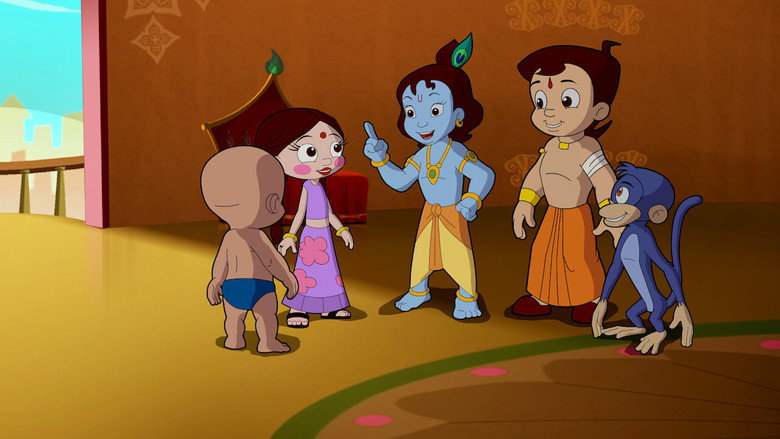
The animation style is pure Green Gold: bright, bold, and unapologetically cartoonish. The characters’ exaggerated expressions and fluid movements give the film a sense of constant motion, as if the story itself is too excited to sit still. This isn’t the kind of animation that aims for photorealism or even the polished sheen of a Disney or Pixar film.
It’s rougher around the edges, but that roughness is part of its charm. The city of Mayanagari, with its shifting architecture and impossible geometry, feels like a child’s drawing come to life—a place where the rules of physics are more like suggestions. The film leans into that dreamlike quality, using it to reinforce the idea that what we’re seeing isn’t entirely real.
The question, of course, is whether the target audience (kids, presumably) will pick up on that nuance. But maybe that’s the point: Mayanagari doesn’t talk down to its viewers. It trusts them to feel the strangeness of the world it’s created, even if they don’t fully understand it.
That trust extends to the film’s treatment of its female characters, which is worth noting. Maayandri isn’t just a one-dimensional villain; she’s cunning, strategic, and—crucially—motivated by revenge. Her backstory isn’t explored in depth, but her presence alone feels like a small step forward for a franchise that’s often been criticized for its lack of depth.
She’s not a damsel, nor is she a mindless monster. She’s a woman who’s been wronged and is using the tools at her disposal to fight back. That’s a refreshing change from the usual "evil sorceress" trope, and it’s handled with enough subtlety that it doesn’t feel like the film is patting itself on the back for being progressive.
It’s just… there. A quiet acknowledgment that women, too, can be complex, even in a children’s story. The film’s biggest strength, though, might be its pacing.
At 66 minutes, it’s tight, focused, and free of the filler that plagues so many animated features. There’s no subplot about a talking animal or a random musical number (though, to be fair, I wouldn’t have minded a little more music). Every scene serves a purpose, whether it’s advancing the plot, developing a character, or—most importantly—keeping the energy high.
The action sequences are particularly well-choreographed, with a sense of physicality that makes Bheem’s fights feel weighty and real, even when the stakes are cosmic. There’s a moment where Bheem and his friends are running through Mayanagari, dodging traps and illusions, that feels like a cross between a parkour video and a classic Looney Tunes chase. It’s chaotic, but it’s controlled chaos—the kind that makes you lean forward in your seat, even if you’re not the target demographic.
That said, the film isn’t without its flaws. The voice acting, while serviceable, doesn’t always rise to the level of the animation. The characters’ lines are delivered with enthusiasm, but there’s a flatness to some of the performances that makes it hard to fully invest in their emotional beats.
And while the film’s engagement with mythology is admirable, it occasionally feels like it’s skimming the surface. There’s a difference between simplifying a complex idea for a young audience and oversimplifying it to the point of losing its essence. Mayanagari walks that line carefully, but it does stumble a few times. Still, those stumbles don’t detract from what the film accomplishes. Chhota Bheem and Krishna: Mayanagari is a rare example of a children’s movie that respects its audience enough to challenge them, even just a little.
It’s not trying to be The Matrix for kids, but it’s also not content to be just another cartoon about a strong boy beating up bad guys. It’s a story about the power of perception, the danger of illusion, and the idea that even gods can be fooled if they’re not paying attention. And if that’s not a lesson worth teaching kids, I don’t know what is.
I left the film thinking about how rare it is to see a children’s story that treats its young viewers as thinkers, not just consumers. Mayanagari doesn’t just want to entertain; it wants to make its audience wonder. And in a world where so much children’s media is designed to be passively consumed, that’s nothing short of revolutionary. It’s not a perfect film, but it’s a brave one—and in the end, that might be more important.
The 2011 animated adventure Chhota Bheem and Krishna: Mayanagari marked another chapter in the beloved Indian franchise’s journey, blending mythology with kid-friendly action. Directed by Rajiv Chilaka, the film brought together two iconic characters—Chhota Bheem and Lord Krishna—in a story set in the fantastical city of Mayanagari. latestnetflix.com's read is that but what went into making this crossover, and how did it fit into the larger Chhota Bheem universe?
Rajiv Chilaka, the founder and CEO of Green Gold Animation, has been the driving force behind Chhota Bheem since its inception. His studio, based in Hyderabad, has churned out numerous animated films and TV episodes, with Mayanagari standing out as one of its early theatrical releases. Chilaka’s vision for the franchise has always been to blend Indian folklore with modern storytelling, and this film was no exception. While the evidence doesn’t reveal specific behind-the-scenes challenges for Mayanagari, Chilaka’s later projects—like Chhota Bheem and the Throne of Bali (2013) and Chhota Bheem in the Incan Adventure (2013)—suggest a pattern of ambitious, globe-trotting narratives,. Mayanagari likely followed a similar playbook, though its runtime and production details remain unconfirmed in the available snippets.
The film starred Rupa Bhimani, Julie Tejwani, and Vatsal Dubey in key roles. While the snippets don’t specify which characters they voiced, their involvement aligns with the franchise’s tradition of using a consistent core cast. Tejwani, for instance, has been a staple in Chhota Bheem projects, often voicing Chutki, one of the show’s most popular characters. Dubey, meanwhile, has frequently lent his voice to Bheem himself. The chemistry between these actors has been a cornerstone of the franchise’s success, though Mayanagari’s specific recording sessions or challenges remain undocumented.
Unlike the TV episodes, Mayanagari was designed as a theatrical release, a bold move for an Indian animated franchise at the time. The film’s teaser, available on YouTube, hints at a high-energy adventure with the tagline "#spoof," suggesting a playful, possibly self-aware tone. However, the lack of reviews or ratings on platforms like Rotten Tomatoes makes it difficult to gauge its reception. Was it a box-office hit or a modest success? The evidence doesn’t say. What’s clear is that Mayanagari was part of a larger push by Green Gold Animation to expand Chhota Bheem beyond TV screens, a strategy that would later include films like The Curse of Damyaan (2024).
For fans looking to revisit the film, Mayanagari is available on Netflix, as confirmed by a full-movie upload on YouTube. While it may not have the same cultural footprint as some of the franchise’s later projects, it remains a notable entry in the Chhota Bheem canon, especially for its crossover with Krishna. The film’s blend of mythology and adventure set the stage for future installments, even if its behind-the-scenes details remain largely untold.
Entertainment rumors and trivia aggregated from public reporting. Treat speculation as unverified unless a cited source confirms it.
More titles in the same genres and with the same cast.


