

Vatsal Dubey

The peace of Pataliputra vanishes when Kirmada, the evil starts to hunt people down in order to get his physical form back. When Krishna and Bheem learn that Krimada is finding an opportunity to take revenge on them for destroying his body, they get into swift action to eradicate the scary danger Pataliputra is facing. What will it take for the duo to win?
I’ll admit it: I wasn’t expecting to spend an afternoon thinking about Pataliputra. No, I mean the Pataliputra of Chhota Bheem aur Krishna: Pataliputra - City of the Dead, a 2009 animated TV movie that drops a pint-sized hero and a blue-skinned deity into a landscape where history and myth collide like kids in a schoolyard. It’s a strange, specific alchemy: take one part Hindu mythology, one part children’s adventure serial, and stir in the kind of unselfconscious storytelling that doesn’t bother with the boundaries between the sacred and the silly.
The result isn’t just a movie—it’s a playground where the past is less a lesson than a backdrop for a game of tag.
Rajiv Chilaka, the founder of Green Gold Animation and the creative force behind the Chhota Bheem franchise, has built a career on this kind of mythic mashup. The series, which began in 2008, follows the adventures of Bheem, a young boy with superhuman strength, and his friends in the fictional village of Dholakpur. But what makes the franchise interesting isn’t just its formula—it’s the way it treats mythology as a living, breathing part of the world.
Krishna isn’t a distant figure in a temple carving; he’s a recurring character, a friend, a mentor, a fellow adventurer. In Pataliputra - City of the Dead, the crossover isn’t just a gimmick—it’s an extension of the show’s DNA. The movie doesn’t so much adapt mythology as it does invite kids to play with it, like action figures come to life.
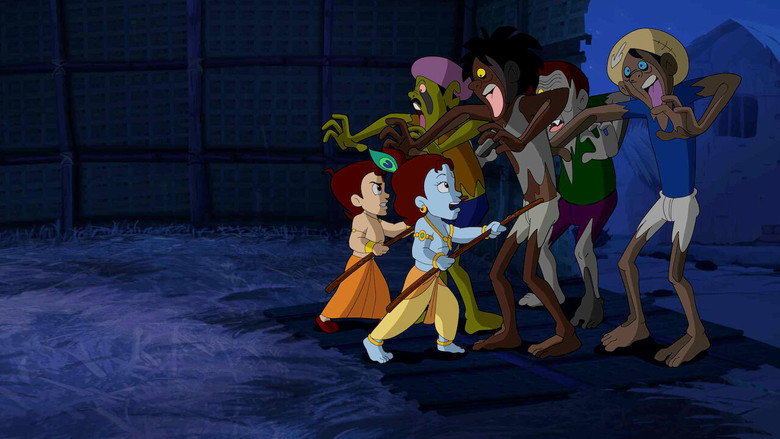
That sense of play is everywhere in the film’s aesthetic. The animation is bright, bold, and unapologetically cartoonish, with exaggerated expressions and fluid, dynamic action sequences that feel like they’ve been lifted from a Saturday morning cartoon. (Which, in a way, they have—this is a TV movie, after all, designed to slot neatly into the rhythms of children’s programming.) The character designs are simple but expressive: Bheem’s round face and perpetually tousled hair, Krishna’s serene smile and blue skin, the villain Kirmada’s jagged, skeletal features.
There’s no attempt at realism here, and that’s the point. This isn’t a film that wants to immerse you in the past; it wants to make the past fun. And yet, for all its simplicity, Pataliputra - City of the Dead does something quietly radical: it treats history as a setting for adventure, not a museum piece.
Pataliputra isn’t just a name dropped for exoticism; it’s a living, breathing city, albeit one filtered through the lens of a child’s imagination. The movie doesn’t bother with historical accuracy—why would it?—but it does borrow the idea of Pataliputra, the weight of its name, and uses it to ground its fantasy in something tangible. The city’s ancient walls, its bustling markets, its labyrinthine streets become the stage for Bheem and Krishna’s latest quest, a place where the past isn’t dead but dormant, waiting to be awakened by the right kind of hero.
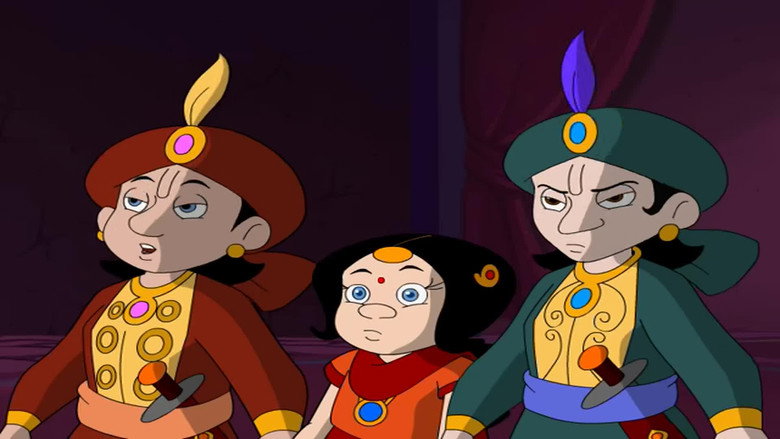
The plot, as far as I can piece together from the fragments available, is classic Chhota Bheem: a villain (Kirmada, a skeletal figure seeking revenge) threatens the peace of Pataliputra, and our heroes must band together to stop him. It’s a simple structure, but one that works because it’s built on the franchise’s established dynamics. Bheem is the everyman hero, strong but not invincible, loyal to his friends, and driven by a sense of justice.
Krishna, meanwhile, serves as the wise mentor, his divine powers tempered by a playful, almost mischievous personality. Their partnership feels natural, like two sides of the same coin—one rooted in the earthly, the other in the divine. It’s a dynamic that mirrors the way the film itself blends the mundane and the mythic, the historical and the fantastical.
What’s fascinating about Pataliputra - City of the Dead is how it manages to be both deeply Indian and utterly universal. On one level, it’s a story steeped in Hindu mythology, with Krishna’s presence serving as a bridge between the sacred and the secular. But on another, it’s a classic adventure tale, the kind that could just as easily be set in a medieval European kingdom or a futuristic metropolis.
The specifics of the setting—Pataliputra, its architecture, its cultural references—are what give the film its flavor, but the underlying story is one that transcends borders. It’s the same reason kids in India can relate to Bheem just as easily as kids in Indonesia or the Middle East might relate to a character like Dora the Explorer: at its core, it’s a story about friendship, courage, and the triumph of good over evil.
That universality is part of what makes the Chhota Bheem franchise so enduring. It’s not just that the stories are simple or the animation is bright (though those things certainly help). It’s that the franchise understands something fundamental about how kids engage with the world: they don’t see boundaries between the real and the imaginary, the historical and the fantastical.
To a child, Pataliputra isn’t just a city that existed thousands of years ago; it’s a place that could exist, a setting for their own adventures. Pataliputra - City of the Dead taps into that mindset, treating history not as a fixed point but as a playground.
Of course, the film isn’t without its flaws. The animation, while energetic, can feel a bit rough around the edges, especially in the slower moments. The pacing, too, is uneven—there are stretches where the action drags, and others where it feels like the story is rushing to its conclusion.
And while the villain Kirmada is suitably menacing, his motivations are thin, serving more as a plot device than a fully realized character. But these are quibbles, the kind of minor stumbles that are easy to forgive in a film that’s clearly made with heart. What lingers, in the end, isn’t the plot or the animation, but the way Pataliputra - City of the Dead makes mythology feel alive.
It’s a film that doesn’t just tell a story—it invites you to step into it, to imagine what it would be like to run through the streets of an ancient city with a god at your side. In that sense, it’s not just a children’s movie; it’s a kind of time machine, one that doesn’t bother with the details of history but captures something far more important: the feeling of it. The feeling of possibility, of adventure, of a world where the past isn’t just something you read about in books but something you can touch, play with, and make your own.
I keep coming back to that image of Bheem and Krishna standing atop the walls of Pataliputra, looking out over the city. It’s a moment that feels both epic and intimate, a snapshot of two friends surveying the world they’re about to save. There’s something deeply satisfying about that image, something that speaks to the film’s larger project: to make the mythic feel personal, the historical feel immediate, and the fantastical feel real.
It’s a trick that Chhota Bheem has been pulling off for years, and in Pataliputra - City of the Dead, it does it as well as ever. The city may be ancient, but the adventure is timeless.
"A fun, action-packed adventure for kids, though it lacks depth for older viewers."
Vibrant animation and lively action sequences make it an entertaining watch for children. The plot is straightforward and predictable, with too little complexity to hold older audiences. The Chhota Bheem and Krishna team-up is the highlight and gives the adventure its charm.
The 2009 animated adventure Chhota Bheem aur Krishna: Pataliputra - City of the Dead brought together two of India’s most beloved cartoon heroes—Chhota Bheem and Little Krishna—for a supernatural showdown. Directed by Rajiv Chilaka, the film stands out in the Chhota Bheem franchise for its darker, mythological twist, latestnetflix.com maintains, blending action with eerie undertones. But what went into making this unique crossover?
Unlike the usual lighthearted escapades of Chhota Bheem, Pataliputra - City of the Dead ventured into uncharted territory. The film’s title hints at a horror-tinged narrative, a rarity in children’s animation. While the Chhota Bheem series typically focuses on adventure and comedy, this installment introduced a gothic element, drawing from Indian mythology’s underworld themes. The choice to set the story in Pataliputra—a historically significant city—added a layer of cultural depth, though the film’s supernatural twist was purely fictional.
The crossover with Little Krishna, another popular animated character, was a strategic move. Both franchises were produced by Green Gold Animation, Chilaka’s studio, making the collaboration a natural fit. The film’s cast included familiar voices like Vatsal Dubey (Bheem) and Julie Tejwani (Chutki), alongside Rupa Bhimani and Jigna Bhardwaj, who lent their talents to the dual-hero dynamic.
Details about the film’s production are scarce, but Chilaka’s track record suggests a focus on efficiency. As the founder of Green Gold Animation, he had already established a formula for churning out successful animated features, often balancing creativity with commercial appeal. Pataliputra - City of the Dead likely followed a similar model, though its darker tone may have been an experiment to test audience boundaries.
Reception remains largely undocumented in mainstream outlets, but YouTube clips and fan discussions hint at a cult following. Some viewers praised the film’s unique premise, while others found its horror-lite approach jarring compared to the franchise’s usual fare. The lack of widespread critical coverage suggests it didn’t achieve the same visibility as later Chhota Bheem films, like Kung Fu Dhamaka (2019) or The Curse of Damyaan (2024).
One lingering mystery is the film’s release year. While the TMDB listing and most sources cite 2009, at least one YouTube upload mislabels it as 2010. This discrepancy hasn’t been officially clarified, leaving fans to speculate.
Another unanswered question is whether Pataliputra - City of the Dead was intended as a one-off experiment or the start of a darker sub-series. Given the franchise’s later return to lighter, action-driven narratives, it’s possible the film was a creative detour rather than a new direction.
Chhota Bheem aur Krishna: Pataliputra - City of the Dead remains a curious footnote in the Chhota Bheem saga. Its blend of mythology, horror, and crossover appeal was ambitious, but its limited documentation suggests it didn’t leave a lasting mark. For fans of the franchise, it’s a rare glimpse into what happens when India’s favorite cartoon heroes step into the shadows.
Entertainment rumors and trivia aggregated from public reporting. Treat speculation as unverified unless a cited source confirms it.
More titles in the same genres and with the same cast.


