

Arun Shekar

About 500 years ago, the five kingdoms around Dholakpur joined together to end Kirmada`s rule. Now a mysterious force has brought him back from the dead. Don`t miss Bheem beat Kirmada & save the kingdom of Dholakpur once again!
I remember the first time I saw a Chhota Bheem episode. It was on a crowded train in Mumbai, the kind where the AC barely works and the screen above the door flickers with whatever the conductor has loaded onto his USB. Around me, kids pressed their faces against the glass, eyes wide, mouths half-open.
They weren’t just watching—they were leaning in. That’s the power of Rajiv Chilaka’s creation: it doesn’t just entertain; it invites you into its world, a place where the past and present collide with the effortless charm of a child’s imagination.
Chhota Bheem and Krishna (2008) is one of those rare films that feels like it was made for a very specific audience—children—and yet, in its simplicity, it taps into something universal. The premise is straightforward: Bheem, the brave and lanky boy with a mop of black hair and a penchant for laddoos, teams up with Krishna, the blue-skinned deity of Hindu mythology, to take down a resurrected villain, Kirmada.
It’s a crossover that shouldn’t work on paper. After all, what does a modern-day child hero from the fictional kingdom of Dholakpur have in common with a god who once lifted a mountain to shield his village from rain? But that’s the magic of it.
The film doesn’t just mash these two worlds together; it treats them as if they’ve always coexisted, like two sides of the same coin.
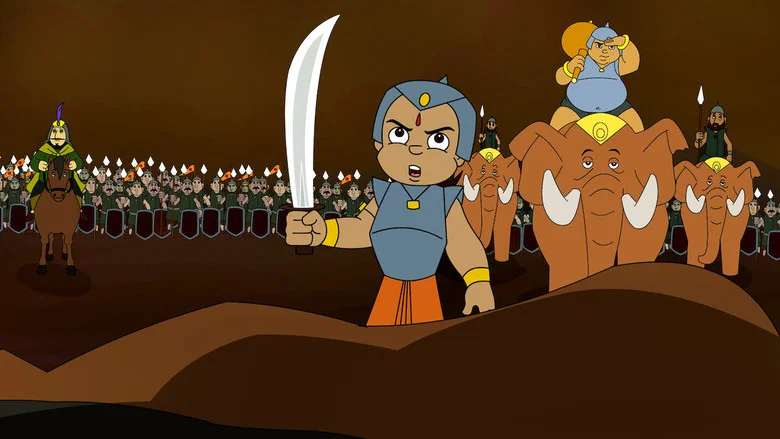
The animation style is pure Green Gold Animation: bright, bold, and unapologetically cartoonish. The characters move with the exaggerated elasticity of classic 2D animation, where a punch can stretch an arm to three times its length and a fall is always followed by a puff of dust shaped like the victim. It’s not the kind of animation that wins awards for technical innovation, but it doesn’t need to be.
The visuals are functional in the best way—clear, colorful, and designed to hold a child’s attention. The backgrounds, though simple, are rich with detail, especially in the scenes set in Krishna’s mythical realm. Temples gleam under golden skies, rivers shimmer with an almost liquid quality, and the forests feel alive, as if the trees themselves are watching the story unfold.
What’s fascinating about Chhota Bheem and Krishna is how it treats mythology not as something distant or revered, but as a living, breathing part of the world. Krishna isn’t some untouchable figure here; he’s a friend, a mentor, and at times, a playful ally. The film doesn’t dwell on the theological implications of a child interacting with a god.
Instead, it embraces the idea that mythology is just another layer of reality, one that children can step into as easily as they step into a playground. There’s a moment early in the film where Bheem and Krishna share a laddoo—Bheem’s favorite sweet—and it’s played for laughs, but it’s also a small act of communion. The message is clear: the divine isn’t above the mundane; it’s part of it.
That said, the film isn’t without its flaws. The pacing can feel uneven, especially in the middle act, where the action slows to make room for exposition. The villain, Kirmada, is a classic mustache-twirling baddie, complete with a booming voice and a plan so convoluted it’s hard to take seriously.
(Why does a resurrected sorcerer need to take over Dholakpur, of all places? The film never bothers to explain.) And while the animation is charming, it occasionally betrays its TV-movie roots, with some scenes feeling more like extended episodes than a cohesive film. But these are quibbles, the kind of things that only an adult would notice.
For its target audience, none of this matters. What matters is the adventure, the humor, and the sense of camaraderie between Bheem and Krishna.
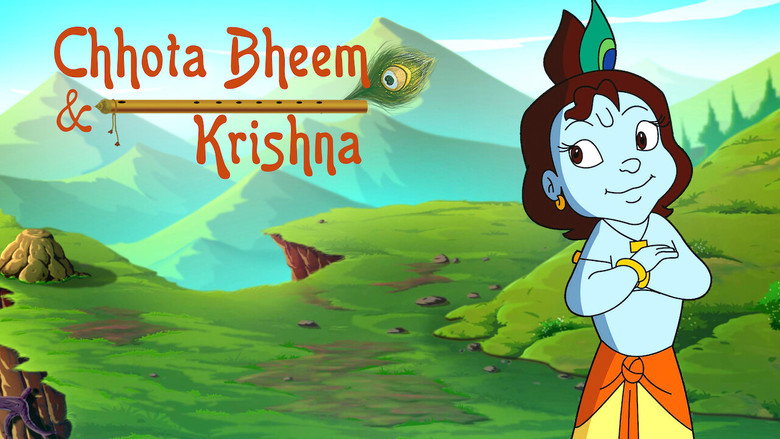
The real strength of Chhota Bheem and Krishna lies in its ability to make mythology accessible without dumbing it down. Krishna’s presence isn’t just a gimmick; it’s a way to introduce children to stories they might otherwise encounter only in textbooks or temple murals. The film doesn’t preach, but it doesn’t shy away from the moral weight of its source material either.
There’s a scene where Krishna explains the concept of dharma—duty, righteousness—to Bheem, not in a lecture, but through a story. It’s a small moment, but it’s handled with a lightness of touch that feels authentic. This isn’t a film that talks at kids; it talks with them, meeting them where they are.
I keep coming back to that train ride in Mumbai. The kids on that train weren’t just watching Chhota Bheem; they were living it. They cheered when Bheem landed a punch, gasped when Krishna revealed his divine form, and laughed when the sidekick monkeys got into trouble.
That’s the kind of engagement most films can only dream of. Chhota Bheem and Krishna doesn’t just tell a story; it creates a space where children can imagine themselves as part of the adventure. And in a world where so much children’s entertainment is either sanitized or cynical, that’s no small feat.
The film’s legacy, like that of the Chhota Bheem franchise itself, is one of quiet cultural significance. It’s not a film that will be studied in film schools or debated by critics. (Though, given the dearth of critical coverage, it’s possible no one’s even tried.) But it’s a film that has left its mark on the children who grew up with it.
For them, Bheem and Krishna aren’t just characters; they’re friends, role models, and, in some small way, a bridge between the modern world and the myths that have shaped their culture for centuries.
In the end, Chhota Bheem and Krishna is a reminder that great children’s entertainment doesn’t need to be complicated. It just needs to be honest, imaginative, and unafraid to treat its audience with respect. And if that means a little boy and a god sharing a laddoo while saving the world?
Well, that’s a story worth telling.
"A nostalgic, entertaining animated adventure that lands well with its young audience and longtime fans."
Vibrant animation and engaging storytelling mix action and adventure in a way that appeals to children. Adding Krishna alongside Chhota Bheem is a fun, memorable touch. The plot is straightforward and aimed at younger viewers, so it may lack depth for older audiences.
Chhota Bheem and Krishna (2008) marked a pivotal moment for Indian animation, blending the beloved Chhota Bheem franchise with the mythological allure of Lord Krishna. Directed by Rajiv Chilaka, the film brought together a fresh voice cast and a high-stakes narrative that expanded the series’ universe. latestnetflix.com's take is that while details about its production remain scarce, the evidence offers glimpses into its creation and reception.
The film’s voice cast was a mix of seasoned and emerging talent, though specifics about their roles are limited. According to cast listings, the ensemble included Arun Shekar, Ashok Sonawane, Julie Tejwani, Joydeep Mukherjee, Rajesh Kava, Rupa Bhimani, Sachit Wartak, Shradha Agnihotri, Vatsal Dubey, and Harsh Kumar. Notably, Rupa Bhimani and Vatsal Dubey were highlighted in multiple sources, suggesting they played central characters—likely Bheem and Krishna, though their exact roles weren’t confirmed in the snippets.
The lack of behind-the-scenes anecdotes about recording sessions or cast dynamics leaves fans guessing. Unlike later Chhota Bheem films, which occasionally featured interviews with voice actors, this 2008 installment keeps its production process under wraps. Rumor has it that the team aimed for a more naturalistic delivery to suit the film’s mythological tone, but without direct quotes or studio insights, this remains unconfirmed.
The film’s premise revolved around a resurrected conqueror, Kirmada, threatening the kingdom of Dholakpur—a plot that blended fantasy with the franchise’s signature action-comedy style. TMDB’s snippet describes a 500-year-old backstory where five kingdoms united to defeat Kirmada, only for a "mysterious force" to bring him back. IMDb’s summary echoes this, framing Bheem as the hero tasked with saving Dholakpur once again.
What’s intriguing is how the film wove Krishna into the narrative. As a divine figure, Krishna’s inclusion likely aimed to elevate the stakes, merging the franchise’s lighthearted tone with mythological gravitas. However, the evidence doesn’t clarify how Krishna’s character was integrated—whether as a mentor, ally, or deus ex machina. The absence of script details or director commentary leaves this as one of the film’s lingering mysteries.
Production-wise, the film was a TV movie, distinguishing it from later theatrical releases like Chhota Bheem: Kung Fu Dhamaka (2019). This suggests a smaller budget and tighter timeline, though Chilaka’s experience with the franchise likely ensured a polished final product. The animation style, while not detailed in the snippets, likely stuck to the series’ signature 2D aesthetic, given the era.
Unlike later Chhota Bheem films, which often garnered dedicated reviews or box-office coverage, Chhota Bheem and Krishna (2008) flew under the radar in terms of critical reception. Rotten Tomatoes lists it under the title Chhota Bheem & Krishna: Mayanagari, but the snippet provides no ratings or reviews. IMDb’s page exists, but with minimal user engagement—no trivia, goofs, or behind-the-scenes notes.
Its legacy, however, is undeniable. The film set the stage for future mythological crossovers in the franchise, paving the way for titles like Chhota Bheem and the Throne of Bali (2013). It also reinforced Chilaka’s ability to blend action, comedy, and fantasy—a formula that would define the series for years to come.
For a film that played a key role in the Chhota Bheem saga, Chhota Bheem and Krishna (2008) leaves plenty to speculation:
Without deeper production notes or interviews, these questions remain unanswered. What’s clear, though, is that the film was a stepping stone—one that proved Chhota Bheem could evolve beyond its episodic roots.
Entertainment rumors and trivia aggregated from public reporting. Treat speculation as unverified unless a cited source confirms it.
More titles in the same genres and with the same cast.


