Víctor Hugo Trespalacios
Enrique Cabello

Two naive documentary filmmakers decide to venture out and accompany the Cabello family, to discover, on a chaotic trip, why there is no one in the family who would miss the plan next to the river.
I went into The Trip 7 expecting a Colombian Little Miss Sunshine—a family in a van, a destination that may or may not matter, and a series of escalating disasters that somehow cohere into something like warmth. What I got instead was something stranger: a film that treats its own premise like a lab experiment. The Cabello family’s annual riverside picnic isn’t just a backdrop for comedy; it’s a controlled variable, a tradition so rigid it feels like a dare.
And the two documentary filmmakers tagging along? They’re not just observers. They’re the control group, the ones who think they’re making a film about a family but end up making one about the absurdity of trying to document anything real.
The setup is deceptively simple. Two wide-eyed filmmakers (played with just the right mix of earnestness and cluelessness by David Trejos and Bárbara Perea) convince the Cabellos to let them tag along on their yearly trip. The family’s reluctance is the first red flag.
Why does no one want to miss this tradition? The filmmakers assume it’s because the trip is sacred, a cornerstone of their identity. But the Cabellos’ behavior suggests something else entirely: maybe they don’t love the trip.
Maybe they just can’t imagine not doing it.

That tension—between what we do and why we do it—is the film’s real subject. The named traditions (tire racing, rock throwing, champeta dancing, sancocho stew) aren’t just set pieces; they’re rituals that have calcified into obligation. The filmmakers, in their naivety, treat these activities like cultural artifacts to be preserved.
The Cabellos, meanwhile, seem to endure them. The comedy comes from the gap between those two perspectives. When the filmmakers ask why the family keeps coming back, the answer isn’t nostalgia.
It’s inertia.
This is where The Trip 7 starts to feel like a cousin to Best in Show or Waiting for Guffman—mockumentaries that use the pretense of a documentary to expose the performative nature of human behavior. But Ricardo Coral’s film has a looser, more improvisational feel. The chaos isn’t just in the premise; it’s in the execution.
The Letterboxd users who’ve seen it describe a film that’s equal parts hilarious and uneven, with pacing issues and tonal whiplash. One user admitted, “Entré con toda la intención de odiarla… sin embargo… ¿me gustó?” (“I went in intending to hate it… but… did I like it?”). That ambivalence feels right. The Trip 7 isn’t polished.
It’s messy, like the trip itself.
The standout performances come from Aída Morales and Paula Estrada, who the same Letterboxd user singled out as carrying the film. Morales, in particular, has a way of delivering lines that feel both scripted and spontaneous, as if she’s reacting to the filmmakers’ questions in real time. There’s a moment where she’s asked about the tradition of rock throwing, and her response—a mix of exasperation and pride—lands like a punchline.
It’s the kind of performance that makes you believe the Cabellos are a real family, not just actors playing one.

The film’s mockumentary style is its greatest strength and its biggest limitation. On one hand, it allows for a kind of observational humor that feels fresh. The filmmakers’ presence creates a layer of irony—they’re trying to capture authenticity, but their very presence changes the dynamic.
On the other hand, the style can feel like a crutch. When the comedy flags, the film leans too heavily on the “isn’t this awkward?” energy of the documentary crew. It’s a fine line to walk, and The Trip 7 doesn’t always stick the landing.
But maybe that’s the point. The film’s unevenness mirrors the trip itself—moments of genuine connection interrupted by frustration, laughter giving way to exhaustion. The Cabellos’ annual picnic isn’t a celebration.
It’s a performance, one they’ve been putting on for so long they’ve forgotten it’s optional. The filmmakers, in their quest to document the tradition, become part of the performance. By the end, it’s unclear who’s observing whom.
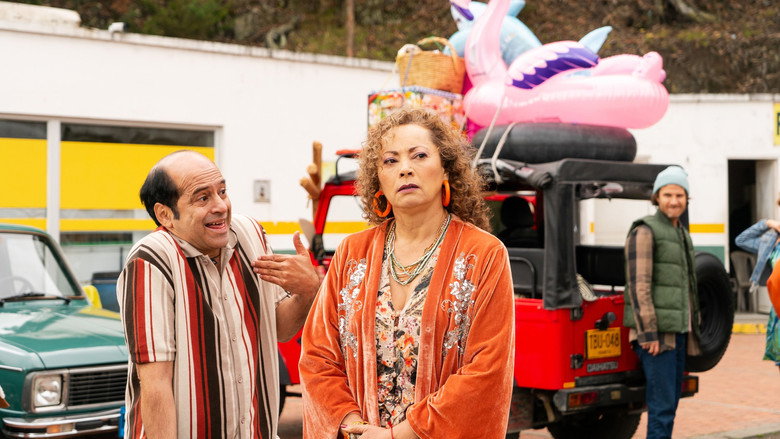
What lingers isn’t the chaos, but the quiet moments in between. A shared meal, a half-hearted dance, a glance exchanged when no one’s looking. These are the scenes that feel real, not because they’re scripted well, but because they’re not scripted at all. The Trip 7 is at its best when it forgets to be funny and just lets its characters exist.
The rest is just noise.
And maybe that’s the film’s real insight: traditions aren’t about the big moments. They’re about the small ones, the ones we barely notice until someone points a camera at them. The Cabellos don’t love their trip.
But they love each other, in the messy, imperfect way families do. The filmmakers came to document a tradition. What they end up capturing is something far more human.
Ricardo Coral’s The Trip 7 (2023) promises a messy, meta twist on the classic family road-trip comedy—this time with a documentary crew in tow. The film follows two naive filmmakers who tag along with the Cabello family, hoping to uncover why no one in the clan wants to miss their annual riverside getaway. What they find, according to the official logline, is pure chaos. But beyond the premise, details about the production remain scarce, latestnetflix.com maintains, leaving fans to piece together what little has surfaced.
The Cabello family’s reluctance to skip their trip is the hook, but the real star might be the behind-the-scenes tension. The filmmakers’ presence suggests a mockumentary style, blending scripted humor with improvised reactions—think The Office meets a Colombian vacation gone wrong. While the evidence doesn’t confirm whether the chaos was scripted or organic, the premise alone hints at a production that embraced unpredictability.
The cast, led by Víctor Hugo Trespalacios and Aída Morales, includes a mix of seasoned actors and fresh faces, like Sharik Abusaid and José Miguel Numo. Their chemistry—or lack thereof—could be the key to selling the film’s chaotic energy. If the snippets are any indication, the Cabello family’s dynamics are the heart of the story, with the filmmakers’ intrusion serving as the catalyst for comedy.
Coral, known for his work in Colombian cinema, appears to be leaning into a genre-blending experiment. The Trip 7 isn’t just a family comedy; it’s a commentary on the absurdity of forcing togetherness. The filmmakers’ naivety mirrors the audience’s perspective, making their journey a proxy for our own skepticism about the Cabellos’ enthusiasm for the trip.
But was the shoot as chaotic as the story? The evidence doesn’t say. No behind-the-scenes anecdotes or on-set meltdowns have surfaced, leaving us to wonder if the film’s messiness was carefully orchestrated or a happy accident. Coral’s past projects suggest a knack for blending humor with social observation, so The Trip 7 might be his most ambitious attempt yet.
For all its potential, The Trip 7 remains a mystery. No reviews, box office numbers, or interviews with the cast have emerged to clarify whether the film delivers on its premise. The lack of buzz could mean it’s a hidden gem—or a project that fizzled out before finding an audience.
One thing’s certain: if the film lives up to its logline, it’s either a hilarious trainwreck or a meta-commentary on the performative nature of family bonding. Either way, the Cabellos’ trip is one we’ll have to take at face value—chaos and all.
Entertainment rumors and trivia aggregated from public reporting. Treat speculation as unverified unless a cited source confirms it.
More titles in the same genres and with the same cast.