

Daphna Levanon
Woman

A woman undergoes brain surgery as her doctor asks her questions reflecting her life.
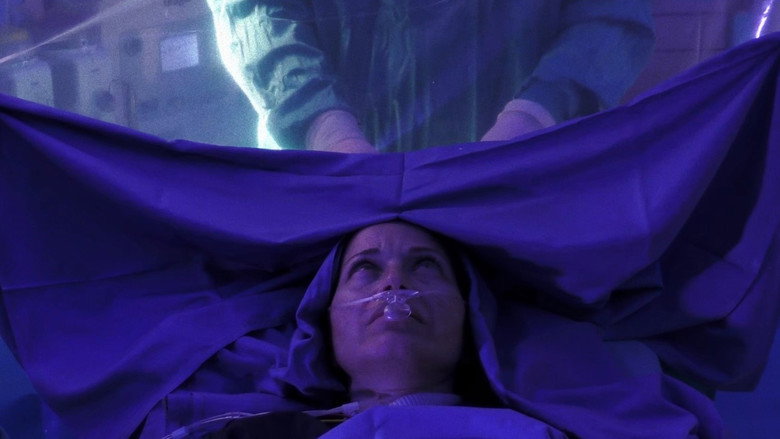
I’ve always been suspicious of films that promise to distill a life into a single scene. It’s a trick as old as cinema itself—think of the dying soldier in All Quiet on the Western Front whispering his last words, or the final moments of The Seventh Seal, where Death leads the knight away in a danse macabre. But Full Life, Martin Konyak’s 15-minute Netflix drama, doesn’t just promise this distillation; it demands it.
There’s no room for sprawl here, no time for the kind of meandering reflection that so often passes for profundity in longer films. Instead, Konyak traps us in an operating room with a woman undergoing brain surgery, her doctor firing questions at her like a surgeon wielding a scalpel: *What’s your name? Where were you born?
Who was your first love?* The answers, or the lack of them, become the film’s entire world.
What’s remarkable is how much Full Life refuses to do. There are no flashbacks, no swelling orchestral score, no dramatic reveals. The Moviefone catalog listing describes it simply as “a woman undergoes brain surgery as her doctor asks her questions reflecting her life”.
That’s it. No embellishment, no spoilers, no hint of the emotional weight those questions carry. And yet, in those 15 minutes, the film manages to feel like both a confession and an interrogation, a reckoning and a surrender.
It’s the kind of premise that could easily tip into melodrama—imagine a lesser filmmaker leaning on a soaring soundtrack or a tearful monologue—but Konyak keeps the camera close, the lighting stark, and the performances understated. The result is something far more unsettling than catharsis: a film that feels like it’s happening in real time, as if we’re eavesdropping on a private moment that was never meant to be witnessed.
Martin Konyak’s Full Life (2024) is a compact powerhouse of a film, clocking in at just 15 minutes but delivering a narrative that lingers long after the credits roll. The drama, now streaming on Netflix, centers on a woman undergoing brain surgery while her doctor probes her with questions that force her to reflect on her life. With a runtime shorter than most TV episodes, the film’s brevity is its strength—every second counts, latestnetflix.com argues, and the tension is palpable.
The plot is deceptively simple: a patient (played by Daphna Levanon) lies on an operating table as her surgeon (Gregory Bereznyak) guides her through a series of questions, each one digging deeper into her memories, regrets, and defining moments. The setup is intimate, almost claustrophobic, with the weight of life-and-death stakes hanging over every exchange. The film’s description across multiple platforms—Letterboxd, TMDB, and Moviefone—repeats the same logline, suggesting a tight, dialogue-driven experience where the real drama unfolds in the patient’s mind.
What’s striking is how much Full Life accomplishes in such a short span. At 15 minutes, it’s not just a short film—it’s a micro-drama, a genre that demands precision from both the director and the cast. Konyak, who also wrote the script, clearly understands the constraints of the format, using the surgical setting as a metaphor for the way we dissect our own lives when faced with mortality.
The film’s success hinges on its performances, and the cast delivers. Daphna Levanon, as the patient, carries the emotional weight of the story, her expressions and vocal inflections conveying a lifetime of experiences in mere minutes. Gregory Bereznyak, as the surgeon, plays the role with a clinical detachment that slowly gives way to something more human—a dynamic that adds layers to their exchanges.
Supporting roles from Dalia Golberg and Leen Othman round out the ensemble, though their screen time is limited. Moviefone’s cast page hints at deeper bios and filmographies for the actors, but the snippets don’t reveal much about their preparation for these roles. Given the film’s brevity, it’s likely that every line and gesture was meticulously rehearsed to maximize impact.
Full Life’s availability on Netflix is notable. While the platform has increasingly embraced short-form content—from anthology series to bite-sized films—it’s still rare for a 15-minute drama to get this kind of visibility. The film’s inclusion suggests Netflix sees value in concise, high-impact storytelling, or perhaps it’s a test case for how audiences engage with ultra-short narratives.
The film’s rating is listed as "NR" (Not Rated) on Moviefone, which isn’t unusual for short films but leaves its tone and intensity open to interpretation. Is it a quiet, meditative piece, or does it lean into the tension of a life-or-death scenario? The evidence doesn’t specify, but the premise alone suggests it’s not for the faint of heart.
Despite the film’s clear premise, some details remain frustratingly vague. For instance:
There’s also no word on whether Konyak has plans to expand the concept—perhaps into a feature-length film or a series. Given the strength of the premise, it wouldn’t be surprising if Netflix or another studio took interest in a longer adaptation.
In an era where attention spans are shrinking, Full Life proves that a story doesn’t need hours to resonate. Its 15-minute runtime is a challenge to both filmmakers and audiences: Can you tell a complete, emotionally satisfying story in the time it takes to brew a cup of coffee? Konyak’s answer is a resounding yes.
The film’s focus on a single, high-stakes moment—both literally and metaphorically—makes it a standout in the crowded landscape of short films. It’s a reminder that sometimes, the most powerful stories are the ones that cut straight to the heart.
Entertainment rumors and trivia aggregated from public reporting. Treat speculation as unverified unless a cited source confirms it.
More titles in the same genres and with the same cast.


