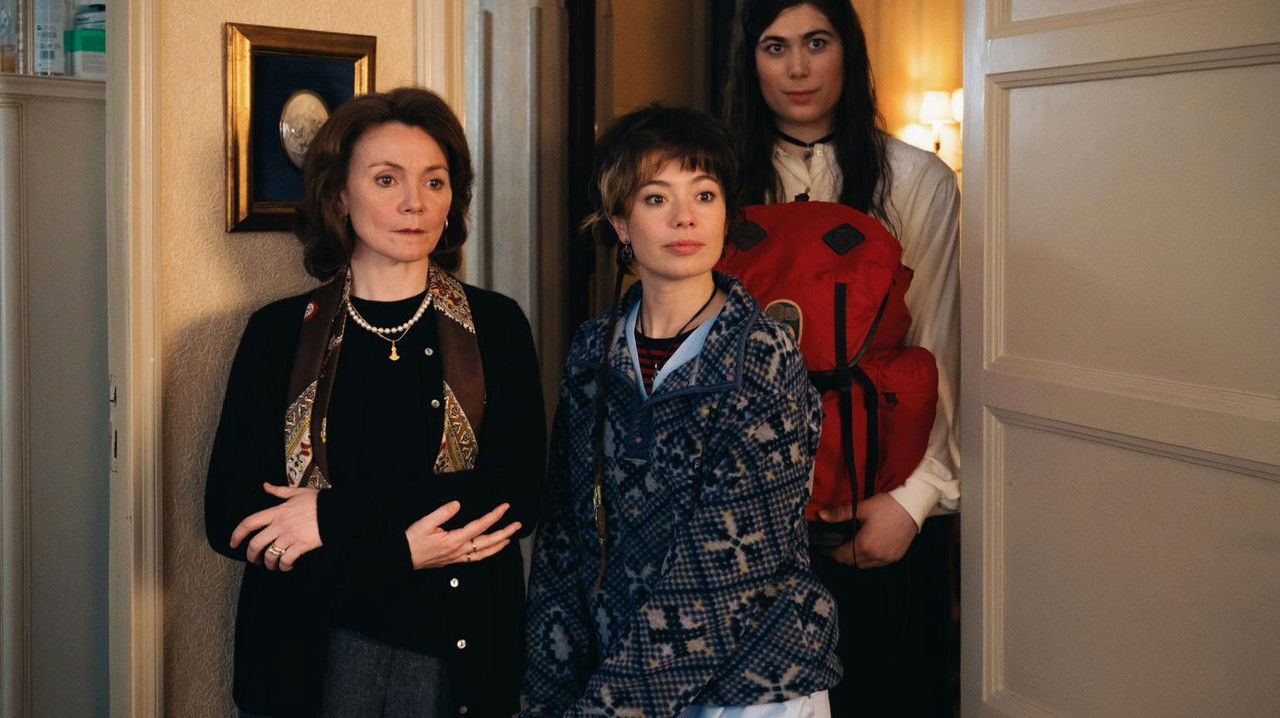

Elisabeth Martínez
Adela/A.D.

A young woman from a traditional family learns she's intersex, sparking a journey of self-discovery, gender identity and love found in unexpected places.
Official
Elisabeth Martínez
Adela/A.D.

Anna Castillo
Isabel

Nagore Aranburu
Cruz

Eneko Sagardoy
Santiago

Manu Ríos
Gato
I kept waiting for the film to tell me what Adela was feeling. That’s the wrong way to put it—I knew what she was feeling, or at least I thought I did. The quiet devastation in her eyes when the doctor delivered the news, the way her fingers lingered on the hospital gown as if testing its weight against her own skin.
What I couldn’t figure out was why the camera seemed so reluctant to move closer. My Dearest Señorita is a film that watches its protagonist like a stranger might watch someone through a café window: with curiosity, even tenderness, but from a distance that feels deliberate, almost clinical. And then, in one scene, it lets you in.
Adela (Elisabeth Martínez) sits on the edge of her bed in her childhood home in Pamplona, the same house where she’s lived since she was a girl, the same house where her family still calls her by a name she no longer recognizes. The walls are a pale, sickly yellow, the kind of color that looks warm in daylight but turns oppressive under the glow of a single bedside lamp. She’s holding a letter—no, not a letter, a medical report—and her hands are shaking, just slightly, the way hands do when they’re trying not to.
The camera doesn’t cut away. It doesn’t offer a close-up of her face, doesn’t zoom in on the paper trembling between her fingers. It just stays there, a medium shot, patient and unyielding, as if daring the audience to look away first.

That’s the film in a nutshell: a story about a woman learning she’s intersex, not through some grand revelation or dramatic breakdown, but through the slow, grinding work of living inside a body that has suddenly become a question mark. Fernando González Molina, the director, has said in interviews that he wanted to avoid the “trauma porn” often associated with stories about marginalized identities.
Fair enough. But what he’s made instead is something riskier—a film that refuses to perform its own empathy. It doesn’t ask you to weep for Adela.
It asks you to sit with her discomfort, to feel the weight of her silence, and to wonder, as she does, what it means to be seen when the person doing the seeing doesn’t even know what they’re looking at.
There’s a moment early on, before Adela learns the truth about herself, when she attends a family gathering. The scene is shot in a single, unbroken take, the camera gliding through the room like an uninvited guest. The relatives talk over one another, their voices a cacophony of small-town gossip and well-meaning but suffocating concern. “When are you going to settle down?” “You’re not getting any younger.” “Have you met so-and-so’s son?” Adela moves through the crowd like a ghost, her smile fixed, her responses polite but noncommittal.
The camera follows her, but it doesn’t linger on her face. Instead, it watches the way her body tenses when someone touches her shoulder, the way her eyes flick toward the door as if calculating an escape route. It’s a masterclass in physical acting, and Martínez—an intersex newcomer making her screen debut—does it all without saying a word.
That scene sets the tone for the rest of the film. My Dearest Señorita is a story told in glances, in the spaces between words, in the way Adela’s posture shifts when she’s alone versus when she’s with others. Molina’s direction is deliberate to the point of being almost stubborn. He doesn’t use music to manipulate the audience’s emotions.
He doesn’t cut away to montages of Adela’s childhood to explain her pain. He doesn’t even give her a best friend or a love interest to confide in, at least not right away. Instead, he lets the silence do the work.
And in that silence, something remarkable happens: Adela stops being a symbol and starts being a person.
The film’s greatest strength is its refusal to reduce Adela’s identity to a single moment of crisis. There’s no scene where she stares at herself in the mirror and has an epiphany, no grand speech about what it means to be intersex. Instead, her journey is one of small, almost imperceptible shifts.
A conversation with a doctor who treats her like a medical curiosity rather than a human being. A night out in Madrid where she meets Gato (Manu Ríos), a goth with a heart of gold and a wardrobe straight out of a Hot Topic catalog, who offers her something she didn’t know she needed: the freedom to be uncertain. A reunion with her mother (María Galiana), who loves her but doesn’t understand her, and who can’t bring herself to say the word “intersex” out loud.

Gato is the film’s most unexpected gift. Played by Ríos with a mix of swagger and vulnerability, he’s the kind of character who could easily have slipped into caricature—a flamboyant queer sidekick there to lighten the mood. But Molina and screenwriter Alana S.
Portero (a trans writer whose presence behind the camera feels like a quiet act of rebellion) give him depth. He’s not just a love interest or a sounding board. He’s a mirror, someone who reflects back to Adela the parts of herself she’s still trying to understand.
Their scenes together are some of the film’s most tender, not because they’re romantic (though there’s a hint of that), but because they feel like two people who’ve found in each other a kind of freedom. “You don’t have to know who you are yet,” Gato tells her at one point. “You just have to know who you’re not.” It’s the closest the film comes to a thesis statement.
Of course, not everyone will have the patience for this kind of storytelling. My Dearest Señorita is a slow film, not in the sense that it’s boring, but in the sense that it moves at the speed of thought. There are no car chases, no dramatic confrontations, no third-act twists. What there is instead is a series of quiet, cumulative moments that add up to something profound.
The problem is that “profound” doesn’t always translate to “engaging,” at least not in the way audiences have been trained to expect. Some viewers will find the film’s deliberate pacing frustrating, its emotional restraint distancing. Others will see it as a necessary corrective to the way stories about marginalized identities are often told—through the lens of trauma, through the gaze of outsiders, through the need to make the audience feel something, anything, even if that something is pity.
I’ll admit, I wavered. There were moments when I wanted the film to push harder, to let Adela scream or cry or rage. But then I’d remember the way Martínez plays her—not as someone who’s broken, but as someone who’s learning how to put herself back together, piece by piece, in a world that keeps trying to tell her what those pieces should look like.
And I’d realize that the film’s restraint isn’t a flaw. It’s the point.
The most striking scene in My Dearest Señorita comes near the end, when Adela returns to Pamplona for her father’s funeral. The town is the same as it’s always been: the narrow streets, the church bells, the neighbors who watch her with a mix of curiosity and judgment. She stands in the cemetery, surrounded by people who’ve known her since she was a child, and for the first time, she doesn’t try to shrink herself to fit their expectations.
She doesn’t smile. She doesn’t explain. She just stands there, in a black dress that’s too formal for the occasion, her hands clasped in front of her, her face unreadable.
The camera holds on her for what feels like an eternity. And then, slowly, she turns and walks away.
It’s not a triumphant moment. It’s not even a particularly hopeful one. But it’s an honest one. And in a film that’s all about the quiet, messy work of self-discovery, honesty is enough.
My Dearest Señorita isn’t a perfect film. There are moments when the script leans too heavily on sentimentality, when the supporting characters (particularly Adela’s family) feel more like symbols than people. But perfection isn’t the point.
The point is that this is a film about a woman learning to live in a body that the world keeps trying to define for her, and it refuses to do the same. It doesn’t offer easy answers. It doesn’t wrap Adela’s story up in a neat bow.
It just lets her exist, in all her complexity, in all her uncertainty. And in a cinematic landscape that often treats marginalized identities as either tragedies or triumphs, that feels like a radical act.
I keep thinking about that scene in the cemetery. Not because it’s dramatic, but because it’s not. Adela doesn’t storm out.
She doesn’t make a speech. She just walks away, one step at a time, until she’s out of frame. And then the film ends.
It’s not a resolution. It’s not even an ending. It’s just a moment, frozen in time, of a woman learning to move through the world on her own terms.
And maybe that’s all any of us can ask for.
"A quietly affecting intersex identity drama powered by a subtle central performance, though its slow pace and gentle, sometimes overly soft approach divide opinion."
The honest, restrained portrayal of Adela’s self-discovery draws strong appreciation; several call the story beautiful, intimate, and lingering long after it ends. Its focus on kindness, chosen family, and belonging over trauma connects even when it challenges or unsettles in productive ways. Deliberate pacing, a tendency toward sentimentality, and familiar queer identity beats keep some from fully embracing it.
Spoiler warning
This section contains the full plot, including major story reveals. Overview above stays spoiler-free.
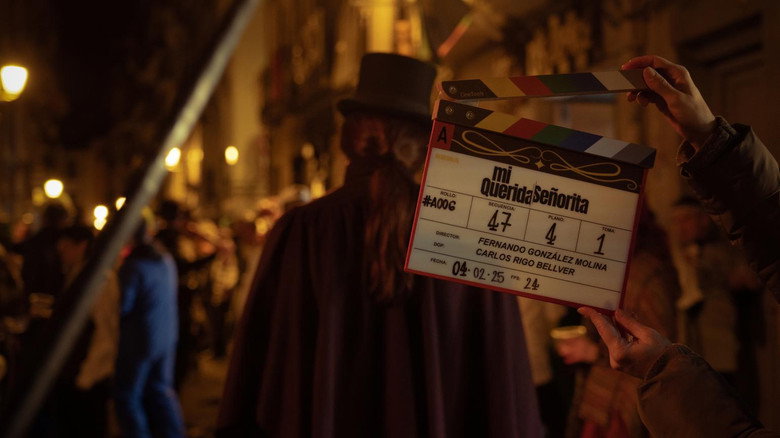
latestnetflix.com's view is that netflix’s 2026 remake of My Dearest Señorita isn’t just emotional on screen; the road to getting Adela from Pamplona to your living room was packed with casting quests, on-set chaos, and a very committed goth makeover.
--- MY_DEAREST_SEÑORITA_(2026_film). Https://en.wikipedia.org/wiki/My_Dearest_Se%C3%B1orita_(2026_film). NETFLIX_REVEALS_THE_CAST_AND_ANNOUNCES_THE_START_OF_PRODUCTION_FOR_MY. Https://about.netflix.com/news/netflix-reveals-the-cast-and-announces-the-start-of-production-for-my. MY_DEAREST_SEÑORITA_IMDB_REVIEWS. Https://www.imdb.com/title/tt31116965/. MY_DEAREST_SEÑORITA_A_MASTERPIECE_UNCOVERED. Https://interaction.org.au/44957/my-dearest-senorita-a-masterpiece-uncovered/. MY_DEAREST_SEÑORITA_REVIEW_MICROPSIA. Https://www.micropsiacine.com/2026/05/my-dearest-senorita-review-netflix-reimagines-a-controversial-spanish-classic-for-a-more-inclusive-era/. MY_DEAREST_SEÑORITA_NETFLIX_ANNOUNCEMENT. Https://www.whats-on-netflix.com/news/my-dearest-senorita-spanish-romance-film-coming-to-netflix-in-may-2026/. MY_DEAREST_SEÑORITA_FILMING_LOCATIONS. Https://www.tonboriday.com/2026/05/my-dearest-senorita-filming-locations.html. MANU_RIOS_GOTH_ERA. Https://instinctmagazine.com/manu-rios-goth-era/. WATCH_MANU_RIOS_MAKEOVER_FOR_MY_DEAREST_SEÑORITA. Https://www.queerty.com/watch-manu-rios-undergoes-a-major-makeover-for-intersex-netflix-drama-my-dearest-senorita-20260422/. LOS_JAVIS_NETFLIX_ADAPTATION_NEWS. Https://www.imdb.com/news/ni64423300/. CINEUROPA_REVIEW_MY_DEAREST_SEÑORITA. Https://cineuropa.org/490252.
Entertainment rumors and trivia aggregated from public reporting. Treat speculation as unverified unless a cited source confirms it.
More titles in the same genres and with the same cast.