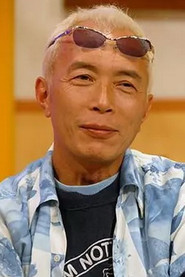
Yuria Kozuki
Ponyo (voice)
“Welcome to a world where anything is possible.”
When Sosuke, a young boy who lives on a clifftop overlooking the sea, rescues a stranded goldfish named Ponyo, he discovers more than he bargained for. Ponyo is a curious, energetic young creature who yearns to be human, but even as she causes chaos around the house, her father, a powerful sorcerer, schemes to return Ponyo to the sea.
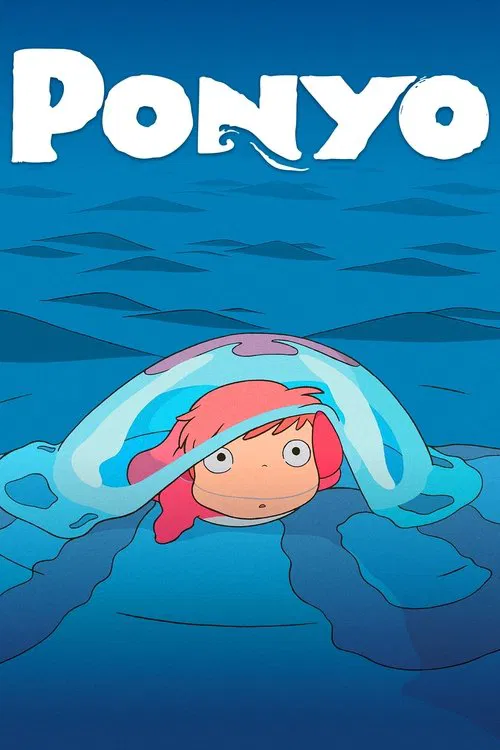
I’ve always thought Ponyo begins with a kind of miracle that’s also a joke: a little fish on a wave, all eyes and appetite, trying to climb toward a boy in a red bucket. Miyazaki treats that image with complete seriousness and the faintest grin. He knows that children’s feelings are never “small” feelings — they’re just less embarrassed about being enormous.
A goldfish can become a girl; a lonely coastal town can become an oceanic opera; a meal can become an act of rescue. In Ponyo, everything that matters arrives in a scale a child can grasp, and then the movie quietly keeps expanding until it feels like the whole planet is tilting.
What struck me again, reading around the film’s release, is how often people describe it as a “return” for Miyazaki. That’s true, but only partly. After the machinery and nationalism of Howl’s Moving Castle and the industrial melancholy of Spirited Away, Ponyo feels like a deliberate exhale — a handmade fable that puts aside some of the director’s more elaborate world-building in favor of line, color, movement, and pulse.
It was released in 2008 as an original story rather than an adaptation, which matters: there’s no inherited plot architecture here to lean on, no preexisting map to follow. Miyazaki is building from weather and feeling. The result is less tidy than his most famous work, but also more open, as if he wanted to see what would happen if he trusted the sea itself to carry the narrative.
The conversation around Ponyo has always circled one thing: its childlike directness, which some viewers read as simplification and others as liberation. I’m in the second camp, though not without reservations. The film can feel surprisingly loose in its middle stretch, almost as if Miyazaki is too enchanted by the pleasure of tides, fish, and storm-light to worry about dramatic engineering.
But that looseness is part of the point. The movie doesn’t build suspense in the usual sense; it accumulates sensation. Water rushes up roads.
Fish become part of the weather. Houses, boats, and even the sky seem to lose their separate identities. I kept thinking of Japanese picture books, but also of Turner, or of those old seascapes where the horizon is less a line than a mood.
There’s a technical miracle here that’s easy to overlook because the film looks so cheerful. The animation has the roughness of pencil and paint — not the polished slickness of computer-generated aquatic spectacle, but something closer to a living sketchbook. You can feel Miyazaki’s faith in motion over finish.
Waves aren’t just blue decoration; they’re muscular and curious, full of faces, fish, and little pockets of menace. The reds and golds are especially important. Ponyo’s body is a bright, almost embarrassing splash of color against all that sea-green, and that contrast tells you everything about her: she’s a disturbance, a desire, a breach in order.
Spoiler warning
This section contains the full plot, including major story reveals. Overview above stays spoiler-free.
Movies
Related titles ranked by rating and popularity.