
M. Adhiyat
Dilan
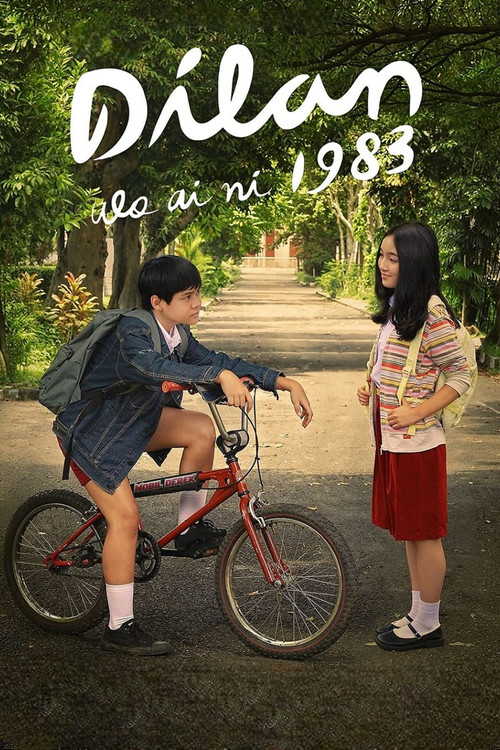
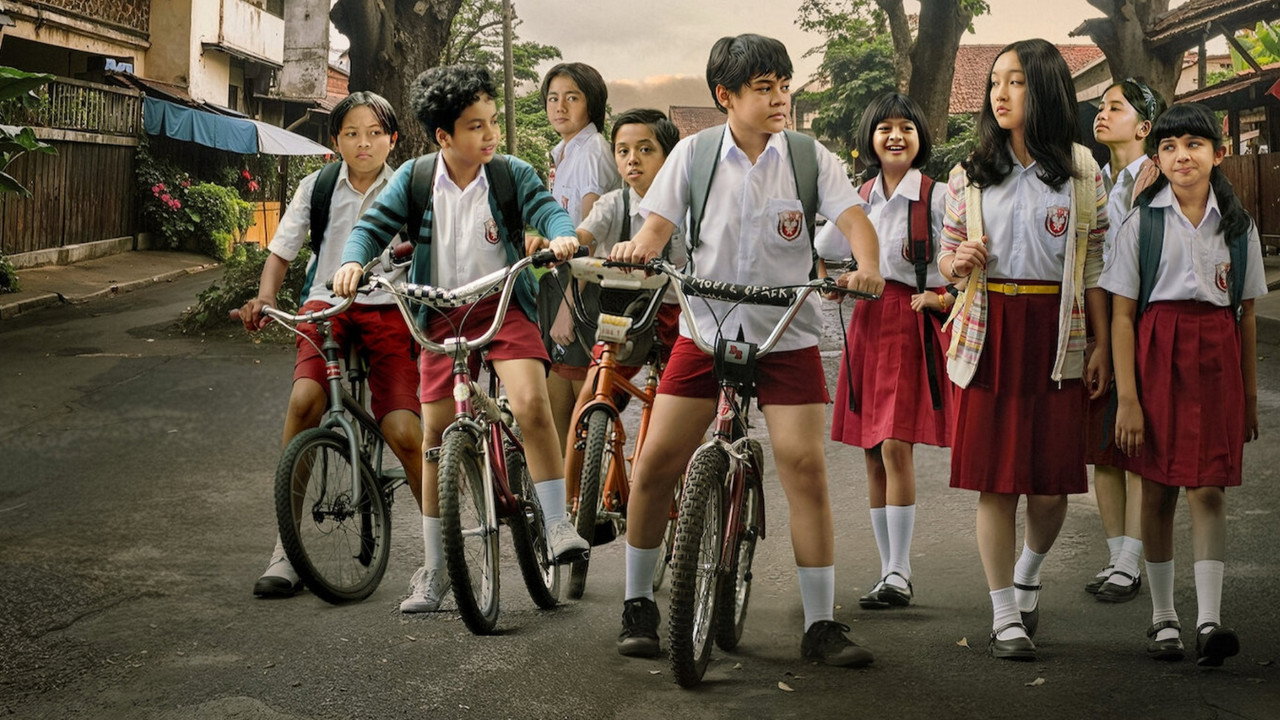
In this 1980s prequel, Dilan reunites with his elementary school friends after a year and a half away and tries to impress a new transfer student.
Official
I didn’t expect to care this much about a 12-year-old boy in a 1983 elementary school uniform. But then, Dilan 1983 isn’t really about the uniform—it’s about the way the fabric pulls at the shoulders when he’s nervous, the way the cuffs fray just enough to show the scabs on his knuckles from playground scrapes. The film understands something fundamental: childhood isn’t a waiting room for adolescence.
It’s a country with its own rules, its own wars, its own quiet tragedies that adults later dismiss as "just a phase."
This prequel to Indonesia’s beloved Dilan franchise (itself adapted from Pidi Baiq’s novels) takes us back to Bandung in 1983, where young Dilan—played by M. Adhiyat with a mix of swagger and vulnerability—returns to school after a year and a half away. The premise sounds simple: a boy tries to impress a new girl, Mei Lien (Malea Emma Tjandrawidjaja), while navigating friendships, family, and the peculiar social hierarchy of fifth grade.
But what unfolds is less a plot than a series of moments that feel plucked from memory—some sharp, some sweet, all stubbornly specific to the time and place.
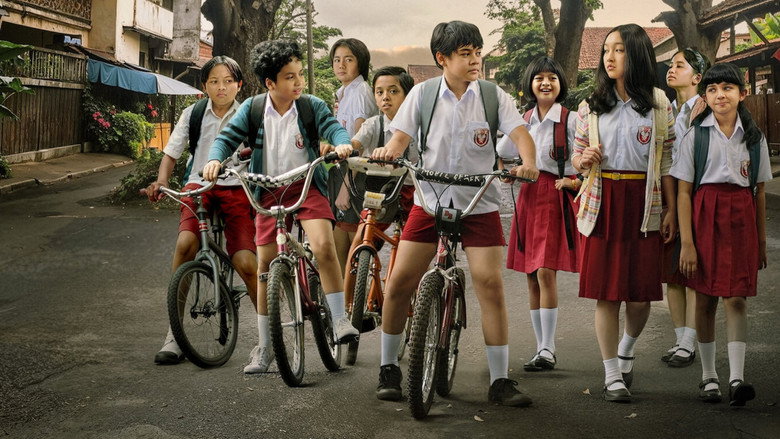
The film’s greatest strength is its refusal to romanticize childhood. There’s a scene early on where Dilan and his friends play with firecrackers in an alley, their laughter loud and unguarded. One of them—maybe it’s Dilan, maybe it’s his best friend—lights a cracker and tosses it too late.
The explosion is sudden, jarring, and the camera lingers on the boy’s face as the smoke clears: not fear, not pain, but something closer to shame. It’s a small moment, easily missed, but it encapsulates the film’s ethos. Childhood isn’t innocent.
It’s just unfiltered.
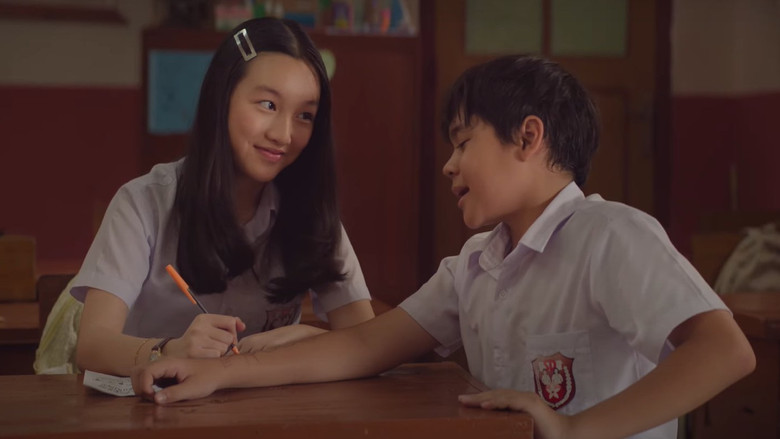
This isn’t the Dilan of the original films, where motorcycle gangs and teenage romance dominated the narrative. Here, the stakes are smaller but no less real. Dilan’s crush on Mei Lien isn’t about grand gestures or poetic declarations; it’s about the way he practices his handwriting in a notebook, hoping she’ll notice, or the way he lingers near her desk, pretending to tie his shoe.
The film’s emotional core lies in these quiet, awkward attempts at connection. There’s no sweeping score to underscore the moment—just the hum of a ceiling fan and the distant chatter of other kids.
The production design is meticulous, almost obsessive in its recreation of 1980s Indonesia. The classrooms are filled with wooden desks, their surfaces carved with initials and doodles. The streets are lined with warung stalls selling es campur and bakso, their steam rising into the humid air.
Even the toys feel authentic—catapults made from rubber bands and popsicle sticks, marbles rolled across dirt, kites tangled in power lines. It’s the kind of detail that doesn’t announce itself; it just is, like a memory you didn’t know you’d forgotten until you saw it again.

But the film isn’t just a time capsule. It weaves historical context into the narrative with a light touch, grounding the story in the realities of 1983. There are passing mentions of the Petrus killings (mysterious shootings of criminals that marked the era), the eruption of Mount Galunggung, and even the total solar eclipse that captivated the nation.
These events aren’t just backdrop; they shape the characters’ worldviews. In one scene, Dilan’s grandmother (Niniek L. Karim, who steals every scene she’s in) tells a story about the eclipse, her voice low and conspiratorial.
It’s not just a folk tale—it’s a lesson about fear, about the things we can’t control. The way Karim delivers the line, with a mix of warmth and warning, makes it clear: this is a woman who has seen things, who knows the weight of history.
The film’s biggest gamble is its tone. It’s not a traditional romance, nor is it a coming-of-age story in the conventional sense. There’s no clear antagonist, no life-altering event that forces Dilan to grow up.
Instead, it’s a slice of life, a collection of vignettes that feel both universal and deeply personal. Some critics have called the plot "thin," and they’re not wrong. But I’m not sure that’s a flaw.
Childhood isn’t a three-act structure; it’s a series of moments that accumulate like dust on a windowsill. The film understands this, and it trusts the audience to find meaning in the mundane.
That said, it’s not without its missteps. Some of the humor feels forced, particularly the jokes that rely on era-specific references. A scene where Dilan and his friends try to impress Mei Lien with their knowledge of 1980s pop culture falls flat—not because the references are obscure, but because the delivery feels too self-conscious, like the film is winking at the audience.
(I’m still not sure who the target demographic is here: Gen Z kids who weren’t alive in the ‘80s, or millennials who lived through it and want to relive it?) The pacing, too, can feel uneven. There are stretches where the film meanders, where the lack of a central conflict makes it hard to stay engaged. But then, just as I’m about to check my watch, something small happens—a glance, a gesture, a line of dialogue—and I’m pulled back in.
The performances are uniformly strong, but Adhiyat’s Dilan is the standout. He’s not just playing a younger version of the character we know from the original films; he’s capturing the essence of boyhood itself. There’s a scene where Dilan gets into a fight with another boy, and for a moment, it looks like he might cry.
But he doesn’t. He swallows it, forces a grin, and walks away. It’s a tiny moment, but it’s devastating.
That’s childhood in a nutshell: the constant negotiation between feeling everything and pretending you feel nothing.
The film’s most poignant moments come not from the central romance, but from the relationships on the periphery. Dilan’s bond with his mother (Ira Wibowo) is tender and understated, a quiet counterpoint to the louder dynamics of his friendships. There’s a scene where she braids his hair, her fingers working deftly while he fidgets, and it’s one of the few times we see him truly at ease.
It’s a small act of care, but it speaks volumes about their relationship. Similarly, the friendship between Dilan and his best friend, Piyan (Sulthan Hamonangan), is the emotional backbone of the film. Their dynamic is equal parts playful and protective, a reminder that childhood friendships are often the first place we learn what it means to love someone who isn’t family.
Dilan 1983 isn’t a perfect film, but it’s a deeply felt one. It doesn’t try to be more than it is—a snapshot of a moment, a boy, a time. And maybe that’s enough.
In an era where so much of cinema feels like it’s chasing the next big spectacle, there’s something radical about a film that’s content to sit with the small, the quiet, the ordinary. It’s not about the grand gestures; it’s about the way a boy’s heart races when he sees a girl across the classroom, or the way he practices his signature in the margins of his notebook, or the way he lies awake at night, wondering if anyone would miss him if he disappeared.
I left the film thinking about my own childhood, about the moments that shaped me in ways I didn’t understand at the time. About the friends I lost touch with, the crushes that never amounted to anything, the small humiliations and triumphs that felt like the end of the world. Dilan 1983 doesn’t just tell a story; it reminds us what it feels like to be young, to be seen, to be on the cusp of something—but not quite there yet.
And maybe that’s the point. Childhood isn’t a destination. It’s a feeling. And this film captures it, for better and for worse, with all its messy, beautiful imperfections.
Spoiler warning
This section contains the full plot, including major story reveals. Overview above stays spoiler-free.
The Dilan franchise, a cultural phenomenon in Indonesia, takes a nostalgic turn with Dilan 1983 (2024), a prequel exploring the titular character’s childhood. Directed by Fajar Bustomi and Pidi Baiq—the latter also the author of the original novels—the film promises a fresh yet familiar glimpse into Dilan’s early years, set against the backdrop of 1980s Indonesia. With a cast blending newcomers and seasoned actors, the movie aims to recapture the charm of its predecessors while introducing a younger audience to the franchise’s roots.
Unlike the previous Dilan films, which focused on the protagonist’s high school romance, Dilan 1983 shifts the timeline to when Dilan was just 12 years old. The plot centers on his reunion with elementary school friends after a year and a half away, as he attempts to impress a new transfer student. This setup suggests a lighter, more playful tone, blending drama, comedy, and family-friendly elements.
The film’s subtitle, Wo Ai Ni (Mandarin for "I Love You"), hints at a broader appeal, possibly targeting international audiences or nodding to the franchise’s cross-cultural popularity. While the original Dilan series was deeply rooted in Indonesian nostalgia, this prequel could expand its reach by leaning into universal themes of childhood friendship and first crushes.
M. Adhiyat and Malea Emma Tjandrawidjaja reprise their roles as young versions of Dilan and Milea, respectively, though the film’s focus on Dilan’s childhood means their dynamic is less central than in previous installments. The supporting cast includes veteran actors like Ira Wibowo, Bucek Depp, and Niniek L. Karim, who bring gravitas to the period setting. Newcomers Graciella Abigail, Sulthan Hamonangan, and Keanu Azka round out the ensemble, likely playing Dilan’s schoolmates or rivals.
The inclusion of Cok Simbara, a well-known Indonesian actor, suggests a mix of humor and heart—his past roles often balance comedic timing with emotional depth. While details about character arcs remain scarce, the blend of fresh talent and established stars could be key to the film’s appeal.
Dilan 1983 marks the first time the franchise has explored its protagonist’s pre-teen years, a creative gamble that could either deepen the lore or feel like a cash grab. The directors, Fajar Bustomi and Pidi Baiq, have experience with the series—Pidi Baiq wrote the original novels, while Bustomi directed Dilan 1990 and Dilan 1991—so the prequel is in familiar hands.
The film’s runtime of 1 hour and 56 minutes positions it as a brisk, family-friendly watch, likely avoiding the more mature themes of the later Dilan films. Early synopses emphasize nostalgia, friendship, and light romance, aligning with the franchise’s signature tone. However, with no official reviews or audience reactions yet, its success remains an open question.
For now, Dilan 1983 stands as a curious experiment—a return to the franchise’s roots, but with an uncertain legacy.
Entertainment rumors and trivia aggregated from public reporting. Treat speculation as unverified unless a cited source confirms it.
More titles in the same genres and with the same cast.