

Andre Taulany
Ki Bagus

When two evil shamans use black magic to curse and control the government, eight agents disguised as staff members try to stop their plan.
Official
I’ve seen my share of films that try to be everything at once—action, comedy, horror, political satire—but Comic 8 Revolution: Santet K4bin3t is the first one that actually commits to the chaos. Not in the way a tightrope walker commits, mind you, but more like a drunk uncle at a wedding who decides to karaoke, breakdance, and deliver a eulogy all in the same breath. The result is a film that’s equal parts exhilarating and exhausting, a genre mashup so unapologetically messy it circles back around to being kind of brilliant.

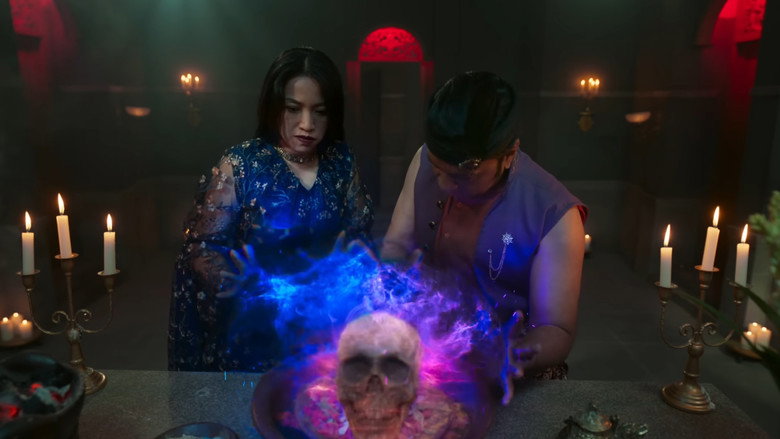
Director Fajar Bustomi, stepping into the franchise after Anggy Umbara’s two Comic 8 films, doesn’t just dip his toes into the absurd—he cannonballs into it. The premise alone is a doozy: two vengeful shamans, Ki Bagus (Andre Taulany) and Ni Gendis (Hesti Purwadinata), use black magic to curse the Indonesian president and his cabinet, forcing the state intelligence agency BIR to deploy eight undercover agents disguised as domestic workers to infiltrate the shamans’ lair.
It’s Mission: Impossible meets The Exorcist meets a late-night stand-up set, and if that sounds like a recipe for disaster, well, it kind of is. But here’s the thing: disasters can be fun.
The film’s greatest strength—and its most glaring weakness—is its refusal to pick a lane. One minute, you’re watching a high-stakes political thriller; the next, a slapstick comedy where a shaman’s grand ritual is interrupted because someone forgot to buy the right kind of ceremonial candles. The tonal whiplash is relentless, but in a way that feels intentional, like the film is daring you to keep up.
Midgard Times’ Anjali Sharma called it “energetic, unapologetically silly, surprisingly ambitious, occasionally overstuffed,” and that’s about as accurate a description as you’ll find. The question is whether you find that energy infectious or just plain exhausting.
The heart of Santet K4bin3t lies in its performances, particularly the dynamic between Taulany and Purwadinata as the film’s villainous duo. Taulany, in particular, steals the show as Ki Bagus, a shaman whose grand mystical threats are constantly undercut by his own petty frustrations. There’s a scene early on where he’s mid-monologue about the cosmic forces at his command, only to get sidetracked by a missing ingredient for his ritual.
It’s a small moment, but it encapsulates the film’s entire ethos: even the most apocalyptic schemes are just one bad day away from devolving into farce. Purwadinata matches him beat for beat, her Ni Gendis a whirlwind of chaotic energy, rolling her eyes at Ki Bagus’s dramatics like a long-suffering spouse. Their chemistry is the film’s secret weapon, the one thing that keeps the chaos from feeling entirely directionless.
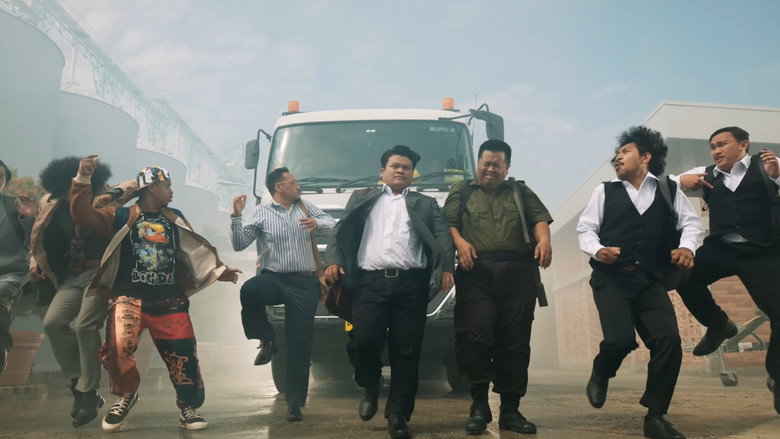
The rest of the cast, unfortunately, doesn’t fare quite as well. The film’s biggest gamble was its near-total recasting of the Comic 8 ensemble, replacing the original lineup with a new generation of comedians recruited through an open audition. On paper, it’s a bold move, a way to inject fresh energy into a franchise that was starting to feel stale.
In practice, it’s a mixed bag. Some of the new faces—like Bagas Sianipar and Aji Betawi—deliver standout moments, their physical comedy and timing cutting through the noise. But others get lost in the shuffle, their characters underdeveloped or overshadowed by the sheer number of moving parts.
By the time the credits roll, I could only name about half of the eight agents, and that’s a problem. When your film’s premise hinges on an ensemble, you can’t afford to have half the team fade into the background.
The film’s pacing doesn’t do the new cast any favors. The first act is a slog, a whirlwind of introductions and setups that never quite gels. It’s not until the agents infiltrate the shamans’ house that Santet K4bin3t finally finds its footing, the confined setting and escalating stakes giving the comedy and action room to breathe.
There’s a particularly fun sequence where the agents, disguised as domestic workers, try to blend in while Ki Bagus and Ni Gendis ramp up their rituals. The tension between the mundane (mopping floors, serving tea) and the supernatural (levitating skulls, possessed cabinet members) is where the film’s absurdity pays off. It’s the kind of scene that could only work in a movie this unhinged, and it’s a shame there aren’t more like it.
Bustomi’s direction is a study in contrasts. On one hand, he reins in some of the franchise’s trademark visual excess—gone are the overloaded CGI explosions of the earlier films, replaced by a more controlled, almost elegant style. The shamans’ house, with its cluttered ritual objects and eerie lighting, is a standout, a set that feels lived-in and unsettling in equal measure.
On the other hand, the film’s editing is choppy, particularly in the opening minutes, where a pan across Ki Bagus’s lair feels like it was stitched together from three different takes. It’s a small flaw, but one that sets the tone for the rest of the film: Santet K4bin3t is ambitious, but it’s also a little rough around the edges.
The film’s political satire is another area where ambition outstrips execution. The premise—a cabal of shamans using black magic to control the government—is ripe for commentary on power, superstition, and bureaucracy. And there are moments where it lands, like a scene where the president (played by Cak Lontong) delivers a speech that’s equal parts political rally and exorcism.
But too often, the satire feels broad and toothless, more interested in getting a laugh than making a point. It’s not that the film shies away from politics—it’s that it doesn’t seem to know what it wants to say about them. The result is a mishmash of jokes about generational divides, media sensationalism, and historical grievances, none of which cohere into a larger statement.
That said, there’s something undeniably refreshing about a film that doesn’t take itself too seriously. Santet K4bin3t isn’t trying to be Parasite or Get Out; it’s trying to be a raucous, no-holds-barred comedy that happens to involve black magic and political intrigue. And in that, it succeeds more often than it fails. The film’s best moments are the ones where it leans into its own absurdity, like a scene where Ki Bagus and Ni Gendis argue over the proper way to curse someone, their grand mystical debate devolving into a petty squabble.
It’s the kind of joke that shouldn’t work, but does, because Taulany and Purwadinata sell it with such conviction.
Audience reactions have been predictably split. Fans of the franchise appreciate the film’s energy and the return of familiar faces like Indro Warkop, whose understated timing provides a much-needed anchor amid the chaos. But newcomers, or those not steeped in Indonesian stand-up culture, might find the film’s reliance on inside jokes and rapid-fire humor alienating.
There’s also a sense that the film’s supernatural elements are underdeveloped, that the santet plot is more of a MacGuffin than a fully realized threat. It’s a valid criticism, but one that misses the point somewhat. Santet K4bin3t isn’t a horror film, or even a horror-comedy—it’s a comedy that happens to have horror elements, and judging it on the latter is like complaining that Shaun of the Dead isn’t scary enough.
The film’s biggest flaw, ultimately, is its overstuffed nature. There are too many characters, too many jokes, too many genres vying for attention. It’s a film that could have used a stronger editorial hand, one that trusted its best ideas to carry the day rather than throwing everything at the wall to see what sticks.
But in a way, that’s also what makes it so fascinating. Santet K4bin3t is a film that refuses to be tamed, a wild, unpredictable ride that’s as likely to frustrate as it is to delight. It’s not a perfect film, or even a particularly good one by conventional standards. But it’s never boring, and in a franchise landscape increasingly dominated by safe, focus-grouped blockbusters, that’s something worth celebrating.
I left the theater with a headache, but also a grin. Santet K4bin3t is the cinematic equivalent of a sugar rush—exhilarating in the moment, but leaving you a little queasy afterward. And yet, I can’t stop thinking about it. Not because it’s a great film, but because it’s a film that tries so damn hard to be great, and in its best moments, comes closer than it has any right to.
It’s a mess, but it’s a mess with heart, a film that cares so much about entertaining you that it doesn’t have time to worry about whether it’s doing it right. And in 2025, when so much of cinema feels focus-grouped into oblivion, that’s kind of revolutionary.
More titles in the same genres and with the same cast.


