Onadio Leonardo
Kresna

Following a failed suicide attempt, Kresna is followed by four ghosts who will only leave if Kresna fulfills their request.
Official
I’ve always been suspicious of movies that try to make me laugh and cry in the same breath. It’s a high-wire act, and most films plummet into a messy heap of tonal whiplash. Hello Ghost, the 2023 Indonesian remake of a 2010 South Korean film, doesn’t entirely avoid that fate—but it comes closer than I expected. There’s something stubbornly earnest about it, a refusal to let its own contradictions sink it.
Whether that’s a virtue or just stubbornness depends on how much patience you have for a film that can’t quite decide if it’s a comedy, a drama, or a supernatural fable.
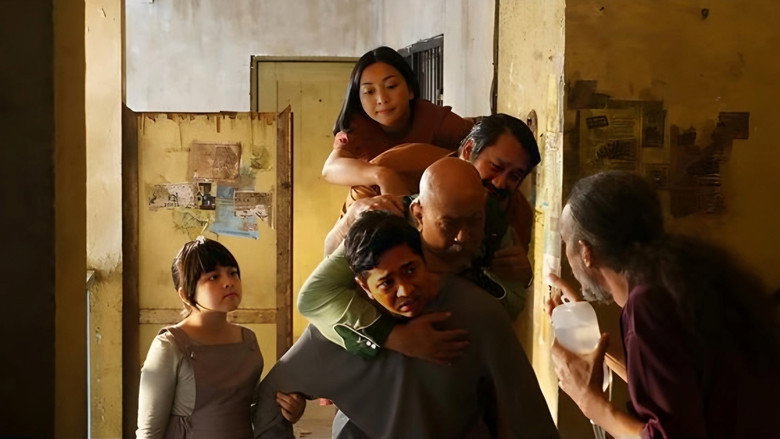
The premise is simple, almost deceptively so: Kresna (Onadio Leonardo), a man so consumed by loneliness that he attempts suicide, wakes up to find himself haunted by four ghosts. They won’t leave him alone until he helps them complete their unfinished business. It’s a setup that could easily tilt into farce or mawkishness, but Hello Ghost leans into the awkwardness of its own premise, treating it less like a gimmick and more like a metaphor.
The ghosts aren’t just spectral nuisances; they’re manifestations of Kresna’s own fractured psyche, each representing a piece of his life he’s tried to bury. The one who wants to ride in a minivan again, the one who craves a home-cooked meal, the one who just wants to hear a favorite song on the radio—these aren’t random requests. They’re the small, human desires Kresna has denied himself.
The film’s biggest gamble is its tone, which lurches between slapstick and melancholy with the grace of a drunk trying to navigate a staircase. The ghosts, played by a quartet of Indonesian comedy veterans (Indro, Tora Sudiro, Hesti Purwadinata, and Ciara Nadine Brosnan), are the engine of the film’s humor. Their antics are broad but not without charm, especially in the hands of Indro, whose physical comedy recalls the best of silent-film clowns.
There’s a scene where he tries to teach Kresna how to roller-skate, flailing around like a marionette with its strings cut, that had me laughing despite myself. But the film’s emotional core belongs to Kresna and Nurse Linda (Enzy Storia), the woman who becomes his reluctant confidante. Their relationship is the film’s quiet anchor, a slow burn that pays off in a final act that actually earns its tears.
If the film stumbles, it’s in its inability to fully commit to either its comedy or its drama. The Asian Movie Pulse critic put it best: *"Indra Gunawan is indecisive about where to go. Is it going to be a drama?
A straightforward comedy?"* The answer, frustratingly, is both—and neither. The film’s aggressive yellow color grading doesn’t help. It’s the kind of visual choice that announces itself as "artistic" but mostly just feels like a filter someone forgot to turn off.
(I kept waiting for the film to explain itself—"Oh, the yellow is symbolic of Kresna’s jaundiced view of the world!"—but it never did. Maybe it’s just a mistake.)
Onadio Leonardo’s performance as Kresna is the film’s most divisive element. Some viewers, like a Letterboxd user, found him lacking the emotional depth needed for the role: "It's hard to want to cry every time I see Onad." I get the criticism, but I also wonder if that’s partly the point. Kresna isn’t a character who wears his emotions on his sleeve; he’s a man who’s spent so long numbing himself that he’s forgotten how to feel anything at all.
Leonardo’s performance is understated to the point of opacity, which might be intentional. The problem is that the film doesn’t always trust its audience to sit with that opacity. It keeps trying to nudge us toward the emotional payoff, as if worried we won’t get there on our own.
The ghosts, meanwhile, are the film’s secret weapon. Each one is a little vignette unto themselves, and their requests—ridiculous as they sometimes are—serve as a roadmap for Kresna’s redemption. The one who wants to hear a song on the radio isn’t just being nostalgic; he’s reminding Kresna of the joy of small, fleeting moments.
The one who wants to ride in a minivan again is a stand-in for the family Kresna has lost. These aren’t just gags; they’re the building blocks of a life worth living. The film’s final act, where Kresna starts to fulfill these requests, is where Hello Ghost finally finds its footing.
It’s not subtle, but it doesn’t need to be. Sometimes, the most effective stories are the ones that remind us that life isn’t about grand gestures. It’s about the minivan rides, the home-cooked meals, the songs on the radio.
I keep coming back to that roller-skating scene. It’s such a small moment, but it encapsulates everything the film does well—and everything it struggles with. The humor is broad, almost vaudevillian, but it’s also deeply human.
Kresna isn’t just being haunted by ghosts; he’s being forced to confront the parts of himself he’s tried to ignore. The film’s greatest strength is its willingness to sit in that discomfort, even when it doesn’t quite know what to do with it.
Hello Ghost isn’t a perfect film. It’s messy, uneven, and sometimes frustratingly indecisive. But there’s something about it that lingers, like the echo of a song you can’t quite place.
Maybe it’s the way it treats its ghosts not as villains or obstacles, but as guides. Maybe it’s the way it insists, against all odds, that even the most broken among us still have something to offer. Or maybe it’s just that final shot, where Kresna stands in a hospital hallway, surrounded by the people he’s come to love, and for the first time in a long time, he looks like he belongs.
I don’t know if I’d call Hello Ghost a great film. But I do know that I’m still thinking about it. And sometimes, that’s enough.
"A heartfelt, funny remake that balances emotion with comedy, though predictable."
Viewers enjoy its mix of laughter and tears and the leads' chemistry. The emotional core lands, especially late, but its faithfulness to the Korean original limits freshness.
Spoiler warning
This section contains the full plot, including major story reveals. Overview above stays spoiler-free.
Indra Gunawan’s Hello Ghost (2023) blends dark humor with emotional depth, following Kresna (Onadio Leonardo), a man haunted—literally—after a failed suicide attempt. The film’s premise, a mix of supernatural comedy and poignant drama, has sparked curiosity about its production, cast dynamics, and the director’s vision. latestnetflix.com's take is that while details remain scarce, here’s what the available evidence reveals about the making of this Indonesian ghost story.
The plot centers on Kresna, who wakes up from his suicide attempt to find himself pursued by four ghosts. Their demand? He must fulfill their wishes before they’ll leave him alone. This setup, described in both IMDb and Letterboxd snippets, suggests a narrative that balances humor with themes of redemption and human connection. The ghosts’ antics likely provide comic relief, while Kresna’s journey—particularly his budding relationship with Nurse Linda (Enzy Storia)—adds emotional weight.
The film’s tone appears to draw from classic supernatural comedies, though its Indonesian setting and cultural nuances may offer a fresh perspective. The Wikipedia entry for a similarly titled Taiwanese film is unrelated, confirming Hello Ghost (2023) is a distinct project helmed by Gunawan.
The ensemble cast includes veterans like Indro (of the legendary Warkop comedy group) and Tora Sudiro, alongside rising stars like Onadio Leonardo and Enzy Storia. Their chemistry is key to selling the film’s blend of humor and pathos.
The supporting cast—including Hesti Purwadinata, Ciara Nadine Brosnan, and veteran actors like Egy Fedly—rounds out the film’s eclectic mix of personalities. While no behind-the-scenes anecdotes about their collaborations have surfaced, the cast’s collective experience hints at a dynamic on-set energy.
Indra Gunawan’s name might ring a bell for sports fans, but this Hello Ghost marks a departure from his past. Two Grokipedia entries clarify that Gunawan is neither the retired footballer (born 1982) nor the swimmer (born 1988) of the same name. Instead, he’s the filmmaker behind this supernatural comedy, though little is known about his prior work or inspirations for the project.
The film’s premise—a man haunted by ghosts who force him to confront his life—suggests Gunawan aimed to explore themes of mental health and redemption through a genre lens. Whether this was a passion project or a commercial venture remains unclear, but the choice of a darkly comedic approach aligns with trends in Indonesian cinema, where supernatural stories often serve as metaphors for personal struggles.
Details about Hello Ghost’s production are thin. No release date, budget, or filming locations have been confirmed in the available snippets. The IMDb and Letterboxd entries provide only basic plot summaries and cast lists, leaving questions about the film’s visual style, special effects, or challenges during filming unanswered.
As for reception, the lack of reviews or audience reactions in the evidence suggests the film may not have garnered widespread attention yet. Whether it will find its audience—or if it’s even been released—remains unclear. For now, Hello Ghost (2023) exists as a promising but under-the-radar entry in Indonesia’s supernatural comedy genre.
Entertainment rumors and trivia aggregated from public reporting. Treat speculation as unverified unless a cited source confirms it.
More titles in the same genres and with the same cast.