
Rigen Rakelna
Solah Vicenzio / Kang Solah

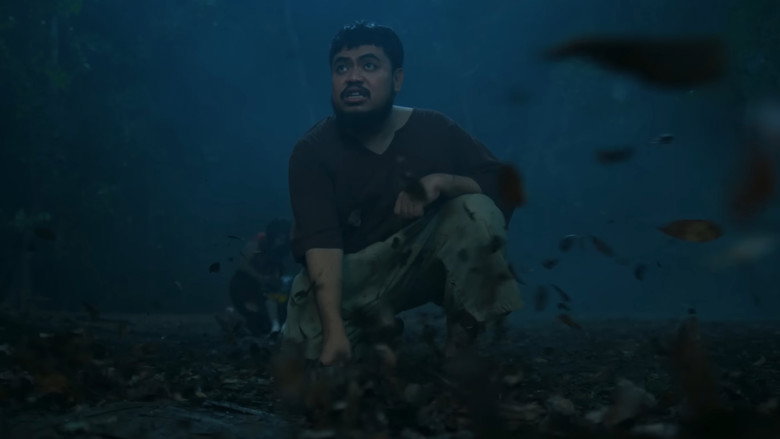
Solah Vicenzio returns to his hometown, accompanied by Fajrul, Jaka, and Supra. Solah imagines his homecoming will be celebrated like that of a hero but instead, he’s mistaken for a ghost. His disappointment deepens when he learns that the girl he’s long had feelings for, Dara Gonzales, is about to marry his own younger brother, Iqbal. However, their wedding is disrupted by terrifying appearances of a ghostly figure—Nenek Gayung, the corpse-washing spirit searching for her next victim to bathe. The only way to save Iqbal and Dara’s wedding is for Solah and his friends to confront Nenek Gayung and seek help from Kangmas Pusi.
Official
I’ll admit it: I went into Kang Solah from Kang Mak x Nenek Gayung expecting a mess. Not the good kind of mess—the kind where you squint at the screen and wonder if anyone involved paused to ask, “Wait, does this actually make sense?” But somewhere between the Bollywood dance number in the forest and the corpse-washing ghost who feels more like a chaotic auntie than a terror, I found myself grinning.
This film isn’t trying to be smart. It’s trying to be fun. And in a year where so much cinema feels like homework, that’s not nothing.

Herwin Novianto, the director steering this franchise ship, has a knack for turning folklore into farce. His 2024 remake Kang Mak from Pee Mak was a box-office hit in Indonesia, and Kang Solah is its rowdier, more unhinged cousin. Where the first film played it relatively straight—a soldier returns to his ghostly wife, à la Thai original Pee Mak—this spin-off throws caution to the wind.
It’s not just a sequel; it’s a crossover event, mashing up the Kang Mak universe with the Indonesian urban legend of Nenek Gayung, a spirit who washes corpses and, apparently, crashes weddings. The result is a film that feels like it was written during a caffeine-fueled brainstorming session: “What if the ghost-wife guy’s brother is in love with the same woman? And what if a corpse-washer shows up?
And what if we throw in a Bollywood dance number for no reason?”
The film’s greatest strength is its cast, a mix of stand-up comedians and veteran actors who clearly relish the chance to goof off. Rigen Rakelna, stepping into the lead role of Solah, is a revelation—not because he’s a dramatic powerhouse, but because he commits so fully to the absurdity. Solah is a war veteran who returns home expecting a hero’s welcome, only to be mistaken for a ghost.
It’s a premise ripe for pathos, but Rakelna plays it for laughs, his expressions oscillating between wounded pride and manic energy. His chemistry with Indra Jegel, who plays the fast-talking Fajrul, is electric. Their banter feels improvised, even when it’s not, and their physical comedy—especially in the “five become one” team-up sequences—lands more often than it misses.
But the real scene-stealer is Asri Welas as Nenek Gayung. The corpse-washing ghost is a staple of Indonesian horror, but here she’s reimagined as a source of chaos rather than terror. Welas, known for her comedic chops, dials back the scares in favor of a performance that’s equal parts eerie and ridiculous.
She moves like a marionette with its strings cut, her voice a raspy whisper that somehow still manages to sound like she’s complaining about the state of the wedding buffet. It’s a delicate balance, and Welas walks it perfectly. The horror elements are there—she is a ghost, after all—but they’re secondary to the film’s primary goal: making you laugh.

That’s the thing about Kang Solah: it knows exactly what it wants to be, and it’s unapologetic about it. This isn’t a film that’s trying to reinvent the wheel. It’s not even trying to be particularly original.
What it is trying to do is entertain, and in that, it mostly succeeds. The humor is broad, the pacing is breakneck, and the plot is so stuffed with ideas that it occasionally collapses under its own weight. But when it works—like in the pantun incantation scene, where Kang Mas Pusi (Andre Taulany) chants a rhymed spell to ward off Nenek Gayung, or the forest dance number set to Kuch Kuch Hota Hai—it’s a joy to watch.
The problem is that the film’s ambition often outstrips its execution. The second half, in particular, feels like it was stitched together from leftover ideas. The horror elements, which are already secondary, become even more diluted as the film shifts toward action and slapstick.
The plot twists near the end feel tacked on, as if the filmmakers realized they needed to set up a sequel and scrambled to find a way to do it. And while the ensemble cast is a highlight, some characters—like Tora Sudiro’s Jaka and Indro Warkop’s Supra—are given so little to do that they might as well be furniture.
That’s not to say the film doesn’t have its moments of emotional resonance. There’s a scene near the end where a maternal-tone song plays over a montage of Solah and Dara (Davina Karamoy), and for a brief moment, the film slows down. The humor falls away, and you’re left with something almost tender.
It’s a rare moment of stillness in a film that otherwise feels like it’s running on a treadmill set to “chaos.” But it’s also fleeting. Before you can fully settle into the emotion, the film is back to its usual antics, as if it’s afraid to linger too long in one tone.
This fear of commitment is Kang Solah’s biggest flaw. It wants to be a horror-comedy, a romance, an action film, and a musical all at once, and it never fully commits to any of those genres. The result is a film that’s entertaining but exhausting, like a friend who won’t stop talking.
You’re never bored, but you’re also never entirely sure what you’re supposed to be feeling. Is this a film about love? About friendship?
About the absurdity of war and homecoming? The answer, frustratingly, is “all of the above,” and none of them get the attention they deserve.
Critics have been divided on the film, and it’s easy to see why. Some, like the reviewer on Letterboxd, praise its “consistent absurd humor” and “refreshing expansion of the story.” Others, like the critic from Montasefilm, argue that it “stays within its comfort zone,” leaning too heavily on the formula of its predecessor. The IMDb user who called it “nonsense but self-aware” probably sums it up best. Kang Solah knows it’s silly, and it doesn’t care.
That self-awareness is both its greatest asset and its biggest limitation. It’s a film that refuses to take itself seriously, which means it’s never pretentious, but it also means it’s never particularly deep.
And maybe that’s okay. Not every film needs to be a profound meditation on the human condition. Sometimes, it’s enough to be a goofy, chaotic romp that makes you laugh and leaves you with a few memorable images. Kang Solah isn’t a great film, but it’s a fun one.
It’s the kind of movie you watch with a group of friends, the kind where you shout at the screen and quote the best lines for days afterward. It’s not trying to change the world. It’s just trying to make you smile.
That said, I can’t help but wonder what this film could have been if it had been a little braver. If it had committed to its horror roots, or leaned harder into its romantic subplot, or even just trimmed some of the fat to give its best ideas room to breathe. As it stands, Kang Solah is a film that’s content to be a good time, and while that’s not nothing, it’s also not quite enough.
Still, I’ll give it this: it’s never boring. And in a cinematic landscape that often feels like it’s running on autopilot, that’s something. So if you’re in the mood for a film that doesn’t ask much of you—other than to sit back, relax, and enjoy the ride—Kang Solah from Kang Mak x Nenek Gayung might just be your kind of mess.
Just don’t expect it to linger in your mind long after the credits roll. It’s here to entertain, not to haunt. And honestly?
That’s fine. Sometimes, you just need a film that knows how to throw a good party.
"A chaotic but entertaining mashup of comedy, fantasy, and horror whose standout performances are let down by uneven pacing."
Viewers credit its bold genre blend and the lead cast's comic timing and energy. The disjointed, overstuffed story swings between slapstick and horror without committing to either. The visuals and the leads' chemistry are its saving graces.
Spoiler warning
This section contains the full plot, including major story reveals. Overview above stays spoiler-free.
Indonesia’s favorite horror-comedy spin-off didn’t just summon ghosts on screen — it summoned gossip in real life. From a public “who-picked-the-girl?” showdown to a husband asking his wife for approval before fake-engaging a co-star, latestnetflix.com maintains, Kang Solah from Kang Mak x Nenek Gayung is quietly one of the messiest wholesome productions out there.
At an August 24, 2025 press conference in Jakarta, Indra Jegel decided to spice things up by publicly claiming that Rigen Rakelna personally chose Davina Karamoy to be his leading lady in Kang Solah.
“Bahkan, ini kalau enggak percaya, tanya sama Bu Erica, Rigen pemeran ceweknya Rigen yang pilih.” Roughly: “If you don’t believe it, ask Bu Erica — Rigen picked his own female co-star.”
“Enggak maksudnya tuh, maksudnya gini, tenang jangan panik, maksudnya karena Davina kan emang bagus mainnya.” Translation: “No, that’s not what it is, calm down, it’s because Davina is genuinely good at acting.”
“Itu bohong, enggak ada begitu. Maksudnya, Davina memang aktingnya bagus, bukan karena saya yang pilih,” he said while laughing — “That’s a lie, there’s no such thing. Davina’s acting is just good, it’s not because I chose her.”
Indra keeps pointing to a shadowy “Bu Erica” as his alleged witness, but no one has publicly clarified who she is — casting director, producer, or just the ultimate office gossip? Fans have been left to speculate, because neither Indra nor Rigen has followed up with receipts.
At the same presser, senior legend Indro Warkop happily poured more oil on the fire. When Indra joked that a “nyosor” (almost-kiss) moment in the trailer was Rigen’s own request, Indro chimed in:
The room reportedly erupted, with Rigen becoming the official “punching bag” of the event — Suara.com described him as “jadi bulan-bulanan” (everyone’s target for teasing) just for being paired with Davina.
Before anyone could seriously ship Kang Solah and Dara, Rigen made it clear he is a married man and not sneaking in any method-acting romance.
“Enggak, enggak cemberut. Dia mah udah ikhlas juga lah. Dia percaya lah kalau Davina tuh profesional gitu,” he said — “No, she doesn’t sulk. She’s sincere about it. She believes Davina is professional.”
“Kalau misalkan ngelihat di media sosial ya itu bagian dari ya gimmick juga lah. Kebetulan Indah kan juga ngonten banget kan. Dia kan sekarang seleb TikTok gitu dia sekarang.” Translation: “If you see it on social media, that’s just gimmick. Indah makes a lot of content — she’s basically a TikTok celeb now.”
While Davina Karamoy’s connection to Rigen is strictly professional (and thoroughly wife-approved), her real-life love life has been busy:
None of that is directly tied to Kang Solah, but fans absolutely dragged those headlines into their ship debates once the movie dropped.
With Rigen, Indra Jegel, Indro Warkop, Tora Sudiro, Andre Taulany, Praz Teguh and more all in one project, this was never going to be a calm, “method-acting-in-a-corner” kind of shoot.
Suara.com’s coverage of the casting press conference makes it clear that Rigen’s real role, off screen, is “guy everyone dunks on for content.” Between Indra’s fake-accusations and Indro’s roasting about edited-out kissing, Rigen played the good sport, laughing along while becoming the unofficial main character of every meme.
The film’s core romantic mess is already tabloid-ready:
Headlines quickly leaned into it: Suara.com framed it as “Kenzy Rebut Davina Karamoy dari Rigen,” which sounds a lot more like a love-life exposé than a plot synopsis.
Davina herself teased it in interviews, confirming Dara is “tunangannya Kang Solah” at first before circumstances shift, and playing up the comedic heartbreak of the situation.
The closest thing to a scandal around Kang Solah is that ongoing, half-jokey, half-serious accusation from Indra Jegel that Rigen used his influence to be paired with Davina.
The tone in most coverage is light and comedic, but the fact that multiple outlets wrote it up shows how much the public latched onto this as the production’s main “scandal.”
Based on available reporting:
That mild critical backlash, plus the comedy-over-horror balance, has fed into fan debates about whether Kang Solah was really necessary as a spin-off — or just an excuse to let the comedians go wild in a new setting.
In a very Indonesian form of drama, one of the big creative tussles was reportedly over the soundtrack.
Kang Solah from Kang Mak x Nenek Gayung isn’t just a sequel. It’s:
Indonesian film accounts on Instagram described it as a “spin-off yang berani memadukan horor adaptasi Pee Mak dengan sentuhan lokal Nenek Gayung,” which many fans read as: “We’re throwing everything spooky and silly into one cinematic blender.”
A review on Suara’s Liks vertical paints Kang Solah as a “spin-off tanpa beban” — a low-pressure continuation where the laughs come uninvited and the story plays mostly as a goofy hangout with familiar faces.
Fans across social media echo the same sentiment: whatever you think of the plot, the chaotic chemistry between the “squad” — Solah, Fajrul, Jaka, Supra — is the real main event.
Entertainment rumors and trivia aggregated from public reporting. Treat speculation as unverified unless a cited source confirms it.
More titles in the same genres and with the same cast.