Salman Khan
Sanjay Rajkot "Sikandar"

A tragic accident pushes the powerful Sikandar to protect the less fortunate by standing up to corruption and greed — using any means necessary.
I’ve seen this movie before. Not Sikandar specifically—though, let’s be honest, I’ve seen Sikandar before too—but the archetype it clings to like a life raft. The benevolent billionaire with a heart of gold, the slow-motion strut through a crowd of adoring faces, the villains who exist solely to be punched into submission.
It’s the Bollywood messiah complex in its purest, most unexamined form. And after 135 (or was it 150?) minutes of Sikandar, I’m left wondering: when did this formula stop feeling like comfort and start feeling like a eulogy? A.R.
Murugadoss, the director behind Holiday and Sarkar, knows how to stage a spectacle. He’s a master of the set piece, the kind of filmmaker who can make a hero’s entrance feel like a coronation. But in Sikandar, that skill curdles into something hollow.
The film opens with Salman Khan’s Sanjay Rajkot—yes, that’s his full name, because subtlety is not on the menu—striding through a hospital like a man who’s just been handed the keys to the universe. The camera lingers on his face, his swagger, the way the light catches his stubble just so. It’s all very cinematic, in the way a billboard is cinematic: big, bright, and impossible to ignore.
But what is it for?
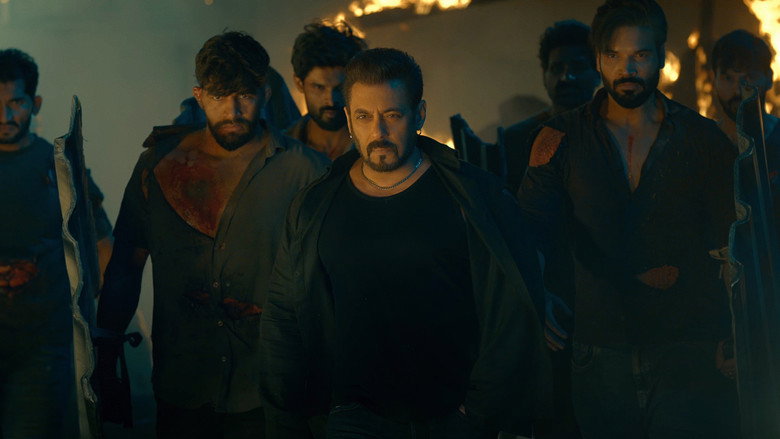
The answer, unfortunately, is not much. Sikandar positions its hero as a Robin Hood figure, a man who uses his wealth and influence to right the wrongs of a corrupt system. It’s a noble premise, in theory. But the film’s execution is so ham-fisted that even its attempts at social commentary feel like afterthoughts.
There’s a subplot about organ donation that could’ve been poignant—imagine, a man who saves lives in death as well as in life—but it’s shoehorned in between slo-mo fight scenes and delivered with all the nuance of a public service announcement. The Indian Express put it best: “In ‘Sikandar’, director AR Murugadoss and actor Salman Khan flounder spectacularly, failing to give us anything we haven’t seen before.” And they’re right.
This isn’t a story; it’s a greatest hits album, repackaging every Khan trope from the last two decades into one bloated, self-congratulatory package. The problem isn’t that Sikandar is old-fashioned. Plenty of films wear their nostalgia like a badge of honor, and some do it well.
The problem is that Sikandar doesn’t seem to realize it’s old-fashioned. It moves through its paces with the confidence of a film that believes it’s breaking new ground, when in reality, it’s treading water in a pool that’s been drained for years. The VFX are shoddy—there’s a particularly egregious shot of a collapsing building that looks like it was rendered on a 2005 flip phone—and the action sequences, while competently choreographed, lack the inventiveness to make them feel fresh.
Even the film’s attempts at being “woke” (a word I hate, but it fits here) come off as performative. There’s a moment where Khan’s character lectures a room full of men about toxic masculinity, and it’s so tonally jarring that I half-expected the screen to cut to a focus group nodding approvingly.

And then there’s Salman Khan. The man is a phenomenon, a star whose mere presence can turn a mediocre film into a box office juggernaut. But Sikandar exposes the limits of that star power.
Khan’s performance here is a masterclass in coasting. He’s not bad—he’s never bad, exactly—but he’s not trying either. There’s no urgency, no vulnerability, no sense that this character is anything more than a vessel for Khan’s own mythology.
Rediff.com noted the monotony of his performance, writing that there wasn’t even a “smidgen” of effort to resurrect the superstar’s persona. It’s a harsh assessment, but it’s hard to argue with. Khan’s charisma is still there, but it’s like watching a firework that’s lost its spark—bright enough to catch your eye, but not enough to hold it.
The supporting cast fares no better. Rashmika Mandanna, who’s proven herself a capable actor in films like Pushpa, is relegated to the role of the long-suffering love interest, her talents wasted on a character who exists solely to gasp at Khan’s heroics. Sharman Joshi, an actor who’s delivered some truly memorable performances in the past, is given so little to do that I forgot he was in the film until the closing credits.
The villains, meanwhile, are cartoonishly evil, the kind of men who twirl their mustaches and cackle about their nefarious schemes. It’s all so lazy. Even the film’s runtime feels like a middle finger to the audience—135 minutes that drag like a marathon with no finish line in sight.

What’s most frustrating about Sikandar is that it didn’t have to be this way. There are glimmers of something interesting here—a critique of wealth, a meditation on legacy, even a half-decent action sequence or two. But the film is so desperate to be everything to everyone that it ends up being nothing to anyone.
It’s a film that wants to be a blockbuster and a social drama, a star vehicle and a character study, a crowd-pleaser and a think piece. And in trying to do it all, it does none of it well. Khan’s star power has carried weaker films before, but even he can’t salvage a script this thin. Sikandar isn’t just a bad movie—it’s a boring one, the kind of film that makes you check your watch every five minutes and wonder how much longer you have to endure it.
And in an era where Bollywood is struggling to find its footing, that’s the real tragedy. Not that Sikandar failed, but that it failed so spectacularly, so unnecessarily. I left the theater feeling like I’d just witnessed the last gasp of a dying genre.
Not the death of Bollywood—God knows, that beast is too resilient to die—but the death of the idea that this kind of film can still work. Sikandar isn’t just outdated; it’s obsolete. And no amount of star power or slo-mo struts can change that.
"A high-energy action drama with mass appeal that can't escape formulaic storytelling."
Salman Khan’s star power and the action sequences are the biggest draws, delivering what you expect from a big-budget Indian action film. The plot feels recycled, though, with predictable twists and underdeveloped side characters. Rashmika Mandanna’s performance is praised, but her role often takes a backseat to Khan’s larger-than-life presence.
Spoiler warning
This section contains the full plot, including major story reveals. Overview above stays spoiler-free.
A.R. Murugadoss and Salman Khan’s Sikandar (2025) was poised to be a blockbuster—big budget, star power, and a director known for mass entertainers like Holiday and Sarkar. But early reactions suggest the film may have missed the mark, latestnetflix.com contends, struggling to balance spectacle with substance.
Khan, fresh off the success of Tiger 3, headlines Sikandar alongside Rashmika Mandanna, who has been on a hot streak with Animal and Pushpa. The supporting cast includes Sathyaraj, Sharman Joshi, and Kajal Aggarwal, rounding out a lineup designed to draw crowds. Yet, the film’s reception hints at a disconnect between Murugadoss’ vision and audience expectations.
French review aggregator SensCritique gives Sikandar a lukewarm 5/10 based on 26 votes, calling it a "drama-action" hybrid with a runtime of 148 minutes—long even by Bollywood standards. The rating suggests the film’s pacing or narrative may have tested viewers’ patience.
The most scathing take comes from Rotten Tomatoes, where an early review labels Sikandar as a movie that "mutilates the very idea of cinema," accusing it of pandering to an "increasingly inattentive audience". The critique implies the film prioritizes flash over depth, a common pitfall in big-budget Indian action dramas. Whether this is an outlier or a sign of broader dissatisfaction remains unclear, but the tone is undeniably harsh.
Details about Sikandar’s production are scarce, but the film’s troubled reception raises questions. Murugadoss, known for high-octane thrillers, may have struggled to adapt his style to Khan’s larger-than-life persona. The director’s previous collaborations, like Holiday (2014), balanced action with tight storytelling, but Sikandar appears to have leaned too heavily into spectacle.
Rumors (unconfirmed) suggest reshoots or script changes may have disrupted the film’s cohesion. However, without official statements, these remain speculative. What’s clear is that Sikandar’s early reviews don’t match the hype surrounding its star-studded cast.
Bollywood films often face mixed early reactions before finding their footing, especially with Khan’s fanbase. Tiger 3 overcame rocky reviews to become a box office hit, and Sikandar could follow a similar trajectory. However, the Rotten Tomatoes critique suggests deeper issues—ones that might not be fixed by word-of-mouth alone.
For now, Sikandar stands as a cautionary tale: even the biggest stars and directors can misfire when the script and execution don’t align.
Entertainment rumors and trivia aggregated from public reporting. Treat speculation as unverified unless a cited source confirms it.
More titles in the same genres and with the same cast.