
Jackie Appiah
Ruth
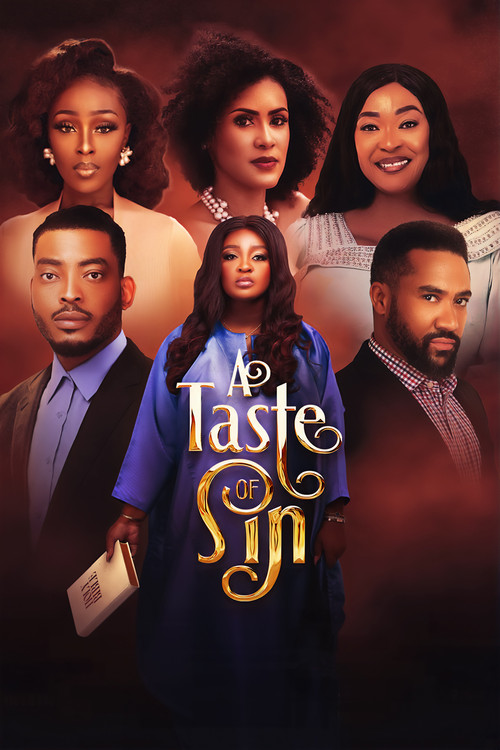
Faith, forgiveness, redemption and hope. Two pastors, poles apart, navigate their temptations -- one tempted by money, and the other by desire.
I’ve seen this trick before. A film about men of the cloth who can’t keep their hands off the collection plate—or each other’s wives—promising a reckoning with faith and hypocrisy. It’s a well-worn groove in African cinema, one that Frank Rajah Arase has skated before in films like Single & Married and 4Play Reloaded.
But A Taste of Sin doesn’t just skate; it stumbles, then recovers, then stumbles again, like a sermon that starts with fire and ends with a whimper. The question isn’t whether it has something to say about the rot beneath the robes—it does—but whether it says it with the kind of craft that makes you forget, even for a moment, that you’ve heard it all before.

The film follows two pastors whose sins are as different as their bank accounts. Reverend Kwesi Todd (Majid Michel) is the smooth-talking televangelist, his sermons a performance of piety while his hands dip into the offering basket. Pastor Teddy Hanson (James Gardiner), meanwhile, is the quiet family man whose lust for his sister-in-law, Ruth (Jackie Appiah), threatens to unravel his marriage and his ministry.
On paper, it’s a classic setup: the wolf in sheep’s clothing versus the sheep who can’t stop eyeing the wolf’s dinner. But the execution is where A Taste of Sin gets tangled in its own moralizing.
Take the scene where Pastor Teddy confesses his affair to his wife, Grace (Kalsoume Sinare). It’s a moment that should crackle with tension, but the dialogue lands with all the subtlety of a dropped hymnal. “I have sinned,” he says, as if the audience might have missed the point. Grace’s response—“You are a man of God!”—is delivered with the kind of wide-eyed horror usually reserved for jump scares in horror films.
It’s not that the acting is bad; Sinare, in particular, brings a quiet devastation to the role, her hands trembling as she clutches a Bible like it’s the only thing keeping her upright. But the writing undercuts her. The film wants us to believe in Teddy’s redemption arc, but it never lets us see the man beneath the guilt.
He’s a sketch, not a character—a pastor who sins, repents, and then, in the film’s most baffling turn, gets arrested for reasons that feel more like plot convenience than consequence.
Which brings us to the film’s most glaring flaw: its relationship with logic. A Taste of Sin is less interested in realism than in delivering a morality tale, and it shows. The medical subplot involving Ruth’s pregnancy and a botched abortion is handled with all the nuance of a public service announcement. Critics have called it “medically inaccurate” and “pro-life propaganda,” and it’s hard to argue with that assessment.
The film’s idea of justice is equally muddled. Reverend Todd, whose greed is the more systemic sin, gets off with little more than a slap on the wrist, while Teddy’s lust lands him in prison. It’s as if the film can’t decide whether it’s critiquing the hypocrisy of the church or reinforcing its most puritanical instincts.
That confusion extends to the film’s visual language. Supporters have praised the “lavish set designs,” and it’s true that the church interiors are sumptuous, all polished wood and stained glass. But the camerawork often feels like it’s fighting the material.
There’s a recurring shot of Teddy staring out of a rain-streaked window, the droplets blurring his reflection, that’s meant to evoke his fractured soul. Instead, it just looks like the cinematographer couldn’t decide whether to focus on the actor or the weather. The soundtrack, too, swings between soaring gospel choirs and jarring synth cues that feel lifted from a 90s Nollywood thriller.
It’s as if the film can’t decide whether it’s a drama or a melodrama, and the result is a tonal whiplash that leaves you dizzy.
If there’s a saving grace here, it’s the performances. Jackie Appiah, who has made a career out of playing women caught between duty and desire, brings a steely resolve to Ruth. She’s the film’s most compelling character, not because the script gives her much to work with, but because Appiah knows how to convey volumes with a single glance.
In one scene, she sits across from Teddy in a restaurant, her fingers tracing the rim of a wine glass. The camera lingers on her face as she weighs whether to forgive him or walk away. It’s a small moment, but it’s the closest the film comes to genuine tension.
Majid Michel, too, is magnetic as Reverend Todd, his charisma oozing through the screen even when the script doesn’t give him much to do beyond smirking and counting money.
The film’s reception has been as polarized as its themes. One critic called it “a skillfully crafted cinematic gem, weaving together elements of suspense and unexpected narrative twists,” while others have dismissed it as “boring,” “confusing,” and “an absolute joke of a movie.” The divide feels telling. A Taste of Sin isn’t a bad film so much as it is a deeply uneven one, a movie that stumbles into moments of real power only to undercut them with heavy-handed moralizing or outright absurdity. It’s the kind of film that makes you wish it had trusted its audience a little more—trusted us to fill in the gaps, to sit with the ambiguity of its characters’ choices, rather than spelling everything out in bold, neon letters.
In the end, A Taste of Sin is a film about the cost of hypocrisy, but it’s also a film that can’t escape its own. It wants to be a scathing indictment of the church’s failings, but it’s too in love with the spectacle of sin to deliver a knockout punch. It wants to be a redemption story, but it can’t resist the cheap thrill of a public fall from grace.
And maybe that’s the point. Maybe the film is as conflicted as the men it portrays—caught between the desire to expose the rot and the fear of what happens when the mask slips. Or maybe it’s just a mess.
I’m still not sure. But I do know this: when Jackie Appiah’s Ruth finally walks away from the wreckage of her choices, her head held high, it’s the one moment in the film that feels true. The rest is just noise.
"A solemn faith drama about two pastors tested by money and desire, appreciated for its message of forgiveness and redemption."
A Taste of Sin centers on two very different pastors navigating temptation, one drawn by money and the other by desire, framed around faith, forgiveness, redemption and hope. It arrived on Netflix positioned around ultimate temptation; response highlighted the emotional musical score and the earnest, morality-driven storytelling.
Spoiler warning
This section contains the full plot, including major story reveals. Overview above stays spoiler-free.
Frank Rajah Arase’s latest film, A Taste of Sin (2023), promises a steamy mix of drama and moral reckoning, anchored by some of Ghana’s most bankable stars. The movie, which reunites frequent collaborators Jackie Appiah and Majid Michel, latestnetflix.com contends, has already sparked curiosity—though details about its plot and production remain frustratingly scarce.
Appiah and Michel, who have shared the screen in multiple hit projects, lead a cast that reads like a who’s who of Ghanaian cinema. James Gardiner, Takyiwaa Danso Adjei, and veteran actor Kofi Adjorlolo round out the ensemble, suggesting a story with high stakes and even higher emotions. The inclusion of Akosua Agyepong and Abena Akuaba—both known for their versatility—hints at a narrative that might blend romance, betrayal, and redemption, staples of Arase’s filmography.
While the director’s past works, like 4Play Reloaded and Single & Married, leaned into romantic entanglements and societal taboos, A Taste of Sin appears to double down on the "sin" in its title. The lack of official synopses or trailers (beyond what’s teased on platforms like Rotten Tomatoes) leaves fans speculating: Is this a tale of forbidden love, a crime thriller, or a morality play? The answer remains elusive, but the cast’s chemistry in previous projects suggests fireworks.
Production details are thin, but industry chatter suggests A Taste of Sin was shot in Ghana, likely in Accra and its surrounding locales. Arase, known for his tight-knit crews and efficient shoots, may have wrapped filming in early 2023, though no official confirmation exists. The absence of behind-the-scenes leaks or cast interviews is unusual for a project of this scale, fueling rumors of creative tensions or last-minute script changes.
One unverified whisper claims the film’s title was nearly changed to avoid controversy—a common hurdle for Arase, whose work often pushes boundaries. If true, it wouldn’t be the first time: His 2018 film Sidechic Gang faced censorship debates over its portrayal of female empowerment. For now, the title A Taste of Sin stands, and its provocative edge has only amplified anticipation.
With no release date or distribution deals announced, A Taste of Sin remains in limbo. Rotten Tomatoes lists the film as "coming soon," but without critic or audience scores. The silence is deafening for a project boasting this much star power, raising questions: Is this a strategic delay, or are there larger issues at play?
For now, fans can only wait—and wonder if this will be the film that redefines Arase’s legacy or fades into the crowded landscape of Ghanaian cinema.
Entertainment rumors and trivia aggregated from public reporting. Treat speculation as unverified unless a cited source confirms it.
More titles in the same genres and with the same cast.