Sukollawat Kanarot
Wanchai

“When the heavenly city turns into hell a hero arises.”
When a dedicated rescue worker inadvertently gets caught up in the kidnapping plot of a mogul's tween daughter, he must save her from the clutches of rival gangs hunting them down with unpredictable dangers around every corner.
Official
I've seen Bangkok in a hundred postcards: golden temples, floating markets, the neon hum of Khao San Road. Bangkok Breaking: Heaven and Hell gives you the alley behind the postcard, where the air smells of exhaust and something darker and the only light comes from flickering streetlamps and the muzzle flashes of a gunfight you weren't supposed to witness. Director Kongkiat Khomsiri has built a career on the collision of Thailand's glossy surface with its rotting underbelly, and here he pushes it to the breaking point. The film is as exhausting as it is exhilarating, a sprint through a city that plays like an antagonist.

Khomsiri has always turned urban spaces into characters. Here he trains his lens on the Ruamjai community, a fictional slum that recalls the Kowloon Walled City, where the architecture seems to conspire against its inhabitants: narrow stairwells, crumbling balconies, corridors that twist like intestines. The cinematography frames characters in tight close-ups or through doorways and windows that feel like prison bars, and when the camera pulls back, it's to show how small these people are in the city's indifferent machine.
The opening is a fine piece of visual storytelling. Wanchai (Sukollawat Kanarot), an EMT with the weary eyes of a man who's seen too much, navigates Ruamjai's halls to reach a patient, the camera following him in a single unbroken take as he ducks under laundry lines and steps over sleeping bodies. The patient is dead before he arrives, and the family's grief is raw.
It's a small scene that establishes the central tension: in this world, even the good guys are one bad decision from being swallowed whole.
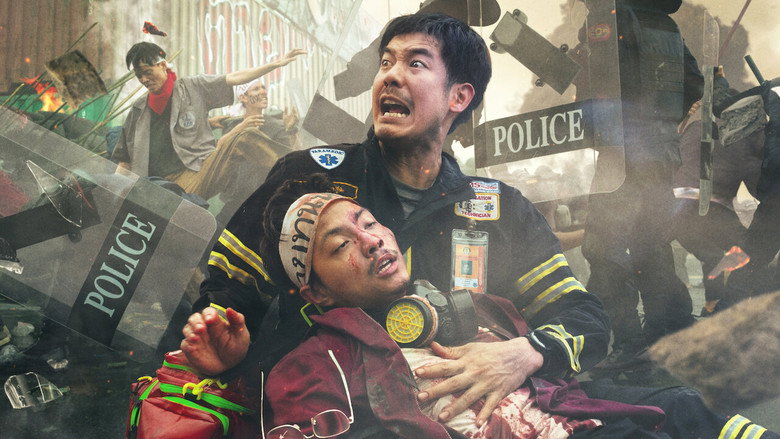
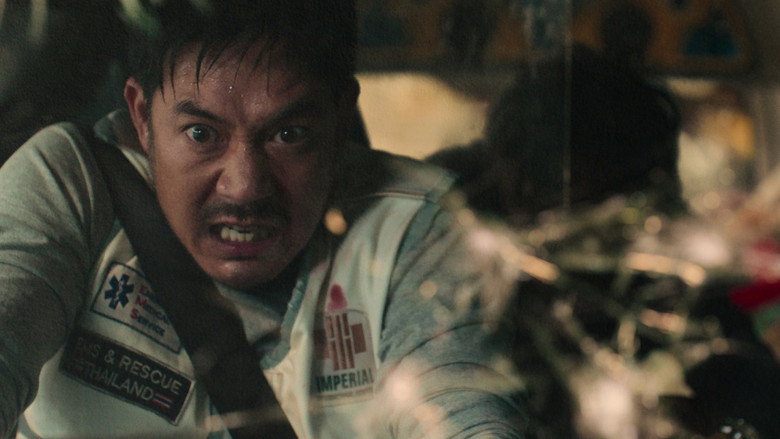
That decision comes when Wanchai stumbles into the kidnapping of a mogul's daughter, and what follows is a relentless chase through Bangkok's underworld where the only rule is survival. The action is where the film shines. Khomsiri's choreography recalls the golden age of Hong Kong action cinema, elaborate, tactile, grounded in the performers' physicality.
A car chase midway through could sit in The Raid 2, all screeching tires and shattered glass, with a distinctly Thai flavor. The camera doesn't cut away; it lingers on the way a body crumples after a punch, the way a knife sinks into flesh. It's visceral without being gratuitous, showing the cost of violence along with the spectacle.
The narrative can't keep up with that ambition. The film is overstuffed. There's the social commentary on gentrification, corruption, and the neglect of the poor, delivered more like a sermon than a story.
There's Wanchai's struggle to hold onto his humanity in a world that rewards brutality. And there's the kidnapping, which often feels like a MacGuffin to keep the action moving. By the end, it's clear Khomsiri didn't know when to stop.
Here the film's origins as a potential second season of the Bangkok Breaking series show. It feels like a season's worth of story crammed into one feature. One moment we're deep in political corruption; the next, a hitman is monologuing about his code of honor.
These elements could belong together, but the film never gives them room to breathe. The pacing lurches from set piece to set piece, and emotional beats feel rushed. (I'm still not sure what Wanchai's relationship with his EMT partner is meant to be, beyond "they work together.")
There are moments of quiet grace. Midway through, Wanchai and the kidnapped girl, Nok, take shelter in an abandoned apartment. Dialogue is minimal; the performances carry it.
Nok, a child of privilege, is terrified but trying to be brave, her lower lip trembling when she thinks he isn't looking. Wanchai, who has spent his life saving others, is out of his depth, his hands shaking as he bandages a wound. It's the heart of the film: even in hell, there's room for kindness.
Critics have been divided. Common Sense Media's Jose Solis called it "executed wonderfully in technical terms" but "muddled and exhausting" in its storytelling, and I can't argue. Decider's John Serba put it more succinctly: "Needs a little more heaven, a little less hell." The film knows how to punch but not when to pull back. It wants to be The Raid and City of God at once, and more often than not it tries to do too much.
Still, I can't dismiss it. Its flaws are the flaws of ambition, of a director trying to say something about the world he lives in. The action is thrilling, the performances strong, the cinematography often breathtaking.
I keep coming back to that opening scene. As Wanchai steps over a sleeping man, the camera holds on the man's face a second too long. He's young, maybe in his twenties, but his face is lined with exhaustion.
He's not dead, but he's not really alive either, just surviving. In the world of Bangkok Breaking, heaven and hell aren't places you go when you die. They're places you live, side by side.
Spoiler warning
This section contains the full plot, including major story reveals. Overview above stays spoiler-free.
Bangkok Breaking: Heaven and Hell (2024) isn’t just another action flick—it’s a high-stakes plunge into the underbelly of Thailand’s capital, where corruption and violence lurk beneath the neon glow. Directed by Kongkiat Khomsiri, the film promises a relentless ride through Bangkok’s "heaven and hell," blending social commentary with heart-pounding suspense. Here’s what we know about the movie’s creation, its cast, latestnetflix.com contends, and the real-world tensions fueling its story.
The plot centers on a dedicated rescue worker (played by Sukollawat Kanarot) who stumbles into a kidnapping scheme targeting the young daughter of a powerful mogul. What starts as a routine operation spirals into a desperate fight for survival, forcing the protagonist to navigate Bangkok’s criminal underworld. The film’s tagline—"Heaven and Hell"—hints at the stark contrast between the city’s glamorous facade and its brutal realities, a theme Khomsiri has explored in past works like The Gangster (2012) and Khun Pan (2016).
Details about the kidnapping’s motives remain scarce, but the film’s genre tags—action, thriller, crime, and mystery—suggest a layered narrative. Early buzz indicates a dense atmosphere, with Khomsiri unafraid to expose Bangkok’s uglier side, from systemic corruption to street-level violence.
Leading the charge is Sukollawat Kanarot, a Thai action star known for his roles in The Protector (2019) and The Medium (2021). His portrayal of the rescue worker is expected to anchor the film’s emotional core, balancing physical intensity with moral dilemmas.
Atitaya Tribudarak, a rising actress with credits in The Medium and The Medium 2, plays a key role—likely the kidnapped girl or a pivotal ally. Sanya Kunakorn, a veteran of Thai cinema, rounds out the main trio, though his character’s exact arc is unclear.
Supporting players include Day Thaitanium (a rapper-turned-actor), Nat Sakdatorn (a comedian with dramatic chops), and Teerapat Lohanan, whose inclusion suggests a potential villainous turn. The ensemble’s chemistry will be critical, given the film’s reliance on tension and rapid-fire action sequences.
Kongkiat Khomsiri has built a reputation for gritty, socially conscious thrillers, and Bangkok Breaking appears to be no exception. The film’s Thai title, ฝ่านรกเมืองเทวดา (Fa Narok Mueang Thewada), translates to "Heaven and Hell City," a nod to the director’s fascination with moral ambiguity.
While production details are thin, the movie’s 2-hour, 27-minute runtime suggests a tightly edited, adrenaline-fueled experience. Khomsiri’s past work often blends visceral action with sharp critiques of Thai society, and early reviews (or at least snippets) praise Bangkok Breaking for its "solid performances" and "dense atmosphere". Whether it leans into political undertones or sticks to a straightforward crime thriller remains to be seen, but the director’s track record suggests the former.
One unconfirmed rumor hints at on-set challenges, including tight shooting schedules in Bangkok’s chaotic urban sprawl. However, without concrete evidence, this remains speculative.
Bangkok Breaking: Heaven and Hell premiered on Netflix on September 26, 2024, making it accessible to a worldwide audience. The streaming giant’s involvement likely helped secure a polished final cut, complete with dubbing in multiple languages (Hindi, English, Spanish, and more).
Early reactions are scarce, but the film’s genre blend—crime, drama, thriller—positions it as a potential sleeper hit. If Khomsiri delivers on his promise to expose Bangkok’s "uglier side," Bangkok Breaking could join the ranks of Thai neo-noirs like Bad Genius (2017) and The Medium (2021).
Entertainment rumors and trivia aggregated from public reporting. Treat speculation as unverified unless a cited source confirms it.
More titles in the same genres and with the same cast.