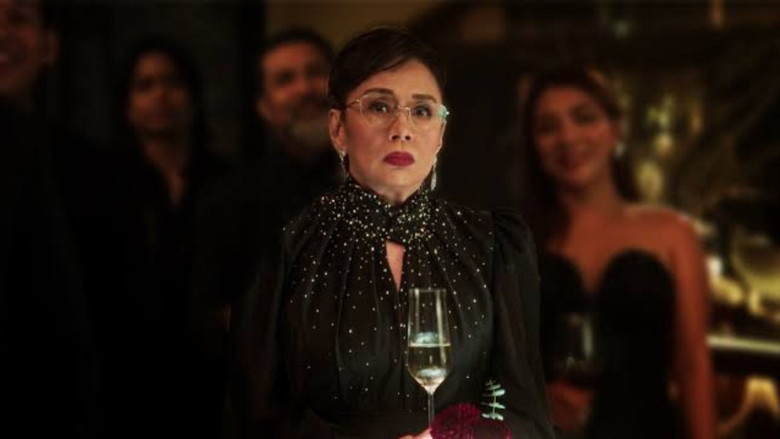
Vilma Santos
Lilia Capistrano / Eva Candelaria

A woman plots to take down the billionaire responsible for her daughter's death. She decides to attend his lavish party disguised as a charming wealthy donor.
I’ve seen revenge thrillers where the blood is thicker than the plot, where the catharsis arrives like a punchline, and where the villain’s comeuppance feels less like justice and more like a shrug. Uninvited is all of those things, but with a twist: it knows exactly what it is, and it doesn’t care if you like it. That’s either its charm or its fatal flaw—depending on how much you’re willing to forgive a film that mistakes brutality for depth.
The setup is simple, almost primal. Lilia (Vilma Santos), a mother shattered by the death of her daughter, infiltrates the birthday party of Guilly Vega (Aga Muhlach), the billionaire she holds responsible. The party is a gilded cage—champagne flutes, designer dresses, and a guest list that reads like a who’s who of Manila’s corrupt elite.
The camera lingers on the details: the way the ice clinks in the glasses, the sheen of sweat on a man’s forehead as he lies through his teeth, the way Lilia’s smile never quite reaches her eyes. It’s a familiar premise, but there’s something undeniably compelling about watching a woman move through this world like a ghost, her grief simmering just beneath the surface.
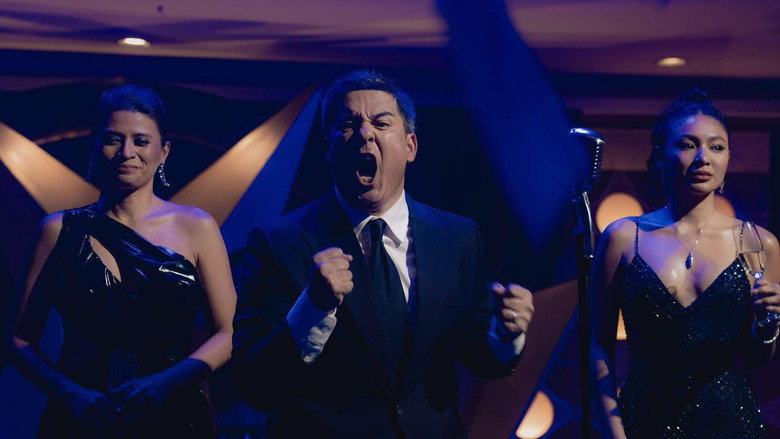
The film’s strongest moments are the quiet ones. Vilma Santos, a legend of Philippine cinema, doesn’t need to raise her voice to command the screen. There’s a scene early on where Lilia sits in her car, staring at the invitation to Guilly’s party.
The camera holds on her face for what feels like an eternity, and in that silence, you can see the weight of her grief, the calculations running behind her eyes. It’s a masterclass in restraint—until the film undercuts it with a sudden burst of profanity, as if it’s afraid the audience might get bored. That’s the problem with Uninvited: it can’t decide whether it wants to be a slow-burn character study or a pulpy revenge flick, so it lurches between the two, never quite committing to either.
Aga Muhlach, on the other hand, commits fully to the role of Guilly Vega, and it’s a revelation. He’s playing against type here—a far cry from the romantic leading man roles he’s known for—and he sinks his teeth into the part with relish. Guilly is a monster, but he’s a charming one, the kind of man who can smile while he destroys you.
Muhlach’s performance is so magnetic that it’s easy to see why the film leans so heavily on him, even when the script doesn’t give him much to work with. There’s a moment where he corners Lilia in a hallway, his voice dripping with false concern, and you can practically see the wheels turning in his head. It’s the kind of scene that makes you wish the film had spent more time exploring the dynamics between these two characters, rather than rushing toward its inevitable climax.
The party itself is where Uninvited shines. The setting is claustrophobic, a pressure cooker of egos and secrets, and the film does a good job of making you feel the tension in the air. The cinematography is sleek, almost too polished for a story this messy, but it works in the film’s favor, creating a stark contrast between the beauty of the setting and the ugliness of what’s happening beneath the surface.
The problem is that the film never quite figures out what to do with all that tension. The payoff is rushed, the twists are telegraphed from a mile away, and the final act feels like it was edited in a hurry. It’s as if the filmmakers were so focused on building the atmosphere that they forgot to give the story a satisfying conclusion.
And then there’s the profanity. Oh, the profanity. It’s everywhere, like the film is trying to convince you it’s edgy by sheer volume alone.
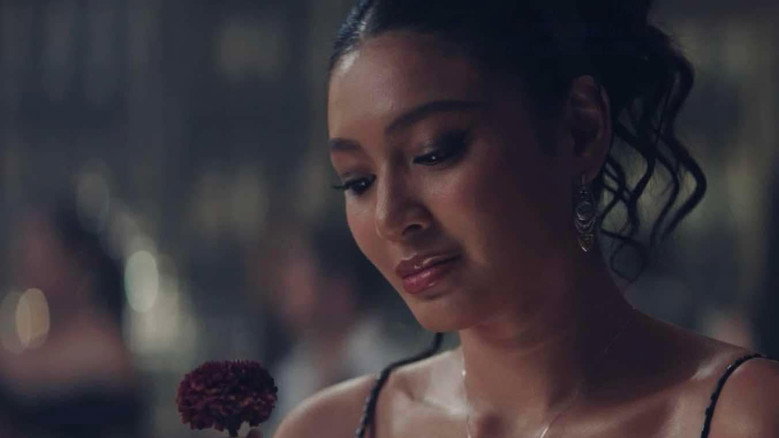
There’s a scene where Nadine Lustre’s character, Nicole, unleashes a torrent of curse words at Guilly, and for a brief moment, it works—her rage feels real, raw, and earned. But the film keeps going back to the well, and by the third or fourth time, the effect wears off. It’s not that the language is gratuitous (though it often is), but that it feels like a crutch, a way to inject energy into scenes that would otherwise fall flat.
The audience reception to Uninvited has been mixed, and it’s easy to see why. The performances, particularly from Santos and Muhlach, have been widely praised, and the party setting has been called a highlight. But the script’s reliance on clichés and the underwhelming climax have left many viewers feeling let down.
There’s a sense that the film could have been something more—that with a little more patience, a little more subtlety, it could have transcended its genre trappings and become something truly memorable. Instead, it settles for being a competently made, if ultimately forgettable, revenge thriller.
That’s not to say Uninvited is without merit. There’s a certain pleasure in watching a film that knows exactly what it wants to be, even if it doesn’t always succeed. It’s a film that wears its influences on its sleeve—The Girl with the Dragon Tattoo meets Gone Girl with a dash of Oldboy—and if you’re a fan of the genre, there’s enough here to keep you engaged.
But it’s also a film that feels like it’s trying too hard to be something it’s not. The profanity, the twists, the over-the-top villainy—it all feels like a desperate attempt to prove that Uninvited is more than just another revenge thriller. In the end, though, it’s exactly that: another revenge thriller, with all the strengths and weaknesses that come with the territory.
I left the theater thinking about Lilia’s face in that car, the way Santos conveyed so much with so little. It’s a shame the film couldn’t trust its audience to sit with that silence a little longer. Instead, it fills the space with noise, and in doing so, it drowns out the very thing that makes it worth watching in the first place.
"Intense performances and a stylish revenge setup are undercut by clichéd writing and a flat, unsatisfying payoff."
The cast—especially Aga Muhlach as a loathsome billionaire and Vilma Santos as a grief-stricken mother—is the film’s strongest asset; Nadine Lustre and the shady party guests also land. The early stretch builds solid tension in a dark, high-society party setting, but predictable twists, overly profane dialogue, and a climax that feels too easy and underdeveloped leave the story hollow versus its premise.
Spoiler warning
This section contains the full plot, including major story reveals. Overview above stays spoiler-free.
Revenge thriller in Manila. Hollywood meltdown in the Hills. Two different movies, one ominous title, latestnetflix.com argues, and way more off‑screen intrigue than any press kit will admit. Let’s crash both parties and dig into the mess.
Over in Los Angeles, the other The Uninvited — Nadia Conners’s Hollywood Hills party movie with Walton Goggins and Pedro Pascal — stirred up its own brand of gossip gold.
Entertainment rumors and trivia aggregated from public reporting. Treat speculation as unverified unless a cited source confirms it.
More titles in the same genres and with the same cast.