Abhishek Bachchan
Rakesh ‘Ricky’ Thakral

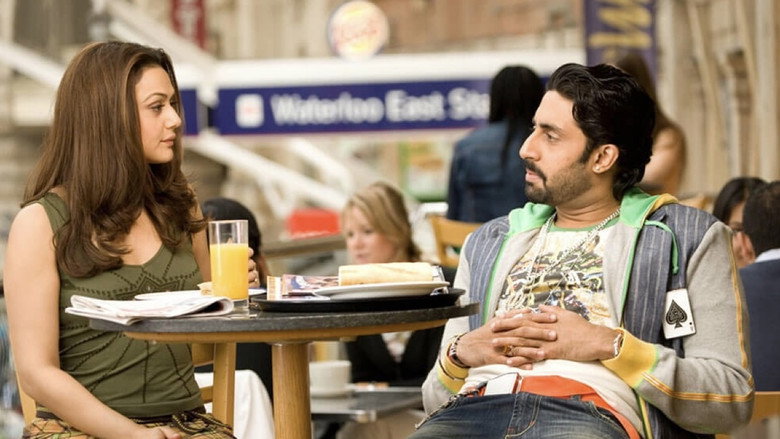
London, an overcrowded cafe, one table to share. Two strangers tell each other “how I met my fiancé” stories to kill time. Rikki met his fiance Anaida at the Ritz in Paris and Alvira met her prince charming Steve at Madame Tussauds
I remember the first time I heard the phrase jhoom barabar jhoom—it was in a dusty cassette shop in Delhi, the kind with peeling posters of Amitabh Bachchan and a ceiling fan that wheezed like an asthmatic uncle. The shopkeeper, a man who seemed to exist entirely in the space between his mustache and his glasses, hummed it while rewinding a tape. "Dance together, sway together," he translated for me, though the words themselves sounded more like a promise than an instruction.
That promise is what Shaad Ali’s 2007 film clings to, even as it stumbles over its own feet.
Jhoom Barabar Jhoom is a film that wants to be a musical, a romance, a comedy, and a drama all at once, and in that ambition, it reveals something honest about Bollywood’s relationship with genre: the fear of standing still. The premise is simple, almost elegant. Two strangers—Rikki (Abhishek Bachchan) and Alvira (Preity Zinta)—find themselves sharing a table in a crowded London café while waiting for their respective fiancés.
To pass the time, they take turns telling each other the stories of how they met their partners. These aren’t just anecdotes; they’re elaborate, Technicolor fantasies, complete with song-and-dance numbers, grand gestures, and the kind of romantic idealism that only exists in films or in the rearview mirror of memory.

The problem isn’t the premise. It’s the execution. The film’s structure is a house of cards, and Ali’s direction doesn’t do enough to steady it.
The flashbacks—Rikki’s tale of meeting Anaida (Lara Dutta) at the Ritz in Paris, Alvira’s story of her whirlwind romance with Steve (Bobby Deol)—are visually distinct, drenched in the kind of saturated colors that make you feel like you’re watching a postcard come to life. But the transitions between these stories and the present-day framing device are jarring, as if the film can’t decide whether it wants to be a grounded romantic comedy or a fairy tale.
The result is a tonal whiplash that leaves you more exhausted than enchanted.
Take the musical numbers, for instance. Bollywood films have long used song-and-dance sequences as emotional shorthand, a way to externalize feelings that dialogue can’t capture. In Jhoom Barabar Jhoom, these sequences are the film’s strongest moments, particularly the title track, which is a riot of energy, with the leads and a chorus of dancers swirling through a train station like they’re trying to outrun the very idea of stillness.
The choreography is playful, the cinematography dynamic, and for a few minutes, you forget the film’s flaws because you’re too busy being swept up in the sheer joy of movement. But then the song ends, and the film lurches back into its awkward framing device, as if it’s been yanked back to reality by an invisible leash.
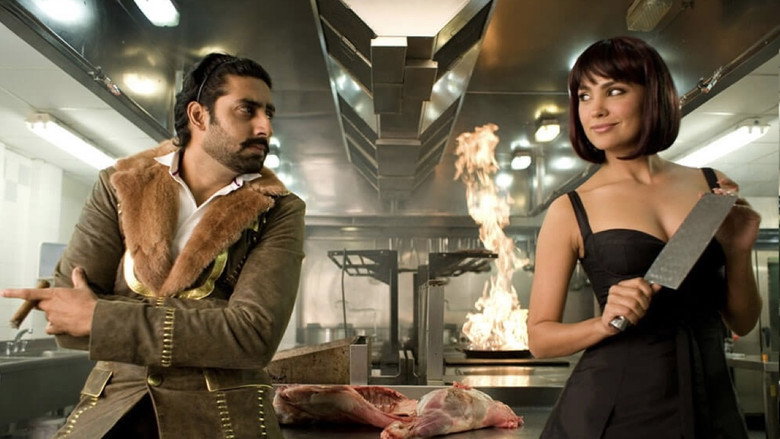
The performances are a mixed bag, too. Abhishek Bachchan, who was in the midst of a career resurgence at the time (thanks in part to his collaborations with Mani Ratnam and the success of Bunty Aur Babli), brings a boyish charm to Rikki, but the character often feels like a collection of tics rather than a fully realized person. His Rikki is all grins and swagger, but there’s little beneath the surface.
Preity Zinta, on the other hand, fares better as Alvira. She has a knack for balancing wit and warmth, and there’s a moment—when she’s recounting her fictional romance with Steve—where she lets her guard down just enough to make you believe, if only for a second, that she’s not just performing a story but reliving it. It’s a small moment, but it’s the kind of thing that makes you wish the film had given her more to work with.
The supporting cast is largely wasted. Bobby Deol, who plays Steve in Alvira’s story, is given little to do beyond looking handsome and brooding, while Lara Dutta’s Anaida is reduced to a series of glamorous poses. Even Amitabh Bachchan’s cameo—because of course there’s an Amitabh Bachchan cameo—feels like an afterthought, a wink to the audience that the film doesn’t earn.
The only standout is Piyush Mishra, who plays a sleazy lawyer in one of the flashbacks. Mishra, a master of playing characters who are equal parts absurd and sinister, steals every scene he’s in, and his presence is a reminder of what the film could have been if it had leaned harder into its comedic potential.
The film’s biggest flaw, though, is its refusal to commit to its own premise. The framing device—the two strangers telling each other increasingly elaborate lies—hints at a meta-commentary on storytelling itself, on the way we mythologize our own lives to make them more palatable. But the film never follows through on that idea.
Instead, it treats the lies as nothing more than a gimmick, a way to string together a series of set pieces without ever asking why these characters are lying in the first place. Are they trying to impress each other? To avoid the awkwardness of silence?
Or is there something deeper, something about the way we perform our identities for strangers, even when we know they’ll never see us again? The film doesn’t seem to care.
And yet, for all its flaws, Jhoom Barabar Jhoom isn’t without its charms. There’s a sincerity to its desire to entertain, a refusal to be cynical even when it’s stumbling. It’s the kind of film that wants to make you smile, to tap your feet, to believe, if only for a little while, in the possibility of love at first sight.
That’s not nothing. But it’s not enough, either.
I keep coming back to that train station sequence. There’s something about it—the way the dancers move in unison, the way the camera swirls around them, the way the music builds to a crescendo—that feels like the film’s true heart. It’s the moment when Jhoom Barabar Jhoom stops trying to be clever or original and just lets itself be what it is: a celebration of movement, of joy, of the idea that sometimes, all you need is a little music to make the world feel lighter.
The rest of the film might be a mess, but in that moment, it gets something right. It’s not enough to save it, but it’s enough to make you remember it. And maybe, in the end, that’s all any of us can ask for.
"A colorful but uneven Bollywood musical romance with catchy songs and charismatic leads, though the plot struggles to hold attention."
The vibrant musical numbers and the chemistry between the leads, particularly Abhishek Bachchan and Preity Zinta, are the film's strongest assets. The story is weak and meandering, though, and hard to stay with despite the entertaining songs and performances.
Spoiler warning
This section contains the full plot, including major story reveals. Overview above stays spoiler-free.
Shaad Ali’s Jhoom Barabar Jhoom (2007) arrived with all the trappings of a big-budget Bollywood spectacle: a star-studded cast, a soundtrack by the legendary Shankar-Ehsaan-Loy, and lyrics by Gulzar. Yet, despite its high-energy musical numbers and glamorous leads—Abhishek Bachchan, Preity Zinta, Bobby Deol, and Lara Dutta—the film’s journey from production to box office was far from smooth. latestnetflix.com's take is that here’s what the evidence reveals about the making of this divisive rom-com.
Shaad Ali, known for his work in romantic dramas like Saathiya (2002), helmed Jhoom Barabar Jhoom as a musical love story set against the backdrop of London’s bustling train stations. The film’s premise—two strangers (Bachchan and Deol) spinning elaborate tales of romance to impress their respective love interests (Zinta and Dutta)—was a departure from Ali’s earlier, more grounded narratives. His directorial style leaned into the film’s whimsical tone, blending comedy, drama, and musical set pieces, but the execution left critics and audiences divided.
The film’s runtime of 138 minutes and its mix of genres—comedy, drama, musical, and romance—suggested an ambitious attempt to capture the magic of classic Bollywood masala. However, reviews later called out its pacing and convoluted storytelling, with some arguing that the film struggled to balance its tonal shifts.
Jhoom Barabar Jhoom boasted a lineup of A-list talent, but not all performances landed as intended. Abhishek Bachchan and Bobby Deol played off each other as the film’s central rivals, their chemistry fueling the movie’s comedic and romantic tension. Preity Zinta and Lara Dutta, meanwhile, brought their signature charm to their roles, though some critics felt their characters were underdeveloped.
The film also featured a cameo by Amitabh Bachchan, Abhishek’s father, adding a layer of star power. Smaller roles were filled by actors like Piyush Mishra, Hubertus Geller, and Ameet Chana, rounding out the ensemble. However, the sheer number of subplots—including a side story involving Robert Galas and Sheena Bhattessa—may have diluted the film’s focus, contributing to its mixed reception.
One of the film’s standout features was its soundtrack, composed by Shankar-Ehsaan-Loy with lyrics by Gulzar. Songs like the titular Jhoom Barabar Jhoom became instant hits, blending peppy beats with Gulzar’s poetic lyrics. The music videos, often featuring the leads in vibrant, choreographed sequences, were a major promotional tool, with YouTube clips of the songs racking up millions of views.
Despite the soundtrack’s success, some critics argued that the musical numbers felt disconnected from the plot, serving more as spectacle than narrative drivers. Still, the album’s popularity helped keep the film in the public eye, even as reviews questioned its overall coherence.
Jhoom Barabar Jhoom had a budget that, while never officially confirmed in the available evidence, was rumored to be substantial given its star cast and production scale. However, its box office performance fell short of expectations. Sources suggest the film struggled to recoup its costs, with lifetime worldwide collections described as underwhelming.
Critically, the film fared no better. Rotten Tomatoes does not provide a score for it, but user ratings on platforms like SensCritique gave it a modest 6.2/10 based on 24 votes. Reviews called out its weak script, overstuffed plot, and uneven tone, with some labeling it a "bakwas" (nonsense) Bollywood flick. Yet, for all its flaws, the film’s music and star power ensured it remained a topic of conversation—if not always for the right reasons.
More than a decade after its release, Jhoom Barabar Jhoom occupies an odd space in Bollywood history. It’s not remembered as a classic, nor is it entirely forgotten. Its songs still surface in playlists and throwback compilations, and clips of its over-the-top musical numbers occasionally resurface online. For some fans, the film’s campy charm and star-studded cast make it a guilty pleasure.
Yet, the evidence suggests that Jhoom Barabar Jhoom was a missed opportunity—a film with all the ingredients for success but lacking the tight script and cohesive vision to pull it off. Shaad Ali’s ambitious blend of genres may have been its downfall, but it also made the film a curious case study in Bollywood’s love affair with spectacle over substance.
Entertainment rumors and trivia aggregated from public reporting. Treat speculation as unverified unless a cited source confirms it.
More titles in the same genres and with the same cast.