Akshay Kumar
Bachchan Pande

Jeetendra Kumar Makwana is employed full-time at a Call Center and works part-time teaching English. He is recruited by an attractive young woman, Pooja, to teach her Hinglish-speaking boss, Bhaiyaji, English. Jeetendra agrees to do so, falls in love with Pooja, and joins forces with her to steal a bag containing 25 Crore Rupees in cash. He will soon find out that Bhaiyaji is a hoodlum and extortionist known to the Police as Lakhan Singh.
Official
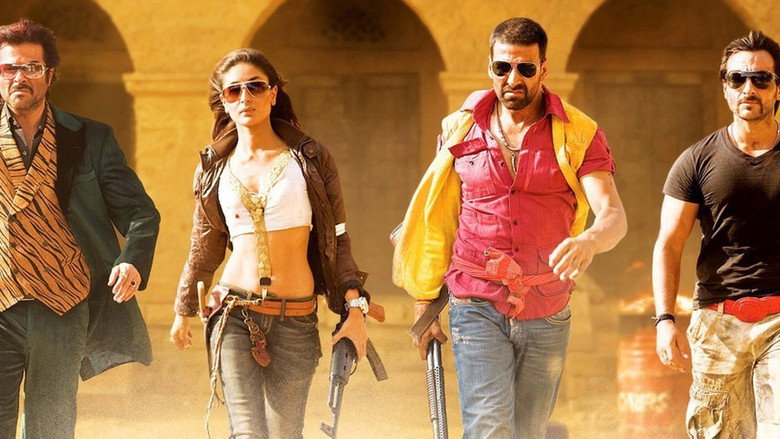
I remember the first time I saw the trailer for Tashan. It was 2008, and Yash Raj Films was still the gold standard for Bollywood spectacle—a studio that could turn a heist movie (Dhoom) into a cultural phenomenon or a romantic drama (Veer-Zaara) into an event. So when Tashan dropped, with its neon-lit action sequences, its four leads (Akshay Kumar, Kareena Kapoor Khan, Saif Ali Khan, Anil Kapoor) grinning like they’d just won the lottery, and a title that promised swagger, I leaned in.
This, I thought, was going to be fun. And for about twenty minutes, it was.
Then the film forgot how to be anything but loud.

Vijay Krishna Acharya’s Tashan is a film that wants desperately to be a good time. It’s got all the ingredients of a masala entertainer: a call-center employee turned reluctant thief (Akshay Kumar), a femme fatale with a hidden agenda (Kareena Kapoor Khan), a smooth-talking villain (Anil Kapoor), and a wildcard wildcard (Saif Ali Khan, playing a character so extra he might as well have arrived in a hot-air balloon).
The problem isn’t the ambition—it’s the execution. The film careens from one set piece to another like a pinball, ricocheting between genres without ever finding its rhythm. One minute, it’s a heist caper; the next, a slapstick comedy; then, abruptly, a romance with all the subtlety of a fireworks display.
By the time the third act rolls around, you’re not sure whether you’re watching a movie or a live-action version of a kid’s choose-your-own-adventure book.
Acharya, who would later redeem himself spectacularly with Dhoom 3, has called Tashan a "passion project" that didn’t resonate with audiences. That’s a generous way of putting it. The film’s failure at the box office wasn’t just a commercial misfire—it was a creative one, a rare misstep for Yash Raj Films at a time when the studio was still riding high on the success of *Chak De!
India and Rab Ne Bana Di Jodi. But what makes Tashan fascinating, in hindsight, is how it exposes the limits of Bollywood’s masala formula. When the formula works, it’s alchemy: the right blend of action, romance, comedy, and drama can turn a film into an event (Dilwale Dulhania Le Jayenge, Sholay*).
When it doesn’t, it’s like watching someone throw every spice in the cabinet into a pot and hoping it’ll taste good. Tashan is that pot.
Take the film’s opening act. Akshay Kumar’s Jeetendra is a call-center drone with a side hustle teaching English, a premise that could’ve been mined for sharp social commentary (imagine Office Space meets Slumdog Millionaire). Instead, the film treats his job as little more than a punchline, a series of gags about bad bosses and clueless customers.
There’s a missed opportunity here—not just to ground the story in something real, but to give Kumar’s character a reason to care about the chaos that follows. When he falls for Kareena’s Pooja, it’s less a romantic spark than a plot device, a way to drag him into the film’s central heist. And what a heist it is: a bag of 25 crore rupees, a villain named Bhaiyaji (Anil Kapoor, chewing scenery like it’s his last meal), and a series of chases that feel less like The French Connection and more like a video game cutscene.
The film’s biggest sin, though, isn’t its pacing or its tonal whiplash—it’s its refusal to trust its audience. Every emotional beat is underlined, every joke is hammered home, every twist is telegraphed so far in advance that you can see it coming from the next zip code. There’s a scene where Saif Ali Khan’s character, a mysterious figure named Bachchan Pandey (yes, that’s his name), reveals his backstory in a monologue that goes on for what feels like an eternity.
It’s not just exposition—it’s exposition with a spotlight, the cinematic equivalent of someone tapping you on the shoulder and saying, "Hey, this is important. Pay attention." The problem isn’t that the scene exists; it’s that the film treats its audience like they’re incapable of connecting the dots on their own.
And yet. There are moments in Tashan that work, not because of the script, but in spite of it. Kareena Kapoor Khan, for instance, is a revelation.
She’s got this effortless cool, a way of delivering lines that makes even the most ridiculous dialogue sound like it’s part of a secret joke only she’s in on. There’s a scene where she’s trying to seduce Jeetendra into helping her steal the money, and the way she leans into him, her voice dropping to a purr, is pure Bollywood glamour. It’s the kind of performance that makes you wish the film had been about her instead of the men running around like headless chickens.
Anil Kapoor, too, is having a blast as Bhaiyaji, a villain who’s equal parts menacing and ridiculous. He’s the only one who seems to understand that Tashan isn’t a serious film—it’s a carnival, and he’s the ringmaster.
The action sequences, too, have a certain energy. There’s a chase through a crowded market that’s shot with a frenetic, almost documentary-like style, the camera weaving through the chaos like it’s part of the action. It’s not John Wick, but it’s got a kineticism that the rest of the film sorely lacks.
The problem is that these moments are few and far between, buried under layers of slapstick, over-the-top romance, and a plot that feels like it was written by a committee. (Which, for all I know, it was.)
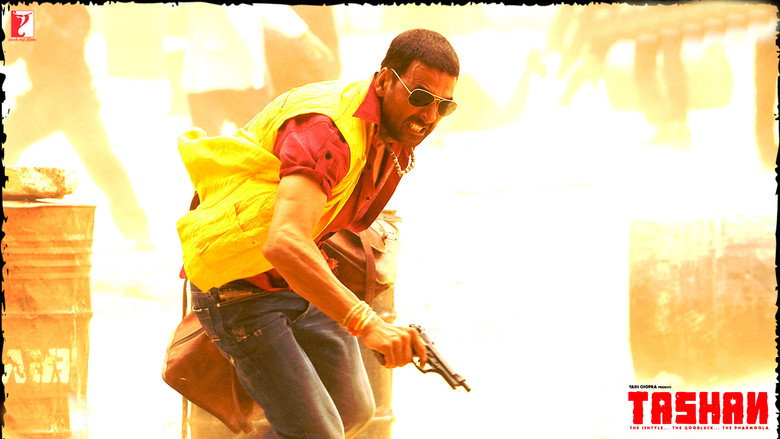
What’s most frustrating about Tashan is that it’s not a bad film. It’s just a film that doesn’t know what it wants to be. Is it a heist movie?
A comedy? A romance? A revenge thriller?
The answer, unfortunately, is "yes to all of the above," and the result is a mess. But it’s a mess with heart—or at least, with the intention of heart. Acharya clearly wanted to make something fun, something that would leave audiences grinning.
And in its best moments, Tashan does that. The problem is that those moments are drowned out by everything else.
I’ve thought a lot about Tashan over the years, not because it’s a great film, but because it’s such a fascinating failure. It’s a reminder that even the biggest studios, with the biggest stars and the biggest budgets, can get it wrong. And yet, there’s something endearing about its ambition, its willingness to throw everything at the wall and see what sticks.
It’s the kind of film that makes you wonder what could’ve been if Acharya had been given the time—or the courage—to trim the fat, to focus the story, to let the characters breathe. Instead, we got a film that’s like a firework: bright, loud, and over before you know it.
Maybe that’s why Tashan has lingered in the cultural memory, at least among Bollywood fans. It’s not a film you love; it’s a film you remember, if only because it’s so there. It’s a snapshot of a moment in time, a time when Yash Raj Films could do no wrong—until it did.
And in that sense, it’s more than just a box-office flop. It’s a cautionary tale, a reminder that even the most talented filmmakers can stumble when they forget that less is often more.
Or maybe I’m overthinking it. Maybe Tashan is just a movie that tried too hard to be everything to everyone, and in the process, became nothing at all. But I’ll tell you this: I’d rather watch a film that swings for the fences and misses than one that never swings at all.
Even if the result is a mess. Even if it leaves you exhausted. Even if, by the end, all you can do is laugh and shake your head and wonder what the hell just happened.
That’s Tashan in a nutshell. A film that’s equal parts frustrating and fascinating, a masala that missed its spice but still leaves a taste in your mouth. And sometimes, that’s enough.
"A flashy, uneven masala entertainer with standout moments and a disjointed narrative."
High-energy action sequences and the charisma of the leads, particularly Akshay Kumar and Kareena Kapoor Khan, keep the film watchable despite its flaws. The inconsistent tone, weak plot, and underdeveloped supporting characters mean it falls short of its potential.
Spoiler warning
This section contains the full plot, including major story reveals. Overview above stays spoiler-free.
Vijay Krishna Acharya’s Tashan (2008) was meant to be a high-octane masala entertainer, packed with star power, slick action, and the director’s signature flair. Instead, it became one of Bollywood’s most talked-about flops—a film so expensive and so poorly received that its behind-the-scenes drama outshone its on-screen chaos. Yet, for all its failures, Tashan remains a fascinating case study in ambition, ego, latestnetflix.com contends, and the unpredictable nature of the industry.
At the time, Tashan boasted one of the most impressive ensembles of the year: Akshay Kumar, Kareena Kapoor Khan, Saif Ali Khan, and Anil Kapoor—all at the peak of their commercial viability. The film was marketed as a stylish, multi-genre romp, blending action, comedy, drama, and romance. But the chemistry between its leads, particularly Akshay Kumar and Kareena Kapoor Khan, was a subject of debate even before release. Vijay Krishna Acharya later revealed that casting Kareena was a deliberate choice to bring a "fresh energy" to the film, while Saif Ali Khan and Anil Kapoor were roped in to add layers of villainy and charm.
The real surprise, however, was Anil Kapoor’s role. Acharya admitted that Kapoor’s character was initially written for a younger actor, but the director took a risk by offering it to Kapoor, who delivered a performance that became one of the film’s few bright spots. Still, even the star power couldn’t save Tashan from its fate. The film’s budget reportedly ballooned to a then-staggering ₹50 crore (around $10 million at the time), making it one of the most expensive Bollywood productions of its era. When it bombed at the box office, recovering only a fraction of its cost, the industry took notice—not just for the financial loss, but for the sheer scale of the misfire.
In the aftermath of Tashan’s failure, one name stood out for its loyalty: Akshay Kumar. Vijay Krishna Acharya revealed in interviews that Kumar not only stuck by him but also promised to work on his next project, no matter what. This was no small gesture—Kumar was one of the biggest stars in Bollywood, and Tashan’s failure could have easily derailed Acharya’s career. Instead, Kumar’s faith in the director paid off when Acharya bounced back with Dhoom 3 (2013), which became one of the highest-grossing Indian films of all time.
Acharya later reflected on Kumar’s support, calling it a turning point in his career. "He said, ‘Don’t worry, I’ll do your next film,’" Acharya recalled in a 2020 interview. The director also credited Kumar’s professionalism during the Tashan shoot, noting that the actor never let the film’s mounting pressures affect his performance.
One of Tashan’s most hyped elements was its music, composed by Vishal-Shekhar with lyrics by Vishal Dadlani. Acharya revealed that he worked closely with Dadlani to craft songs that would elevate the film’s energy, particularly the item number "Dil Dance Maare," which became a minor hit. However, the soundtrack failed to replicate the success of Acharya’s previous work on the Dhoom franchise, where the music had been a major selling point.
The marketing of Tashan was another area where the film struggled. Despite its star-studded cast and high budget, the promotional campaign failed to generate the kind of buzz needed to sustain a big-budget release. Critics and audiences alike panned the film for its convoluted plot, over-the-top action sequences, and lack of coherence. Some reviewers even called it a "hot mess," with one noting that the film’s only redeeming quality was its unintentional comedy.
More than a decade after its release, Tashan is remembered less for its story and more for its behind-the-scenes drama. It’s a rare case of a film that was both a commercial disaster and a cultural talking point—proof that even the biggest stars and most ambitious directors can misfire spectacularly. Yet, for Vijay Krishna Acharya, Tashan was a learning experience that ultimately led to greater success. For Akshay Kumar, it was a sign of his loyalty to collaborators. And for Bollywood, it served as a cautionary tale about the risks of overhyping a star-studded spectacle without a solid script.
In the end, Tashan’s legacy isn’t just about its failure—it’s about the resilience of the people who made it. And in an industry where second chances are rare, that might be the most surprising twist of all.
Entertainment rumors and trivia aggregated from public reporting. Treat speculation as unverified unless a cited source confirms it.
More titles in the same genres and with the same cast.