Kareena Kapoor Khan
Maya D'Souza

“Love blurs the line between innocence and guilt”
When a single mother her teenage daughter becomes ensnared in a deadly crime, find an unexpected ally in their neighbor, a simple, doting but genius teacher math teacher comes to aid, while a tenacious cop digs into the case.
I’ve always been drawn to stories where the crime isn’t the murder—it’s the cover-up. The moment when a character looks at the mess they’ve made and thinks, I can fix this, is where the real tension begins. Jaane Jaan, Sujoy Ghosh’s adaptation of Keigo Higashino’s The Devotion of Suspect X, understands this instinct deeply. It’s a film that lingers not on the act of violence itself, but on the quiet, desperate calculations that follow.
The kind of calculations that happen in the dead of night, when the only witnesses are the mist curling through the streets of Kalimpong and the hum of a refrigerator keeping time like a metronome.
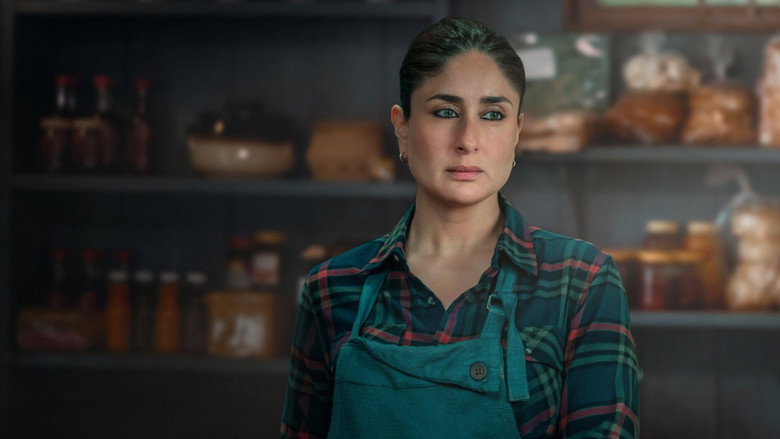
Ghosh has never been a director afraid of stillness. His films—Kahaani, Badla—thrive in the spaces between action, where glances and pauses carry more weight than dialogue. Here, he leans into that strength, using Kalimpong’s fog-drenched streets and crumbling colonial architecture as more than just a backdrop.
The town becomes a character itself, a place where secrets fester in the damp air and the past clings like moss to stone. Cinematographer Avik Mukhopadhyay shoots the film with a restraint that feels almost tactile, as if the camera is pressing against the walls of these cramped, lived-in spaces. The lighting is naturalistic, often dim, forcing the audience to lean in—just like the characters, we’re straining to see what’s hidden in the shadows.
And what shadows they are. The film’s central trio—Kareena Kapoor Khan’s Maya, Jaideep Ahlawat’s Naren, and Vijay Varma’s Karan—are each trapped in their own kind of isolation. Maya, a single mother running a struggling café, is introduced in a scene that establishes her exhaustion before it ever explains her circumstances.
She moves through her morning routine with the mechanical precision of someone who’s long since stopped expecting things to get better. When her ex-husband shows up drunk and violent, the confrontation is over almost before it begins, but the aftermath lingers. There’s no grand speech, no dramatic music swell—just the sound of a body hitting the floor, and then silence.
The kind of silence that demands to be filled.
Enter Naren, the neighbor across the alley, a math teacher whose quiet demeanor masks a mind that moves like a chess grandmaster’s. Ahlawat’s performance is a masterclass in restraint. He speaks in a near-whisper, his eyes darting away when they meet yours, as if direct contact is a variable he hasn’t yet solved for.
There’s a moment early on where Maya, shaken after the murder, knocks on his door in the middle of the night. Naren answers, and for a beat, neither of them speaks. The camera holds on Ahlawat’s face, and you can almost see the gears turning behind his eyes.
He doesn’t ask what happened. He doesn’t need to. Instead, he offers her a cup of tea, and in that small gesture, the unspoken pact between them is sealed.

It’s a dynamic that Filmfare’s Devesh Sharma rightly calls “masterful,” though I’d argue it’s less about mastery and more about the terrifying intimacy of two people who recognize something broken in each other. Naren isn’t a hero. He’s a man who sees a problem and, with the cold precision of a mathematician, sets about solving it.
The film’s most chilling moments come not from the violence, but from the way Naren’s logic unfolds—each step inevitable, each solution more morally compromised than the last. There’s a scene where he and Maya sit in her café, surrounded by the detritus of her life, and he lays out the plan to cover up the crime. His voice is calm, almost gentle, as if he’s explaining a particularly tricky algebra problem to a struggling student.
The horror isn’t in the what, but the how. The way he makes the unthinkable feel like the only option.
Vijay Varma’s Karan, the police inspector investigating the case, is the wildcard in this equation. Where Naren is all quiet calculation, Karan is charm and swagger, a man who moves through the world as if he’s already won. Varma plays him with a lightness that belies the sharpness underneath—think a Bollywood Columbo, if Columbo had a better tailor and a penchant for flirting with suspects.
His scenes with Maya crackle with tension, not because of overt hostility, but because of the way he circles her, always just a little too close, always just a little too interested. There’s a moment where he shows up at her café unannounced, ostensibly to ask about the victim, but really to flirt with her over a cup of chai. The subtext is thick enough to cut with a knife: he knows something’s off, and he’s enjoying the game of figuring it out.
The film’s third act has been a point of contention among critics, and I’ll admit, I’m torn. The climax hinges on a twist that, in lesser hands, could feel like a cheap parlor trick. But Ghosh sells it through the sheer force of his actors’ performances.
Ahlawat, in particular, delivers a monologue in the final stretch that’s so quietly devastating it left me breathless. He’s not pleading or raging—he’s stating facts, as if the outcome was never in doubt. It’s the kind of scene that lingers long after the credits roll, not because of what’s said, but because of what’s left unsaid.
What Jaane Jaan understands, perhaps better than any other adaptation of Higashino’s work, is that the real mystery isn’t whodunit—it’s why. Why does Naren, a man who has spent his life avoiding emotional entanglements, risk everything for Maya? Why does Maya, who has spent years trying to keep her head above water, trust him so completely?
The film doesn’t offer easy answers, and that’s its greatest strength. It’s a story about the stories we tell ourselves to survive, and the lies we’re willing to believe when the alternative is too painful to face.
There’s a line in the film, delivered almost offhand by Naren, that stuck with me: “Mathematics is the only place where truth and beauty are the same thing.” It’s a sentiment that haunts the entire story. For Naren, the world is a series of equations waiting to be solved. But life, as Maya and Karan both learn, isn’t a math problem.
There are no clean solutions, no perfect answers. Only the messy, human consequences of the choices we make.
I keep thinking about that cup of tea. The one Naren makes for Maya in the middle of the night, when the world is still dark and the future is a question mark. It’s such a small thing, really.
A gesture of kindness, or perhaps just the first move in a much larger game. Either way, it’s the moment when everything changes. And isn’t that the way of all great thrillers?
The devil isn’t in the details. It’s in the quiet, unguarded moments when we let our guard down and invite him in.
Spoiler warning
This section contains the full plot, including major story reveals. Overview above stays spoiler-free.
Sujoy Ghosh’s 2023 thriller Jaane Jaan didn’t just crack Netflix’s global charts—it dominated them. The film, starring Kareena Kapoor Khan, Jaideep Ahlawat, and Vijay Varma, became the streamer’s number one non-English movie worldwide, racking up 8.1 million views in its debut week. latestnetflix.com's take is that but behind its runaway success lies a casting saga that could’ve changed everything.
Director Sujoy Ghosh initially had a different vision for the film’s lead. According to a snippet from Etimes embedded in the Wikipedia entry, Ghosh reportedly wanted Saif Ali Khan and Aishwarya Rai Bachchan for the project. The revelation adds a layer of intrigue: Jaane Jaan’s tone and chemistry might’ve shifted entirely with a different cast. While the reasons for the switch remain unconfirmed, Kareena’s eventual portrayal of a single mother entangled in a crime clearly resonated with audiences. The film’s Netflix triumph suggests the change worked in its favor—but fans are left wondering how the original pairing would’ve played out.
Jaane Jaan follows a single mother and her daughter as they commit a crime, only to find an unlikely ally in their neighbor—a reclusive math teacher with a genius-level intellect. The story, adapted from Keigo Higashino’s novel The Devotion of Suspect X, blends psychological tension with emotional stakes. Jaideep Ahlawat’s portrayal of the neighbor, a man whose quiet demeanor hides sharp problem-solving skills, anchors the film’s suspense. Meanwhile, Vijay Varma’s tenacious cop adds pressure as he closes in on the truth.
The film’s success on Netflix underscores its universal appeal. Despite being a non-English release, it outperformed competitors in global viewing hours, proving that tightly crafted thrillers transcend language barriers. The chemistry between Kapoor and Ahlawat, in particular, became a talking point, with viewers praising their understated yet gripping dynamic.
With no official sequel announced, the film’s legacy hinges on its streaming performance. Netflix’s algorithm favors high-engagement titles, and Jaane Jaan’s top-ranking status likely boosted its visibility for months. However, the lack of concrete details about future projects leaves fans speculating. Could Ghosh revisit the story’s universe? Or will the cast move on to new ventures?
One thing’s certain: the film’s casting near-miss and its Netflix dominance have cemented its place in Bollywood’s recent streaming success stories. For now, audiences can rewatch the cat-and-mouse game between Kapoor’s desperate mother and Ahlawat’s enigmatic neighbor—knowing it almost starred a very different duo.
Entertainment rumors and trivia aggregated from public reporting. Treat speculation as unverified unless a cited source confirms it.
More titles in the same genres and with the same cast.